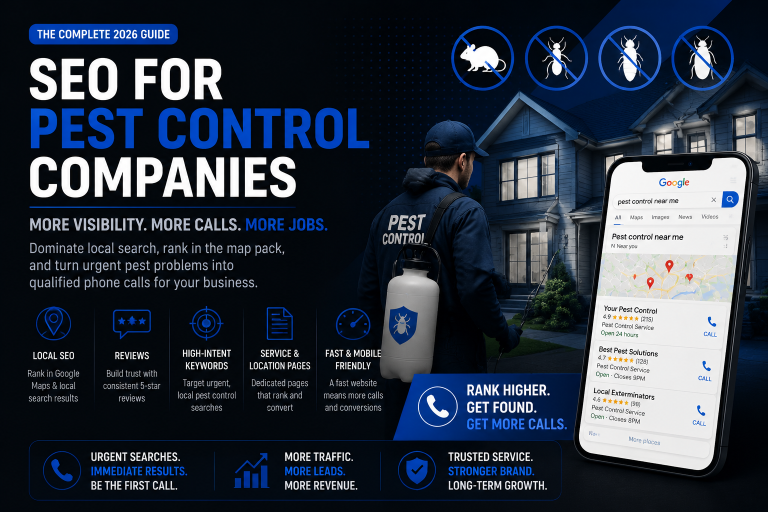
SEO (Search Engine Optimization) for pest control companies helps your business show up when local homeowners and businesses search for emergency exterminators or routine bug management. A strong strategy targets local map packs and organic results to turn urgent searches into phone calls.
The way people find pest control services has changed forever. Today, a homeowner spots a cockroach, grabs their phone, and types "pest control near me". If your business isn't dominating that screen - both the Google Maps 3-pack and the organic blue links - you're handing revenue to your competitors. At Inteliware Growth, we've built frameworks for high-intent service industries like pest control, blending local SEO, conversion-focused content, and technical precision to ensure that when panic strikes, your phone rings. This guide walks you through the exact SEO playbook that puts exterminators on the map and keeps them there.
Local SEO and Google Maps
Local visibility is the lifeblood of pest control SEO. Most of your customers are within a 20-mile radius and need help fast. You don't need to rank nationally; you need to dominate the hyper-local pack that appears above the organic results. That dominance starts with a meticulously optimised Google Business Profile, a steady stream of positive reviews, and flawless Name, Address, Phone Number (NAP) consistency across the web.
Verify your Google Business Profile
Your Google Business Profile (GBP) is your digital storefront. Claim it, verify it, and fill out every single field Google offers. List your accurate business hours, including emergency service windows. Add the specific services you provide - termite fumigation, rodent exclusion, mosquito fogging - directly within the services section. Upload real photos of your trucks, your uniformed technicians, and before/after job shots. A fully populated profile signals to Google that you're an active, legitimate business worthy of appearing in the local map pack.
Collect consistent positive reviews
Reviews are a direct ranking factor for local pack placement and a massive trust signal. A pest control company with 4.9 stars and 150 reviews will almost always outrank a 4.0 competitor with 15 reviews. Make leaving a review frictionless: send a follow-up text or email within 24 hours of service completion containing a direct Google review link. Train technicians to ask for reviews right at the door after a successful treatment. Respond professionally to every review - thanking happy customers and calmly addressing any concerns.
Ensure NAP consistency & service areas
Your GBP allows you to define specific service areas by city, postal code, or neighbourhood. Don't just list your physical address; add every community you actually serve. This helps you appear in searches that include those location names. Then, ensure your NAP - business Name, Address, and Phone Number - is identical everywhere it appears online. Even "St." vs "Street" can dilute your local ranking power. Tools like Moz Local can help audit these citations, but manual diligence works if you're systematic.
Keyword strategy & content
With local foundations solid, you need to prove to Google that your website is the most relevant answer for pest-related queries in your territory. This requires a surgical keyword strategy focused on high-intent, localized terms, supported by dedicated service pages and hyperlocal landing pages.
Target high-intent local keywords
Broad terms like "pest control" are too generic. Target the language people use when they're ready to hire: "bed bug treatment in [City Name]", "rat exterminator near me", "emergency wasp nest removal [Neighborhood]". These long-tail keywords carry clear intent. Use tools like Ahrefs, SEMrush, or Google Keyword Planner filtered to your city to build a list of high-volume, high-intent terms. Then map each keyword to a specific page on your site. A family in Oakville searching "ant infestation kitchen" sees your dedicated ant control page optimised with location modifiers and immediate solutions.
Create dedicated service pages
A single "services" page listing everything is a recipe for invisibility. Google wants the most specific page. Create separate, robust pages for rodents, mosquitoes, ants, bed bugs, termites, cockroaches, and wildlife removal. Each page should explain signs of infestation, your treatment methodology, prevention tips, and a clear call to action for a free inspection. These service pages become pillar content that ranks for dozens of long-tail variations while demonstrating deep expertise. We have built this same dedicated service architecture for cleaning companies, turning their websites into lead generation engines that capture every relevant search.
Build unique location pages
A pest control company covering a metro area of 30 towns needs 30 location-specific landing pages - no duplicates. Each page must feature unique, genuine content about that town: mention local parks where ticks are a problem, older housing stock prone to mice, seasonal mosquito patterns near lakes, and even include a local testimonial. Avoid lazy templated pages with only the city name swapped out. Google's algorithm penalizes thin, duplicate local content. Embed a Google Map, list your service availability, and write as if you're speaking directly to a resident of that specific community.
Technical website health
Even the best keyword strategy fails if your website is slow, confusing, or broken. For pest control companies where a user's emotional state is often one of distress, technical performance directly impacts conversions. A site that loads in one second captures the call; a site that takes five seconds loses the customer.
Optimize mobile loading speeds
Nearly all emergency pest searches happen on a phone. A homeowner who just found a snake in the garage will not wait for your image-heavy homepage to load. Run your site through Google's PageSpeed Insights and fix what's flagged: compress images to WebP format, reduce server response time, eliminate render-blocking JavaScript, and use lazy loading for off-screen images. Speed is not just a ranking factor - it's a conversion factor. We often see mobile conversion rates double when page load time drops from 4 seconds to under 2 seconds.
Add prominent click-to-call buttons
A user landing on your mobile site with a wasp hovering nearby needs to call you in one tap - not search for your number. Place a prominent, click-to-call button in a sticky header that follows as they scroll. Use a contrasting colour. Every service and location page should repeat the phone number in a tappable format. Some pest control companies even add a bottom-of-screen floating "Call for Emergency Service" bar. Track these clicks via Google Tag Manager events to measure ROI accurately. This simple fix turns mobile traffic into revenue without friction.
Fix broken links & clean navigation
Regularly audit your site with a tool like Screaming Frog or Ahrefs to find and fix broken internal links, 404 errors, and redirect chains. A clean site structure - Home > Services > Ant Control > Ant Control in [City] - helps search engines understand your hierarchy and helps users find information quickly. Ensure no page is more than three clicks from the homepage. A robust internal linking strategy, where location pages link to relevant service pages and vice versa, distributes link equity and improves indexing.
Build local authority with link building
Links from relevant local sites tell Google your business is a trusted part of the community. Sponsor a youth sports team and get a link from their website. Join the Chamber of Commerce directory. Offer a guest article for a neighbourhood news site about preventing ant infestations. Partner with real estate agents for pre-purchase inspections and ask for a link back. Create a valuable resource like a "Town-Specific Pest Calendar" that local blogs will naturally link to. Avoid spammy paid link schemes; one quality local link is worth a hundred irrelevant ones. This same local authority approach has been a cornerstone for our immigration lawyer clients, where a single well-placed directory link can transform client acquisition.
Measure & optimise SEO performance
What gets measured gets managed. Install call tracking numbers on your website to attribute calls back to organic search and specific landing pages. Set up Google Analytics 4 goals for form submissions and click-to-call taps. Track local keyword rankings with a tool like Local Falcon to see exactly where you appear in the map pack across your service area. Monthly reporting should show not just traffic, but cost per lead compared to paid channels. This data lets you double down on high-converting pages and prune underperforming content. Our real-time dashboards have enabled doctors and clinics to see exactly which keyword drove each patient appointment, making SEO a transparent, accountable growth channel.
Why Inteliware Growth's approach wins
Most agencies treat pest control SEO as a generic local campaign. We don't. We audit your market - analysing competitor backlinks, audience search behaviour, and conversion funnels - to build a custom roadmap. Our strategy phase sets precise KPIs and channel forecasting. Execution includes conversion-optimised landing pages that tie seamlessly with organic efforts. Advanced attribution tracking ensures you know exactly which keyword produced the call. Then, we scale based only on winning data. The same rigorous framework has scaled taxi companies from a handful of weekly calls to a full booking calendar. For pest control, that discipline means the difference between a trickle of leads and a flood.
Frequently Asked Questions
How long does it take to see results from pest control SEO?
Map pack movement usually shows in 3–6 months; highly competitive terms may take up to 12 months. Consistent reviews and technical health speed it up.
Can I do SEO for my pest control company myself?
Claiming your GBP and collecting reviews are DIY-friendly. Keyword research, content creation, and technical audits need specialized tools; a hybrid approach often works best.
How important are reviews for local ranking?
Critically important. They're a confirmed ranking factor and heavily influence click-through rates. A higher volume of positive reviews consistently attracts more calls.
Do I need a different page for every town?
Yes, if you want to rank in multiple towns. Each page must offer unique, genuine content. Duplicate location pages can trigger a Google penalty.
What's the difference between SEO and Google Ads for pest control?
SEO builds lasting, free visibility that grows over time. Google Ads deliver instant, paid placement at the top. The strongest strategy combines both: ads for immediate leads, SEO for a sustainable pipeline.
Does social media affect pest control SEO?
Social signals aren't a direct ranking factor, but an active presence can drive branded searches and traffic that indirectly boost SEO. It's also a review generation channel.
Take control of your digital territory
Your next emergency call depends on a homeowner finding you before they find your competitor. SEO for pest control companies isn't a set-it-and-forget-it project - it's a strategic discipline that combines local map mastery, precision content, and relentless technical optimisation. Every day your site isn't fully dialled in, you're leaking potential revenue. At Inteliware Growth, we build transparent, data-driven SEO and paid campaigns that turn panic searches into booked trucks and measurable growth.
If you're ready to dominate your local map pack and stop relying on hope as a strategy, let's talk. Our team will audit your current online presence and deliver a custom roadmap aligned with your revenue goals.
Contact Us
📞 +92 344 3503901
📧 sales@inteliwaregrowth.com
📍 London, United Kingdom