SEO for pharmaceutical companies is a specialized digital strategy that improves online visibility for medical treatments, drugs, and health conditions. It requires strict adherence to healthcare regulations, a clear split between patient and healthcare professional (HCP) audiences, and high standards for medical accuracy and trust (E-E-A-T).
Pharma brands, showing up on Google isn’t just about traffic—it’s about putting credible, life-changing information in front of the right eyes at the right moment. Whether you’re launching a new therapy, educating patients, or supporting HCPs, your search presence must be built on a foundation of compliance, authority, and deep audience understanding. At Inteliware Growth, we’ve taken the data-driven performance frameworks we’ve proven for high-intent service industries—from taxi companies and immigration law firms to doctors & clinics and adapted them to the unique regulatory and content demands of the pharmaceutical sector. This guide unpacks exactly how to do SEO for pharma, the right way.
Why pharmaceutical SEO is different (and why that matters)
A generic SEO playbook will fail in pharma. You’re not selling shoes. You’re communicating science that directly impacts human health. That changes everything.
Search engines treat medical content as a “Your Money or Your Life” (YMYL) topic. This means Google applies its strictest quality standards, demanding expertise, authoritativeness, and trustworthiness (E-E-A-T). On top of that, you must navigate FDA, EMA, or MHRA regulations on drug promotion, fair balance, and adverse event reporting. The result? Your SEO strategy must be built to satisfy both the search algorithm and the health authority that governs your market.
A compliant yet high-performing pharma website needs to:
- Separate unbranded disease-awareness content from branded product information
- Clearly label content intended for patients versus healthcare professionals
- Cite only peer-reviewed, authoritative medical sources
- Avoid making unsubstantiated claims or promising outcomes
Master this, and you unlock a sustainable competitive advantage. Many pharma companies still rely heavily on paid media and sales reps. A robust organic search presence builds long-term, cost-efficient brand authority that keeps working 24/7.
Core strategies for pharma SEO
Here are the five foundational pillars that transform a pharmaceutical website from invisible to essential.
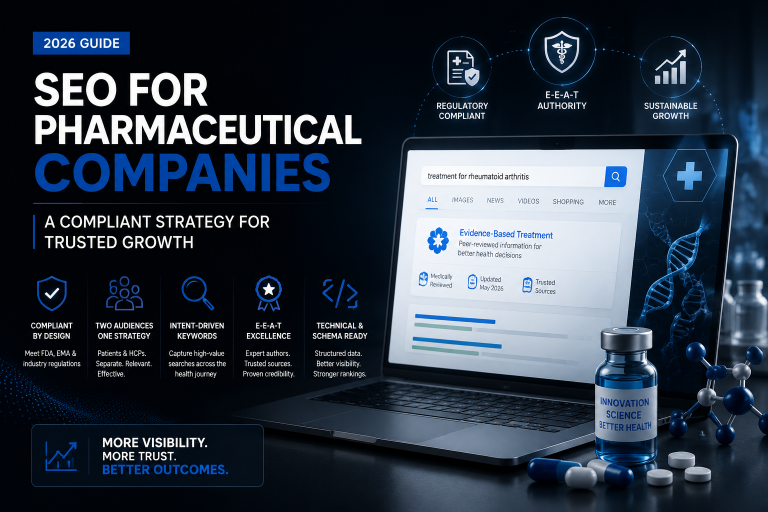
1. Audience segmentation to build two experiences
A patient searching for “how to manage asthma triggers” has a completely different intent than a pulmonologist looking up “IL-5 inhibitor mechanism of action.” Jamming both onto a single, generic page confuses users and erodes trust.
Cleanly separate your site architecture:
- Patient-facing content: Use simple, symptom-based language (e.g., What causes heartburn?). Focus on lifestyle tips, disease education, and when to see a doctor. Navigation should feel welcoming and uncluttered.
- HCP-facing content: Deliver clinical terminology, dosing guidelines, mechanism-of-action animations, and pivotal trial summaries. This section often sits behind a registration gate, but even the publicly indexable pages (like medical affairs summaries) must signal deep scientific authority.
Our work with healthcare providers has repeatedly shown that a segmented, intent-matched user journey increases both time-on-page and conversion rates. The same principle applies to pharma—if not more critically.
2. Intent-driven keywords: target education, not just promotion
Pharma SEO lives and dies by keyword strategy. The trap many brands fall into is chasing only branded terms (e.g., “Drug X”). While important, branded searches are often limited to existing awareness.
Expand your reach with non-promotional, long-tail keywords:
- Disease state queries: “early signs of rheumatoid arthritis”
- Treatment comparison: “metformin vs sulfonylurea safety profile”
- Mechanism of action: “how do GLP-1 agonists work”
- Condition management: “diet plan for chronic kidney disease patients”
These terms capture people earlier in their health journey. By providing genuinely helpful, scientifically accurate information, you build trust before a prescription is ever written. Our team uses advanced data analytics to uncover high-volume, low-competition pharma keyword clusters that drive qualified traffic.
3. E-E-A-T compliance: make your content unquestionably credible
Google’s Quality Rater Guidelines put medical content under a microscope. You need visible, verifiable signals of expertise.
Actionable steps to build pharma-grade E-E-A-T:
- Author bios: Every medical article must display the author’s credentials (MD, PhD, PharmD) with a link to their professional profile or published research.
- Medical review: Add a clearly stated review date and the reviewer’s name and qualifications. This is non-negotiable.
- Citations: Link to primary sources—PubMed-indexed studies, NICE guidelines, FDA labels—not just internal pages.
- Transparency: Include a prominent editorial policy explaining how content is created, reviewed, and updated.
When we audit pharma sites, the first thing we check is whether the “about us” and author pages would convince a skeptical clinician. If not, rankings will eventually reflect that. We build the same trust architecture we use when generating compliant leads for law firms, where credibility is the entire conversion engine. For a deeper understanding of the standards applied to medical content, refer to the search guidelines which explicitly address YMYL topics.
4. Technical & schema optimization: speak Google’s language
Medical content can be complex, but structured data makes it instantly digestible for search engines.
Implement critical medical schema mark-up:
- Drug schema: Detail active ingredients, dosage forms, and indications
- MedicalCondition schema: Structure disease pages with symptoms, risk factors, and treatments
- Physician and MedicalOrganization schemas where relevant
- FAQ schema for question-and-answer style patient content (it captures prime real estate in search results)
Beyond schema, technical performance remains a ranking factor. Ensure your site loads in under 2.5 seconds on mobile, passes Core Web Vitals, and is secured with HTTPS. We’ve seen secure, schema-rich pharma pages earn featured snippets and “People Also Ask” placements that drive 30%+ more organic clicks.
5. Regulatory alignment: never sacrifice compliance for rankings
One poorly phrased claim on an indexable page can trigger a warning letter or worse. Your entire SEO strategy must run inside a regulatory safety wrapper.
Key compliance guardrails:
- Unbranded vs. branded separation: Disease awareness content should never mention your product unless proper fair balance and safety information (ISI) is present and approved by your legal/medical review team.
- No off-label promotion: Even keyword-targeted blog content must stick rigidly to approved indications.
- Social media rules: If you embed social feeds, they must be monitored for adverse event reports.
- Regional requirements: An SEO page visible globally might need geo-blocking or disclaimers if a product isn’t approved in certain territories.
Align with your medical-legal-regulatory (MLR) team from day one. At Inteliware Growth, we treat regulatory boundaries as a creative brief rather than a barrier. The result is content that’s both compliant and compelling. For specific prescription drug promotion rules, always review the latest FDA guidance.
Building a pharma content engine that ranks
With the core strategies in place, you need a sustainable content plan.
Create a topic cluster model around medical conditions. For example, a pillar page on “Type 2 Diabetes Management” links out to sub-pages covering diet, exercise, medications, monitoring blood sugar, and mental health. This interlinking signals to Google that you have deep authority on the subject.
Refresh content regularly. Medical guidelines change. Set a schedule to review every high-traffic page every 6-12 months and update it with the latest clinical data. A page that was accurate in 2022 might be dangerously outdated by 2026.
Leverage multimedia. Search engines increasingly prioritize video, diagrams, and interactive tools. A short mechanism-of-action video with a proper transcript can rank in both web and video search results, doubling your real estate.
Why pharma brands partner with Inteliware Growth
Inteliware Growth isn’t a generalist agency. We’re a performance marketing firm that has built its reputation on scaling high-intent service industries through data-backed, ROI-focused strategies. Our work with Doctors & Clinics gave us direct experience in the healthcare compliance landscape, and our frameworks have been proven in tightly regulated markets.
When you partner with us for pharmaceutical SEO, you get:
- A 5-step roadmap: Audit, Strategy, Execution, Tracking, and Scale—applied to your unique regulatory needs.
- Real-time dashboards showing exactly which medical content drives HCP registrations or patient support program sign-ups.
- Creative ad and content teams who understand the difference between a PubMed citation and a marketing claim.
We’ve helped app startups slash acquisition costs while scaling users; we bring that same analytical rigor to your pharma digital ecosystem. All our medical content strategies are built on a foundation of authoritative sources like PubMed research to ensure absolute scientific accuracy.
Measuring pharma SEO success
Traffic is vanity; meaningful engagement is sanity. For pharma, define your conversion events carefully:
- Patient audience: Downloads of condition-specific guides, tool usage (symptom checkers), newsletter sign-ups, or “find a specialist” clicks.
- HCP audience: Time spent on clinical data pages, PDF downloads of prescribing information, or requests for medical science liaison (MSL) contact.
Use event tracking in GA4 and feed this data into a dashboard that ties organic search performance back to your brand’s medical communication goals. Our transparent reporting model ensures you can see the precise ROI of every page and keyword.
Conclusion
SEO for pharmaceutical companies is a high-stakes discipline that, when executed correctly, builds unshakeable trust with both patients and healthcare professionals. By segmenting your audience, targeting intent-based keywords, fortifying your E-E-A-T signals, leveraging medical schema, and never compromising on regulatory standards, your brand can own the search results that matter most.
At Inteliware Growth, we blend deep healthcare marketing knowledge with the relentless data optimization that has made us the growth partner for service businesses across the UK and beyond. Ready to build a compliant, high-performing search presence that delivers measurable results? Let’s talk.
Frequently Asked Questions
1. Can pharmaceutical companies do SEO without violating FDA regulations?
Yes. Focus on unbranded disease education, clearly label HCP content, and have all content reviewed by a medical-legal team.
2. How long does it take for a new pharma website to rank?
Typically 6-12 months. A strong E-E-A-T foundation and quality backlinks from medical associations can speed this up.
3. What is the most important ranking factor for pharmaceutical content?
Trust. Content authored and reviewed by qualified medical professionals, backed by peer-reviewed citations, is critical.
4. Should we gate our HCP content or make it publicly accessible?
Use a hybrid approach. Indexable summaries build authority, while gating full clinical materials captures qualified HCP leads.
5. How do we handle international SEO when products have different indications per country?
Implement hreflang tags and localised URLs, and always serve country-appropriate prescribing information and legal disclaimers.
Get a compliant, high-impact pharma SEO strategy
Contact Us
📞 +92 344 3503901
📧 sales@inteliwaregrowth.com
📍 London, United Kingdom