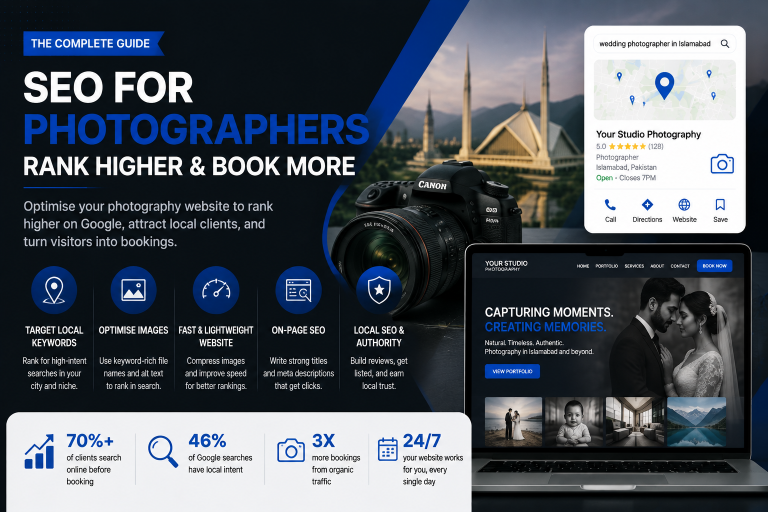
SEO for photographers is the process of optimising your portfolio website so it ranks higher on Google, helping local clients find your services. Focus on target keywords (like Islamabad wedding photographer), image alt text, fast page speeds, and a verified Google Business Profile to drive consistent bookings.
If you want wedding bookings, family sessions, or commercial gigs to find you instead of your competitors, the work starts on your website. Search engines don’t see beautiful pictures the way humans do – they read text, file names, and structured data. The good news? A handful of technical tweaks and a local-first mindset can put your work in front of people who are ready to hire right now. Below, we’ll walk through every step that matters, with honest advice from a performance agency that lives inside Google’s algorithms every day.
Key on-page steps
On-page SEO is everything you control directly on your website. For photographers, it’s not just about words – it’s about making your images work for you, structuring pages so Google understands your location, and giving visitors a lightning-fast experience.
Target local keywords
General terms like “photographer” are impossibly broad. Pair your specific niche with your city or service area to attract high-intent clients. Think “newborn photographer in Manchester” or “corporate headshot photographer London”. These long-tail, local phrases have less competition and much higher conversion rates.
Actionable move: Brainstorm five core services you want to book (weddings, portraits, real estate, food, etc.) and combine each with the neighbourhoods or cities you serve. Use these naturally in your homepage headline, service page titles, and the first 100 words of each page. Don’t stuff them – one primary keyword per page, supported by closely related phrases.
At Inteliware Growth, we’ve seen localised landing pages increase inquiry rates by over 40% for service businesses. The principle is the same for your photography studio – search engines reward specificity because it matches user intent exactly. (If you want to turn that traffic into actual bookings, our [performance marketing services](https://inteliwaregrowth.com/services/) help you design pages that convert visitors into leads.)
Optimise image file names and alt text
Your photos are your product, but Google can’t “see” them. It reads the file name and alt attribute. If you upload DSC_4521.jpg, you’ve told Google nothing. Rename every file before uploading using descriptive, keyword-aware language: islamabad-family-portrait-session.jpg or london-corporate-headshot-john.jpg.
Alt text (alternative text) describes the image for screen readers and search crawlers. Write it like a short, factual caption: “Outdoor family portrait session at Fatima Jinnah Park, Islamabad, with golden hour light.” Include your primary or secondary keyword naturally, but never stuff. Every image on a page should have unique, meaningful alt text – it’s one of the few SEO signals that directly ties your visual work to search queries. For deeper guidance, Google’s image best practices spell out exactly how to help your visuals rank.
Pro tip: For gallery pages, write alt text that answers “what’s happening in the photo” and “where”. This helps you appear in Google Image search, which can drive serious portfolio traffic and, importantly, booking inquiries from people who fall in love with a specific shot.
Compress image sizes
A slow website kills both user experience and rankings. Photography sites are notorious for 10MB hero images that take seconds to load on mobile. Google’s Core Web Vitals measure loading performance as a direct ranking factor. Keep individual image files under 500KB without sacrificing quality.
Use tools like TinyPNG, ShortPixel, or Squoosh to compress images before upload. If you use WordPress, enable lazy loading so images load only when a visitor scrolls to them. Consider next-gen formats like WebP – they often reduce file size by 25-35% compared to JPEG with no visible quality loss.
Page speed directly correlates with bounce rate. If your site takes longer than three seconds to load, over half of mobile visitors will leave. A compressed, fast-loading gallery keeps potential clients on your site long enough to browse your portfolio and click your contact page. At Inteliware Growth, we track this relentlessly because even our Google Ads campaigns fail if landing pages are sluggish. The same logic applies to your organic traffic. Run your site through Google PageSpeed Insights right now – it shows exactly what’s slowing you down and how to fix it.
Write page titles and meta descriptions
Every page on your site needs a unique, concise title tag (the blue clickable link in search results) and a compelling meta description (the short paragraph below it). This is your shop window in Google.
- Title tag formula: Primary Keyword + Secondary Keyword/Benefit + Brand Name. For example: Islamabad Wedding Photographer | Candid & Timeless Portfolios | YourStudio. Keep it under 60 characters.
- Meta description formula: Describe what you do, who you serve, and what makes you different, including the primary keyword and location. “Searching for a natural light wedding photographer in Islamabad? We capture authentic moments with a documentary style. View our portfolio and check availability.” Aim for 150-155 characters.
While meta descriptions aren’t a direct ranking factor, they massively influence click-through rate – a strong signal to Google that your page deserves its position. Write for the human who’s comparing three options in the search results.
Local SEO and authority
Most photographers serve a geographic area. Local SEO puts you on the map – literally – when someone searches “photographer near me” or “event photographer in [city]”. It’s often the highest-return effort because the intent is immediate and transactional.
Claim a Google Business Profile
A verified Google Business Profile (GBP) is non-negotiable for ranking in the local map pack and local finder. This free listing appears when people search for services in your area. Fill it out completely: accurate business name, precise category (choose “Photographer”, not something vague), service areas, working hours, phone number, and website link.
Then, treat your GBP like a mini-portfolio. Post new images weekly – actual session photos, behind-the-scenes shots, client-approved highlights. Google favours active, frequently updated profiles. Use the “Posts” feature to share offers, blog links, or “now booking” updates. If you cover multiple cities, set service areas rather than adding multiple locations you don’t physically occupy.
A fully optimised GBP can drive more calls and direction requests than any other channel. At Inteliware Growth, we’ve helped cleaning companies and medical clinics dominate local pack positions – the same local ranking principles apply to photographers. Consistency between your GBP details and your website’s name, address, and phone number (NAP) is essential.
Collect client reviews
Reviews are modern-day word-of-mouth and a top local ranking factor. After a successful session, send clients a direct link to leave a Google review. Make it effortless – a short email with a warm thank-you note and the review link can double your response rate.
Respond to every review, positive or negative. Thank happy clients by name and mention something specific from their session. For any critical feedback, reply professionally, offer to resolve the issue offline, and show future clients you care. A business with 30+ genuine, detailed reviews will consistently outrank a competitor with a handful of thin “great service” entries.
Encourage clients to mention the service type and location in the review text. When someone writes “Amir was the best wedding photographer in Birmingham – he captured every candid moment beautifully,” you’ve just reinforced the exact keywords Google uses to rank you.
Publish helpful blog posts
A static portfolio site rarely attracts consistent organic traffic. Blogging adds fresh, indexable content and helps you target long-tail searches that signal purchase intent. Think about the questions clients ask before booking: “what to wear for an outdoor family photoshoot,” “best locations for engagement photos in London,” or “how to prepare for a newborn session.”
Each blog post targets a specific query, establishes your local expertise, and can link back to your core service pages. Real session stories with client permission (and a link to the gallery) blend portfolio display with SEO power. Venue guides, seasonal availability posts, and styling tips all serve this dual purpose.
Create a content calendar around the rhythms of your business – engagement season, graduation months, autumn family sessions. Each post should answer one question completely and be at least 800 words. When a bride searches “Islington town hall wedding photographer tips,” your venue guide with sample photos can be exactly what she finds – and books. For more on how to structure blog content that actually ranks, browse the Inteliware Growth blog – it’s packed with frameworks we use for service businesses.
Ready to turn clicks into clients? Work with Inteliware Growth
Contact Us
📞 +92 344 3503901
📧 sales@inteliwaregrowth.com
📍 London, United Kingdom
Frequently Asked Questions (FAQs)
1. How long does it take for photographer SEO to show results?
Typically 3–6 months for meaningful rankings and traffic growth. Quick wins from on-page fixes and GBP optimisation can start working in weeks.
2. Can I do SEO myself, or do I need an agency?
Basic on-page tasks (file names, alt text, meta tags) are very DIY-friendly. Technical speed improvements and ongoing content strategy often benefit from experienced support.
3. Personal name or studio name for local SEO?
Use the exact business name clients recognise, and keep it identical across your website, Google Business Profile, and all directories to avoid confusion.
4. Do backlinks still matter for photographers?
Yes – quality links from wedding directories, venue vendor lists, and local business collaborations strengthen your authority. Focus on relevance, not quantity.
5. How do I track whether my SEO is working?
Use Google Search Console for keyword rankings and clicks, then connect organic traffic to contact form submissions and phone calls in Google Analytics.