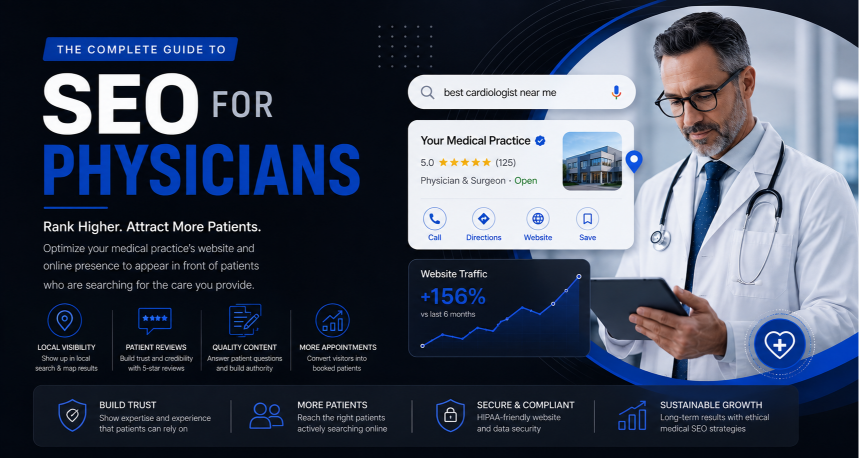
SEO for physicians (medical SEO) is the process of optimizing a medical practice's website and online profiles to rank higher in search engine results. This strategy helps local patients find your clinic, book appointments, and access health information by focusing on local search listings, mobile speed, and authoritative medical content.
Why SEO for physicians is no longer optional
Walk into any clinic waiting room and you'll see patients scrolling their phones. Before they ever step through your door, they've already searched family doctor near me, best dermatologist in [City], or urgent care open now. If your practice doesn't appear in those results, you don't exist to them.
Medical SEO bridges that gap. It puts your practice directly in front of patients who are actively looking for the exact services you provide. Google processes over 1 billion health-related searches every day. Those searches aren't casual browsing. They carry strong intent. Someone searching knee replacement surgeon Birmingham isn't window-shopping. They're ready to book.
Yet many physicians still rely on word-of-mouth alone. While referrals remain valuable, ignoring search means leaving 77% of potential patients to choose competitors who show up first. This guide gives you the actionable steps to claim that visibility, build trust, and grow your practice sustainably.
Core strategies for medical SEO
A successful medical SEO strategy rests on two pillars: local visibility and a website that turns visitors into patients. Below, we break down exactly how to strengthen both.
Local search and profiles
Your local presence determines whether you appear in the map pack, the three highlighted listings that dominate mobile results.
- Google Business Profile: Claim and verify your profile with your exact practice name, correct medical category, and active hours. A complete GBP signals to Google that your practice is legitimate and ready to serve.
- NAP Consistency: Keep your Name, Address, and Phone number identical across your website and directories. Even minor differences like Street versus St. can confuse search engines and dilute your rankings.
- Directory Citations: Build accurate listings on medical platforms like Healthgrades, Zocdoc, or local equivalents. These citations reinforce your location data and often serve as discovery channels in themselves.
- Patient Reviews: Gather and reply to genuine patient reviews to build local trust. Practices with at least 40 reviews generate significantly more clicks than those with fewer than 10. A thoughtful response to every review also shows Google that you actively engage with patients.
Website and content optimization
Your website is your digital front desk. It must load fast, answer questions, and guide visitors toward booking.
- Service Pages: Create distinct pages for every medical condition treated and procedure offered. A single Services page doesn't help a patient searching for mole removal. Dedicated pages target specific queries and improve your relevance score.
- Local Keywords: Target geo-specific terms like cardiologist in [City] or pediatrician near me. Weave these naturally into headings, page titles, and the first 100 words of your content.
- Mobile Friendliness: Ensure fast load times and responsive design for users searching on phones. Over 60% of health searches happen on mobile devices. A slow-loading site frustrates users and triggers Google penalties.
- Medical Schema: Add structured data markup to help search engines understand your location, specialty, and FAQs. Schema enables rich results – star ratings, office hours, accepted insurance – that make your listing stand out.
Beyond basics: advanced SEO tactics for medical practices
Once your foundational local and on-page SEO is in place, these advanced tactics can push you ahead of competing practices.
Authoritative content that builds E-E-A-T
Google holds medical content to the highest standards under its E-E-A-T framework (Experience, Expertise, Authoritativeness, Trustworthiness). This means every health-related article you publish can directly impact your site's overall ranking power.
Create content that demonstrates real clinical experience. Instead of a generic overview of diabetes, write about the specific treatment protocols your practice follows, backed by references to medical guidelines. Cite studies from PubMed, NHS, or the Mayo Clinic. Include author bios that highlight your board certifications and years of practice. This isn't fluff – it's a ranking signal.
Consider adding these content types to your site:
- Condition deep-dives with symptoms, causes, and when to see a doctor.
- Procedure explainers detailing what patients can expect before, during, and after treatment.
- FAQ sections that directly answer the questions you hear most in consultations.
- Video testimonials and virtual office tours to humanize your practice.
Every piece of content should conclude with a clear next step, such as booking an appointment. This simple nudge turns readers into patients.
Technical SEO: the invisible advantage
A beautiful website means nothing if search engines can't crawl it efficiently. Technical SEO is the backbone of a high-performing medical site.
- Core Web Vitals: Google measures loading speed, interactivity, and visual stability. A site that shifts layout while loading frustrates users and slips in rankings. Use tools like PageSpeed Insights to diagnose and fix issues.
- HTTPS Security: Medical sites handle sensitive information. An SSL certificate is mandatory, not optional. Sites without HTTPS are flagged as not secure, driving patients away.
- XML Sitemap and Robots.txt: Ensure your sitemap lists all important pages and your robots.txt doesn't block key sections. Submit the sitemap to Google Search Console for faster indexing.
- Internal Linking Structure: Link service pages to relevant blog posts and vice versa. A pillar page on Cardiology Services linking to posts about echocardiograms, stress tests, and heart disease prevention tells Google your site covers the topic comprehensively.
The role of paid ads in a physician SEO strategy
SEO builds long-term organic visibility, but it takes time. Paid search advertising puts you at the very top of results immediately. Together, they form a powerful patient acquisition engine.
Google Ads for physicians allows you to bid on high-intent keywords and pay only when someone clicks. You can target by location, device, and even time of day, ensuring your ads appear when patients are searching. Our team at Inteliware Growth specializes in managing Google Ads for doctors and clinics, reducing wasted spend and increasing appointment bookings. View [our services](https://inteliwaregrowth.com/[services](https://inteliwaregrowth.com/services/)) for Doctors & Clinics.
Combine SEO and paid search data to uncover the highest-converting keywords, then create content around those terms to dominate both paid and organic real estate. This data-driven synergy consistently lowers cost per acquisition.
Measuring success: metrics that matter
You can't improve what you don't measure. For physician SEO, the vanity metrics – raw traffic – matter far less than conversion actions.
Key performance indicators to track:
- Organic traffic to service pages: Is your core treatment pages growing?
- Google Business Profile insights: Track calls, direction requests, and website clicks from your listing.
- Keyword rankings for local terms: Monitor movement for [specialty] near me queries.
- Conversion rate: What percentage of visitors complete a contact form or click-to-call?
- Patient acquisition cost: Divide total marketing spend by new patients gained.
We build real-time dashboards for our clients so they see exactly how their budget translates into patient appointments. Every pound is accounted for. Our data-driven culture is at the core of how we operate – learn more about our approach.
Common SEO mistakes physicians should avoid
Even well-intentioned practices make errors that tank their rankings. Steer clear of these pitfalls:
- Ignoring GBP updates: Google regularly adds features like appointment links, Q&A, and health insurance fields. An incomplete profile loses clicks.
- Duplicate content: Copying manufacturer descriptions for devices or medications hurts your site. Write original, patient-focused descriptions.
- Keyword stuffing: Phrases like best dentist best teeth cleaning dentist near me read terribly and trigger penalties.
- Neglecting negative reviews: Not responding signals indifference. A professional, empathetic reply can turn a detractor into a loyal patient.
- Siloed marketing efforts: SEO, paid ads, and social media should reinforce each other. A unified strategy consistently outperforms disconnected tactics.
Our proven 5-step framework – Audit, Strategy, Execution, Tracking, Scale – ensures none of these mistakes go unnoticed. We audit your competitors, build a custom roadmap, launch high-converting campaigns, track every conversion, and scale what works. That's the Inteliware approach that's helped niche service businesses across the UK. Explore our Case studies to see real results.
Actionable checklist: start your medical SEO today
- Claim and fully optimize your Google Business Profile.
- Audit all directory listings for NAP consistency.
- Generate a list of 20 local keywords your ideal patients use.
- Create or refine dedicated service pages for your top procedures.
- Implement medical schema markup on your location and FAQ pages.
- Ask three satisfied patients to leave a Google review this week.
- Run a technical audit with Google Search Console and fix crawl errors.
- Start a blog answering common patient questions with E-E-A-T signals.
- Set up conversion tracking in Google Analytics to measure bookings.
- Consider layering paid search for immediate visibility while SEO matures.
If this list feels overwhelming, you're not alone. Most physicians are busy running a practice, not running SEO campaigns. That's where we come in.
Frequently Asked Questions
How long does SEO take to show results for a medical practice?
Typically 3 to 6 months for noticeable ranking improvements, but the timeline varies based on competition, current site authority, and consistency of effort. Paid ads can generate leads in the meantime.
Can I do SEO myself, or do I need an agency?
You can certainly implement the basics like optimizing your GBP and collecting reviews yourself. However, technical SEO, content creation, and strategic scaling usually require specialized expertise to maximize ROI.
Is SEO better than Google Ads for doctors?
They serve different purposes. SEO builds a sustainable, long-term patient pipeline, while Google Ads deliver immediate visibility. The best strategy uses both, feeding insights from one into the other.
How important are patient reviews for rankings?
Very. Review quantity, quality, and recency all influence local pack rankings. They also act as social proof, dramatically increasing click-through rates.
What's the first step I should take right now?
Claim and verify your Google Business Profile if you haven't already. Then request a free marketing audit from Inteliware Growth to see exactly where your practice stands and what opportunities exist.
Partner with Inteliware Growth for patient acquisition that scales
At Inteliware Growth, we don't do generic marketing. We build performance-driven frameworks specifically for doctors and clinics who want a steady stream of new patients. Our data-driven approach ensures every pound you invest works harder, whether through SEO, Google Ads, or conversion rate optimization.
Our process starts with a deep-dive audit into your market, your competitors, and your current digital footprint. We then craft a custom strategy with clear KPIs, execute with precision, track every click and call, and scale the campaigns that deliver real patients. No guesswork. No wasted budget.
Contact Us
📞 +92 344 3503901
📧 sales@inteliwaregrowth.com
📍 London, United Kingdom
Book Your Free Consultation