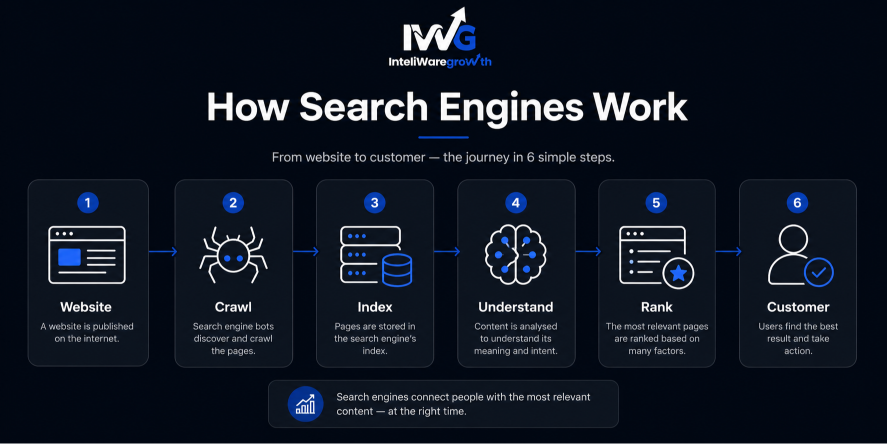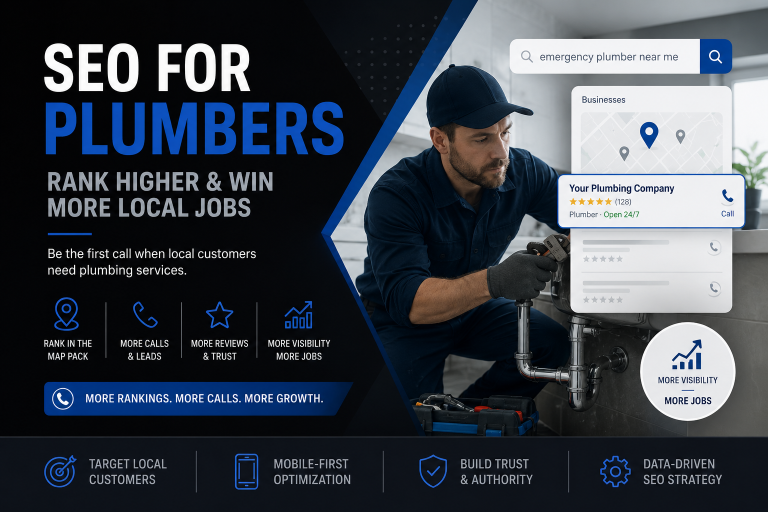
When a pipe bursts at 2 a.m. or a water heater fails on a freezing morning, homeowners don’t flip through a directory. They grab their smartphone and search for an emergency plumber near them. That’s where SEO for plumbers comes in: the process of optimizing your website and online footprint to rank high on search engines when local customers need urgent plumbing repairs, installations, or emergency services. A strong strategy targets the Google Map Pack, mobile searches, and high-intent local keywords to consistently drive phone calls.
At Inteliware Growth, we build data-driven growth frameworks for service businesses across the UK. Plumbing is a trust-based, urgent-need industry. Every second your phone isn’t ringing is a job lost to a competitor. This guide gives you the exact local SEO playbook to make sure your company gets called first.
Why SEO is the lifeline of a plumbing business
Plumbing searches carry massive commercial intent. Someone who types emergency plumber London or drain cleaning near me is minutes, sometimes seconds, away from making a call. If your business doesn’t appear in those top three Google Map Pack results or the first organic positions, you effectively don’t exist to that customer.
Paid ads can work, but organic SEO creates a long-term, compounding asset. A well-optimized site keeps delivering leads month after month without a per-click price tag. When you add the fact that 76% of people who perform a local search visit a business within 24 hours, it’s clear that local SEO isn’t optional for plumbers. It’s revenue infrastructure.
Google Business Profile & local map pack dominance
Your Google Business Profile, or GBP, is the single most powerful local ranking tool a plumber has. It powers your appearance in the Map Pack, the three highlighted listings shown above organic results, and feeds information directly into Google Maps.
Claim and verify your profile
Start by claiming and verifying your Google Business Profile. This step alone signals to Google that you are a legitimate, active business. Complete every single field with precise details, such as your business name, the primary category set as Plumber, service areas, working hours, and a local phone number. Incomplete profiles look untrustworthy and rank lower.
Maintain NAP consistency
NAP stands for Name, Address, and Phone number. This exact information must be identical on your GBP, website, social media pages, and every online directory you appear on. Even a minor discrepancy, such as St. instead of Street, can confuse search engines and weaken your local rankings. Use a spreadsheet or a tool to audit and enforce consistency across the web.
Gather reviews continually
Positive reviews are local SEO fuel. They influence both your position in the Map Pack and a homeowner’s decision to click your listing. After every completed job, prompt the client with a simple text or email link that takes them directly to your Google review form. A steady stream of fresh, detailed reviews builds trust, boosts click-through rates, and tells Google your business is active and loved. Always respond to reviews, thank happy customers, and address any negative feedback professionally.
Add local photos regularly
Profiles with photos receive 42% more requests for directions and 35% more clicks to websites. Upload real project pictures showing before and after drain repairs, water heater installations, or your emergency call-out vans. Do this at least once a week. Geotagged images from your actual service locations add another layer of local relevance.
Leverage Google posts and Q&A
Use the Posts feature inside your GBP to share seasonal offers, maintenance tips, or success stories. The Q&A section often goes ignored by competitors, so populate it yourself with common questions and answer them clearly. This enriches your profile and feeds Google valuable content.
Website structure & on-page SEO built for local plumbers
Your website is the hub that all local signals point to. It must be organized, fast, and crystal-clear about where you work and what you do.
Create dedicated service pages
Don’t bury all your services on one long page. Build separate, detailed pages for each core offering, such as drain cleaning, water heater repair, burst pipe emergency fixes, boiler servicing, and bathroom installations. A dedicated page targets long-tail keywords like water heater repair in Manchester and matches specific search intent. Each page needs original content, a clear headline, a service description, a local trust signal, and a strong call-to-action button.
Build location pages if you serve a wide area
If your plumbing company covers multiple towns, boroughs, or neighbourhoods, you need individual location pages. These pages should not be duplicate copies. Customize the content with local landmarks, area-specific customer testimonials, and unique service nuances. The goal is to show Google and real users that you genuinely operate in that spot.
Optimize title tags, meta descriptions, and headings
Every service and location page must have a unique title tag that includes both the service and the location. The meta description should read like an ad, containing your primary keyword, a secondary phrase, and a compelling reason to click. The H1 tag on each page should naturally reflect that same keyword focus. Use H2s and H3s to structure the page logically, weaving in semantic variations like blocked toilet repair, gas safe engineer, or boiler installation.
Implement schema markup
Schema markup is code that helps search engines understand the context of your content. For a plumbing website, implement Local Business or Plumber schema. Include your business name, address, phone, opening hours, service area, and aggregate review data. Schema can enable rich results like star ratings right in the search snippet, which significantly improves your click-through rate. If you use WordPress, plugins can handle this, otherwise let a developer add JSON-LD to your site.
Technical & mobile performance that stops bounces
A plumbing customer dealing with a flooded basement won’t wait ten seconds for a website to load. Technical SEO failures directly kill your leads.
Ensure mobile-friendliness
Over 60% of plumbing emergency searches happen on a phone. Your site must use a responsive design that adjusts flawlessly to any screen size. Buttons need to be large enough for a thumb tap, phone numbers must be click-to-call, and forms must be short and easily filled on a small screen. Test your site using Google’s Mobile-Friendly Test tool and fix every issue it flags.
Improve page speed
Page speed is a confirmed ranking factor, but for plumbers, it’s a conversion factor. If your homepage or a key service page takes longer than 2.5 seconds to load, you are likely losing more than half your potential callers. Compress images, minimize code, enable browser caching, and use a content delivery network. Tools like Google PageSpeed Insights provide a checklist to shave off critical milliseconds.
Secure the site with HTTPS
An SSL certificate encrypts data and shows the padlock icon in the address bar. Google labels non-HTTPS sites as not secure, which can scare away customers ready to type in personal details. Most modern hosting providers offer free SSL certificates, so there is no excuse not to have one.
Keyword research and content that captures local intent
The right content brings in customers at different stages, from emergency fixes to planned upgrades.
Identify high-intent keywords
Start with emergency and near me modifiers, such as emergency plumber near me or 24 hour plumber combined with your city. Then move to problem-aware terms like water heater not heating, low water pressure fix, or smell from drain. Use keyword research tools to find what your local audience actually types and group these into service pages and blog topics.
Create a plumbing resource hub
Blog posts answer questions homeowners ask before they pick up the phone. Write articles like Why Is My Water Brown? or How to Shut Off Your Main Water Valve. These posts build topical authority and can rank for informational queries. Within each post, naturally link to your relevant service page with a simple prompt to call your team for professional help. This structure captures traffic that competitors who only have commercial pages miss.
Embed local flavour
Mention your city, neighbourhood, and local landmarks in blog posts and service pages. When you write about hard water problems in London or boiler servicing in Glasgow tenements, you signal regional relevance. Real photos of your team working on a recognizable street corner build instant trust and geolocation signals for search engines.
Link building and citation strategies that move the needle
Backlinks from relevant, reputable websites remain a core ranking factor. For a local plumber, it’s about quality and local context, not volume.
Get listed in relevant directories
Beyond the obvious choices like Yell, Checkatrade, or TrustATrader, find hyper-local business associations, chamber of commerce directories, and industry-specific platforms. Each citation must be accurate and consistent with your NAP. These act like digital thumbs-up to Google.
Earn local links through partnerships
Sponsor a local football team, supply materials for a community garden project, or collaborate with a local hardware store for a home maintenance workshop. These activities earn local links that are hard for a national competitor to replicate. A link from a local news site or council page carries serious weight.
Leverage supplier and manufacturer relationships
If you install a specific brand of boilers or water softeners, ask to be listed on their find an installer page. Those sites typically have strong domain authority and the links are contextually relevant.
How Inteliware Growth helps plumbers win
At Inteliware Growth, we don’t offer fluff. We build custom growth roadmaps for service businesses that rely on phones ringing. Our 5-step framework audits your entire local presence, fixes the technical leaks, builds high-converting landing pages, and layers in advanced tracking so you know exactly which campaign drove that emergency call. You can explore real results on our Case studies page.
While this guide focuses on organic SEO, we understand that plumbing businesses often need an immediate flow of leads while SEO gains traction. Our Google Ads Management complements your organic efforts by capturing the same high-intent searches with paid visibility. Our conversion rate optimisation ensures that every visitor, whether from ads or organic, has the highest chance of becoming a customer.
We apply the same rigorous methodology across multiple industries. If you run a taxi company or an immigration law firms, we have tailored frameworks for your niche too. The principles are the same: data-driven decisions, transparent reporting, and profit-focused scaling.
If you want a team that integrates SEO, paid search, and CRO into one transparent, data-driven machine, we’re ready to talk.
Contact Us
📞 +92 344 3503901
📧 sales@inteliwaregrowth.com
📍 London, United Kingdom
Frequently Asked Questions
How long does SEO take to show results for a plumbing business?
You can expect local ranking movement within 3 to 6 months, with significant Map Pack dominance taking 6 to 12 months. Quick wins like fixing NAP issues and adding localized pages can speed up early results.
Can I do SEO myself as a plumbing company owner?
You can manage the basics such as claiming your GBP and collecting reviews. Technical SEO, citation building, and ongoing content creation require significant expertise, so many busy plumbers partner with an agency for the heavy lifting.
Is local SEO different from normal SEO?
Yes. Local SEO targets queries with geographic intent like plumber near me by leaning on your Google Business Profile, reviews, citations, and location-specific pages, while general SEO focuses on broader topics without a local focus.
How important are online reviews for plumber SEO?
Extremely important. Review volume, recency, and overall rating heavily influence local pack rankings and conversion rates. A 5-star business with many reviews consistently outranks and out-converts a competitor with fewer or lower-rated reviews.
Do I need a separate mobile website?
No. A fully responsive website that adapts to all screen sizes is the best approach. A separate mobile site often causes duplicate content issues and is harder to maintain.
Should I use plumber or plumbing contractor in my keywords?
Use the language your customers actually type. Plumber and emergency plumber are far more common in consumer searches than plumbing contractor. Always match your keyword choices to real local search data.