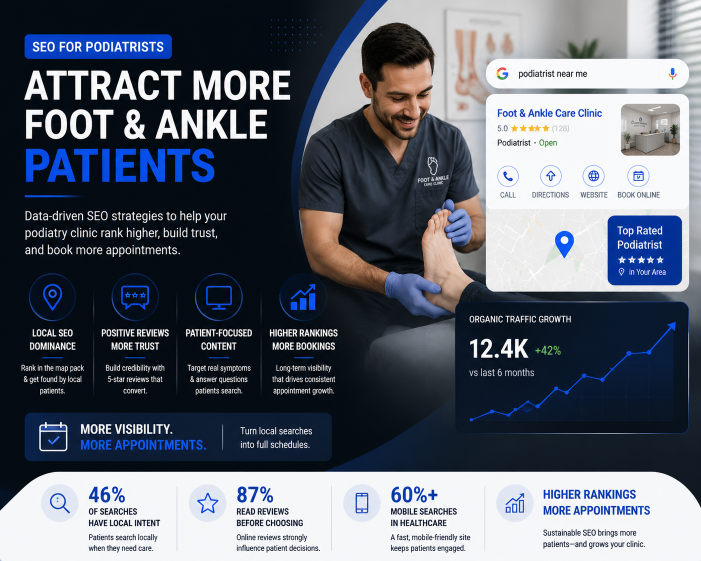
Search engine optimization (SEO) for podiatrists helps foot and ankle clinics attract local patients by ranking higher on Google. Essential tactics include claiming a Google Business Profile, building dedicated pages for specific symptoms like heel pain or bunions, and collecting positive patient reviews. Yet in a competitive healthcare market, a basic checklist isn't enough. You need a patient-first, data-driven strategy that makes your clinic the obvious choice when someone types “podiatrist near me” at 7 a.m. with a throbbing heel.
At Inteliware Growth, we've built growth frameworks for doctors and clinics that turn local search intent into real appointment bookings. This guide walks you through every SEO pillar a podiatry practice must master, from local SEO and content strategy to technical foundations, off-page authority, and measurement. All of it comes through a performance marketing lens so you see not just rankings, but ROI.
Local SEO & maps for podiatry clinics
Patients don't just search for podiatry information; they search for a podiatrist they can visit today. That makes local SEO the single highest-impact channel for your practice.
Claim and optimise your Google Business Profile
Your Google Business Profile (GBP) puts you on the map, literally. Without it, you won't appear in the local 3-pack or Google Maps when neighbours hunt for immediate care.
- Verify your listing and add accurate clinic hours, including holiday schedules. (Google's official guidelines walk you through verification steps.)
- Select the primary category “Podiatrist” and secondary categories like “Foot Care Clinic” or “Sports Medicine Clinic.”
- Upload high-resolution photos of your reception, treatment rooms, and team to humanise your practice.
- Use the Q&A section to pre-answer “Do you treat diabetic foot ulcers?” or “Is parking available?”
Gather patient reviews consistently
Reviews are the digital word-of-mouth that fuels map pack rankings. A BrightLocal study found that 87% of consumers read online reviews for local businesses, and healthcare is no exception.
- Send a post-appointment SMS or email with a direct link to leave a Google review.
- Respond to every review, positive or negative, in a HIPAA-compliant, professional manner.
- Showcase five-star reviews on your website using schema markup to build immediate trust.
Maintain NAP consistency everywhere
Your Name, Address, and Phone number (NAP) must be identical on every directory, social profile, and local citation. Inconsistent details confuse search engines and dilute your local authority.
- Audit existing listings on Healthgrades, Yelp, Zocdoc, and local chambers.
- Use a tool like BrightLocal or Moz Local to push updates in bulk.
- Keep the exact same format, don't write “Suite 200” on one site and “#200” on another.
Content & keyword strategy for podiatry practices
Most podiatry websites still read like medical textbooks. Your SEO content must mirror how real patients describe their pain. Otherwise, you're invisible.
Target symptoms, not just procedures
A patient with a stabbing heel doesn't search for “plantar calcaneal enthesophyte management.” They type “why does my heel hurt when I wake up” or “heel spur relief near me.”
- Map each condition you treat to a cluster of patient-friendly keywords: “plantar fasciitis treatment,” “ingrown toenail removal,” “bunion pain relief,” “diabetic foot care podiatrist.”
- Build a dedicated landing page for each core term that explains symptoms, non-surgical treatments, surgical options, and recovery.
- Include local modifiers naturally: “plantar fasciitis podiatrist in [City]” within H2 tags and the first 100 words.
Create standalone service pages
A single “Services” page buries your expertise. Search engines reward depth.
- Diabetic foot care: Cover neuropathy screening, wound prevention, and custom orthotics.
- Sports injuries: Detail stress fractures, ankle sprains, and return-to-play protocols.
- Custom orthotics: Show 3D scanning technology and how orthotics are fabricated.
- Paediatric podiatry: Address flat feet, intoeing, and growing pains.
Each page must have a clear call-to-action, like “Book a Biomechanical Assessment.”
Educate through blog content
A well-researched blog builds trust before a patient ever walks through your door. It also gives you extra real estate to rank for long-tail questions.
- Write answers to “Can flat feet cause knee pain?” or “How do I prepare for bunion surgery?”
- Use short paragraphs, bulleted lists, and summary boxes so skimmers absorb key points.
- Link internally to your service pages to guide readers toward booking.
Technical & on-page best practices
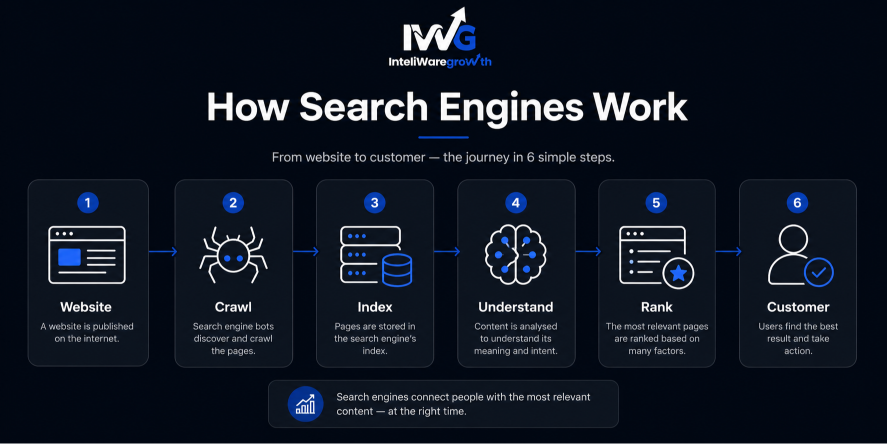
Even the richest content fails if your site loads slowly or confuses visitors. Technical SEO ensures Google can crawl, understand, and reward your expertise.
Ensure a fast, mobile-friendly experience
Over 60% of health-related searches now happen on smartphones. Google's mobile-first index judges your site primarily by its mobile performance.
- Use a responsive design that adapts fluidly to all screen sizes.
- Compress images, enable browser caching, and minimise render-blocking JavaScript.
- Test your Core Web Vitals via PageSpeed Insights. Aim for Largest Contentful Paint under 2.5 seconds.
Create clear conversion paths
Your site isn't a brochure, it's a patient acquisition machine.
- Place a prominent “Book Appointment” button in the header, hero section, and after every service description.
- Embed a simple online scheduling tool (Calendly, Zocdoc, or your EMR's widget) so patients can book without a phone call.
- Add click-to-call buttons on mobile so users can dial with one tap.
Implement schema markup
Structured data helps Google display rich snippets, such as your star rating, address, opening hours, and upcoming events, directly in search results.
- Use Local Business schema with subtype “Podiatrist.”
- Add Medical Clinic or Medical Business schema to specify services like “Podiatry.”
- Mark up your FAQs with FAQ Page schema to capture “People Also Ask” boxes.
Off-page SEO & building authority
Google treats backlinks as votes of confidence. For a local podiatry clinic, quality trumps quantity every time.
Earn backlinks from trusted health sources
- Offer to write a guest column for your local newspaper's health section on “Back-to-School Shoe Fitting Tips.”
- Partner with local running stores, physiotherapists, or orthopaedic surgeons and request a reciprocal link on their “Recommended Partners” page.
- Get listed in professional directories like the APMA or your national podiatry society.
Leverage local partnerships and sponsorships
- Sponsor a 5K race or community health fair, and most event sites will link back to their sponsors.
- Host free “Foot Health Check” days and publish a press release with a link to your registration page.
- Join your local Chamber of Commerce and secure a directory listing.
Tracking & measuring SEO success
Without data, you're guessing. Focus on metrics that tie directly to patient revenue.
- Google Business Profile Insights: Monitor total searches, views, calls, and direction requests monthly.
- Keyword rankings: Track positions for your target terms, both branded and non-branded, using a rank tracker.
- Organic traffic & conversions: Set up Goals in Google Analytics for appointment form submissions and phone call clicks.
- Return on investment: Compare the lifetime value of a new patient against your SEO investment (time, tools, or agency fees).
How Inteliware Growth amplifies your podiatry SEO
At Inteliware Growth, we don't believe in SEO silos. Our data-driven framework layers paid acquisition and conversion optimisation on top of your organic foundation, so you capture demand from every angle.
- Audit: We dissect your current site, competitor rankings, and patient intent gaps.
- Strategy: We build a custom roadmap with KPIs like cost-per-acquisition and appointment booking rate.
- Execution: Our team launches high-converting Google Ads for “bunion surgeon near me” and retargets website visitors who didn't book.
- Tracking: Real-time dashboards show exactly how many calls, forms, and booked appointments each channel delivers.
- Scale: Once we identify winning keywords and ads, we optimise budgets to grow your patient volume predictably.
We specialise in five high-intent niches, including Doctors & Clinics. To see the full breadth of our performance marketing expertise, [View all services](https://inteliwaregrowth.com/Services) and discover how we drive growth across industries like taxi fleets, immigration law, cleaning companies, and app startups.
If you're ready to turn local search traffic into a steady stream of patients without the guesswork, our dedicated clinic framework bridges the gap between clicks and care.
View Our Doctors & Clinics Services
FAQ
How long does SEO take for a podiatry practice?
Most clinics see meaningful improvements in local rankings within 3 to 6 months. Highly competitive metro areas may take 9 to 12 months. SEO is cumulative. The longer you invest, the stronger your authority.
What are the best keywords for podiatrists?
The highest-intent keywords are “podiatrist near me,” condition-specific terms like “plantar fasciitis treatment,” and procedure searches such as “bunion surgery [City].” We recommend building a full keyword matrix that includes symptom, treatment, and insurance-related queries.
Is SEO better than Google Ads for podiatrists?
Both channels serve different purposes. SEO builds long-term, no-click-cost organic trust, while Google Ads deliver immediate visibility for time-sensitive needs. The most successful clinics run them in tandem. Ads capture today's emergencies, while SEO grows tomorrow's reputation.
Can I do podiatry SEO myself?
You can certainly implement basics like claiming your Google Business Profile and asking for reviews. However, technical audits, content strategy, and link building require specialised expertise. Partnering with a performance marketing agency ensures you don't waste time on tactics that never convert.
Does blogging really help my podiatry website rank?
Absolutely. Each well-targeted blog post acts as a new entry point for search engines. Answering common foot-care questions demonstrates expertise, builds topical authority, and keeps your site fresh, a signal Google rewards with higher rankings.
Get in touch with Inteliware Growth
If you're ready to fill your appointment book with patients who are actively searching for your services, our team is here to build the data-driven framework that makes it happen.
Contact Us
📞 +92 344 3503901
📧 sales@inteliwaregrowth.com
📍 London, United Kingdom
Book Your Free Consultation