Restaurant SEO helps local diners find your business when they search for food online. Success relies on optimizing your Google Business Profile for local map packs, maintaining consistent name, address, and phone number data, and using HTML menus instead of PDFs.
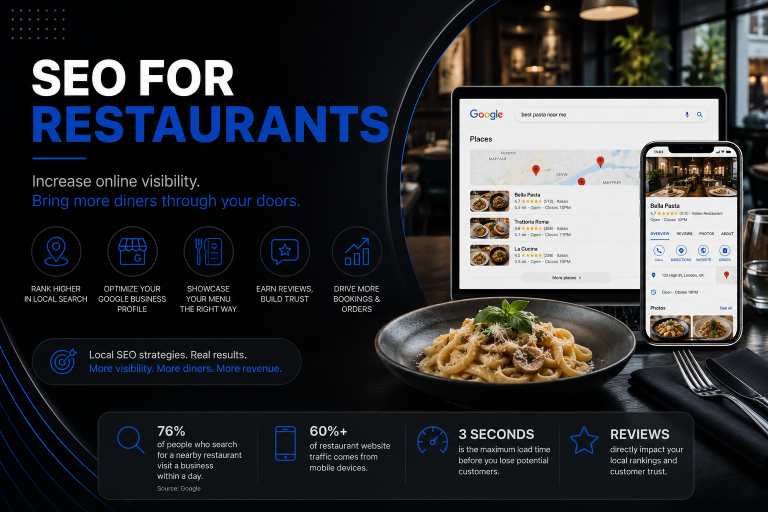
If your restaurant isn’t appearing in the "Local 3-Pack" or Google Maps when someone searches for “best pasta near me” or “vegan restaurant in London,” you are leaving money on the table. The modern diner makes split-second decisions. According to a Google study, 76% of people who search for a nearby restaurant on their phone visit a business within a day. To capture that traffic, your digital presence must be technically flawless, locally authoritative, and engineered for conversions.
At Inteliware Growth, we don’t believe in generic marketing. We build data-driven performance frameworks for high-intent service industries. Here is how to apply that same rigorous, ROI-focused methodology to your restaurant’s SEO.
Google Business Profile: your digital storefront
Your Google Business Profile (GBP) is the single most powerful tool for local restaurant SEO. It powers your visibility in Google Maps and the local pack. An incomplete or neglected profile signals to Google that your business is less relevant.
Claim and fully verify your profile
You cannot rank what you don’t own. Start by claiming your profile at Google Business Profile. Verification usually happens via postcard, but phone or email options are sometimes available. A verified profile shows Google you are a legitimate business and unlocks management of your information.
Add accurate hours, holiday schedules, and phone numbers
Accuracy is a direct trust signal. If your weekend brunch hours differ from weekday hours, set them specifically. Always update your profile for bank holidays or seasonal closures. A single customer who drives to a closed restaurant because of outdated hours may never return, and they often leave a negative review.
Upload fresh, high-resolution photos of dishes and the dining room
Restaurant choices are visual. Profiles with high-quality photos receive 35% more clicks to their websites than those without. Post new images weekly. Showcase your signature dishes, the ambiance of the dining room, and even a short video of the chef at work. Avoid stock photography; Google’s algorithm and customers both prefer authentic, geotagged original images.
Encourage customers to leave reviews and reply to them promptly
Reviews are the lifeblood of local SEO. The quantity, velocity, and diversity of your reviews directly impact your local ranking. Train your floor staff to ask happy diners for a review. Crucially, you must reply to every review, positive or negative. A professional, keyword-aware response shows both the reviewer and potential customers that you value feedback.
Website optimization: removing friction for diners
Even with a perfect GBP, a poorly optimized website will cost you bookings. Your website must load instantly and answer the diner’s two primary questions without friction: “What can I eat?” and “How do I get it?”
Use text-based HTML menus instead of downloadable PDF files
This is a non-negotiable technical signal. Google cannot “read” the text inside a PDF image the way it can crawl an HTML page. When you hide your menu items inside a PDF, you make those dishes invisible to search engines. An HTML menu allows Google to index “wood-fired margherita pizza in Shoreditch” and rank you for that specific query. It also loads faster and is accessible for visually impaired users.
Ensure fast loading times and seamless mobile navigation
Restaurant searches happen on the go. Over 60% of restaurant web traffic comes from mobile devices. If your site takes longer than three seconds to load, you will lose potential customers. Use compressed images, a reliable host, and minimize heavy scripts. A mobile-first design with large, tappable buttons for the menu and reservation link is essential.
Add clear calls-to-action for online ordering or table reservations
Every page on your site should guide the user toward a conversion. A “Book a Table” or “Order Delivery” button must sit above the fold and follow the user as they scroll. Eliminate dead ends. A customer who lands on your blog post about wine pairings should still be one click away from making a reservation.
Optimize image alt text with specific dish names and your location
Alt text helps search engines understand your images, but it’s often wasted on text like “image001.jpg.” Instead, be descriptive. Write “pan-seared salmon with lemon butter sauce at The Docklands, London” instead. This semantic detail reinforces your local relevance and makes your images discoverable in Google Image searches.
Local citations and keywords: being found for what you serve
Keyword research for a restaurant isn't just about volume; it's about intent and locality. You need to speak the language of your diners across every directory and piece of content.
Target specific local and niche keywords
Don’t just optimize for “restaurant.” Optimize for “gluten-free Italian restaurant in Birmingham” or “rooftop cocktail bar in Soho.” These long-tail, niche keywords have lower competition and extremely high conversion intent. Use these phrases naturally in your page titles, headings, menu item descriptions, and meta tags.
Keep business name and contact details identical across directories
You must build a fortress of consistency. Your NAP (Name, Address, Phone Number) needs to be pixel-perfect across Yelp, TripAdvisor, OpenTable, and local chambers of commerce. Even a minor discrepancy like “St.” vs. “Street” creates a citation conflict that weakens your local search authority.
Build local relevance by getting featured in community or food event blogs
Google evaluates your prominence beyond just links. Sponsoring a local food festival, hosting a charity dinner, or being featured in a local lifestyle blog generates unstructured citations and topical authority. These signals tell Google that your restaurant is not just a business, but a participating member of the local community.
Advanced technical health and E-E-A-T signals
Google’s algorithm prioritizes content that demonstrates Experience, Expertise, Authoritativeness, and Trust. You can satisfy these qualitative demands through technical execution.
Your restaurant is a subject matter expert. Showcase that by publishing structured data markup. Implement Restaurant schema to tell search engines directly about your menu, price range, and accepted currencies. Add LocalBusiness schema to solidify your NAP data in a machine-readable format. For maximum visibility, use FAQ schema on pages answering common diner questions. This can capture rich results that sit above standard blue links, dramatically increasing your click-through rate.
When technical SEO gets complex, our performance marketing experts can implement these advanced optimisations so you can focus on running your kitchen. Additionally, ensure your site architecture supports strong internal linking. Connect your menu page to your reservation page, and your blog content to your location page. This topical clustering signals to Google that your site thoroughly covers the dining experience in your area, boosting your topical authority. These are the invisible technical layers that push a good website to a great one.
How Inteliware Growth turns clicks into revenue
Generating traffic is just the start. At Inteliware Growth, we are a UK-based performance marketing agency that lives at the intersection of data and diner psychology. We don’t deliver vanity metrics; we deliver covers and orders.
We apply a rigorous 5-step performance framework to scale your restaurant’s growth:
- Audit: We dive deep into your competitor’s ad strategies and your current conversion funnel leaks.
- Strategy: We build a custom roadmap with clear KPIs, not just for traffic, but for cost-per-booking.
- Execution: We launch precision-targeted Google Ads campaigns, ensuring you show up for high-intent searches like "vegan delivery open now."
- Tracking: We implement real-time dashboards, giving you 100% transparency on what every click costs and which keywords bring in diners.
- Scale: We amplify your budget only against campaigns proven to deliver automated, profitable conversions.
While our core expertise spans niches like taxi companies, Immigration lawyers, and healthcare clinics, our local search frameworks are perfectly calibrated for the restaurant industry. If you can turn a search into a ride or a patient booking, you can absolutely turn it into a dinner reservation. Explore our Case studies to see how we’ve driven measurable growth for service businesses just like yours.
Ready to put your restaurant on the map?
Stop relying on outdated PDF menus and inconsistent directories. Your competitors are fighting for the top of Google right now. We help you win with a strategy engineered purely for return on investment.
Book Your Free Consultation today to audit your restaurant’s digital presence.
Contact Us
📞 +92 344 3503901
📧 sales@inteliwaregrowth.com
📍 London, United Kingdom
Frequently Asked Questions about restaurant SEO
Why does my restaurant need an HTML menu instead of a PDF?
Google can’t crawl text inside a PDF, so your dishes stay invisible. An HTML menu turns every item into a searchable keyword that attracts diners.
How long does it take to see results from local restaurant SEO?
Quick GBP fixes can show results in days, but building lasting local dominance typically takes 3 to 6 months of consistent work.
Do online reviews really impact my Google ranking?
Yes. Reviews are a strong local ranking signal. Keyword-rich replies further boost your visibility in the map pack.
Can I do restaurant SEO myself, or do I need an agency?
You can manage basics like GBP and NAP. However, technical schema, citation cleanup, and conversion tracking are best handled by specialists.
What’s the first step to improving my restaurant’s visibility?
Verify your Google Business Profile, ensure fast mobile load times, and fix any inconsistent NAP details across the web immediately.