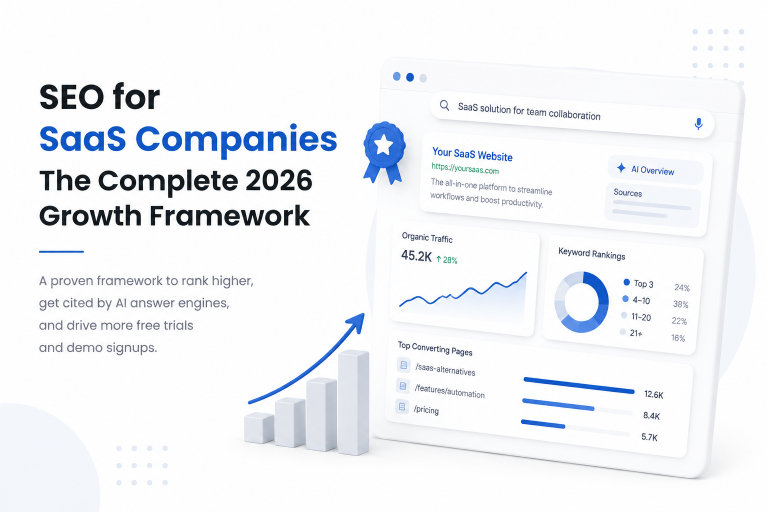
SEO for SaaS and app companies is the practice of optimizing software websites to rank on search engines and get cited by AI answer engines to drive free trials and demo signups.
If you are running a SaaS or mobile app startup, you already know the harsh reality: organic acquisition is the only sustainable way to scale without hemorrhaging venture capital. But the old rules of blogging, pumping out generic 500-word articles on productivity tips, are dead.
At Inteliware Growth, we don't do vanity metrics. We treat SEO like a paid acquisition channel: it must be tracked, optimized, and directly tied to revenue. In this guide, I'm breaking down the exact framework we use to help SaaS founders and App developers get found by high-intent users and cited by AI platforms like ChatGPT.
The 2026 search landscape
Before we dive into tactics, you must understand why we structure SEO differently for software than for e-commerce or local services.
SaaS buyers are sophisticated. They don't click on the first result without doing research. They use Google to compare tools, read reviews, and validate choices. If your content strategy doesn't intercept them at these specific validation stages, you are invisible.
Furthermore, the rise of Answer Engine Optimization (AEO) has changed the game. Google's AI Overviews and ChatGPT are scraping the web for the clearest, most authoritative answers. If your site structure is messy, AI won't cite you, and your organic traffic will plummet.
Here are the four key strategy pillars we implement for every software client.
Key strategy pillars
To rank in this competitive niche, you cannot rely on guesswork. At Inteliware Growth, our SaaS SEO campaigns are built on four non-negotiable pillars. These are the mechanisms that separate companies with hockey-stick growth from those stuck in a plateau.
1. Bottom-of-funnel keywords
Target high-intent search terms first, such as [competitor] alternative or X vs Y, because they convert significantly higher than top-of-funnel blog posts.
Most SaaS blogs fail because they chase volume. They want to write What is Project Management thinking it will bring 10,000 visitors. But a visitor looking up a definition is a student, not a buyer.
We prioritize Bottom-of-Funnel (BOFU) keywords immediately. These are searches where the user has a credit card ready and is looking for a reason to buy your specific type of tool.
High-converting BOFU categories include:
- Competitor alternatives: e.g., Monday.com alternative, HubSpot alternative.
- Comparison pages: e.g., Asana vs. Trello.
- Integration searches: e.g., Slack + Salesforce integration.
- Pricing and objection handling: e.g., [Tool Name] pricing or Is [Tool Name] worth it.
By capturing users who are already problem-aware and solution-aware, you shorten the sales cycle drastically. For an App company, this looks like Uber Eats for laundry or Calm app alternative. Check out our app startup marketing to see how we apply this framework.
2. Technical foundation
Prioritize server-side rendering for JavaScript-heavy apps so search crawlers and AI models can actually read your page content instead of seeing an empty shell.
This is where most App companies fail catastrophically. Your dashboard is built on React, Vue, or Angular. If your marketing site is also rendered 100% on the client side, Googlebot often sees a blank white screen.
If Google can't see the text, it doesn't exist. If it doesn't exist, you can't rank. If you can't rank, AI can't cite you.
The solution is Server-Side Rendering (SSR) or Static Site Generation (SSG) using frameworks like Next.js or Nuxt. This ensures the HTML is populated with your content before it reaches the browser.
Additionally, Core Web Vitals are a ranking signal. A slow landing page increases bounce rate and signals to Google that your user experience is poor. We routinely audit SaaS sites where heavy JavaScript animations are tanking their rankings. Strip the bloat. Speed is a feature.
3. Answer engine optimization (AEO)
Structure content with clear data tables, schema markup, and direct answers so AI platforms like ChatGPT and Perplexity cite your software.
In 2026, ranking #1 on Google isn't the only goal. You want to be the source that Google's AI Overview quotes. When a user asks ChatGPT What is the best CRM for a solo founder, the AI pulls from training data and real-time indexes.
To get cited, you need to make your content machine-readable:
- Use People Also Ask formats: Write a 40-50 word definition immediately after a heading.
- Schema markup: Implement SoftwareApplication, FAQPage, and Review schema. This tells search engines exactly what your product does in a language they understand natively.
- Data tables: AI models love tables. If you are comparing pricing or features, use an HTML table, not an image. AI cannot read text inside an image.
We treat our blog posts like database entries. Clear questions, clear answers, structured data. Our Google Ads management also leverages structured data for better ad quality scores.
4. Authority building
Earn mentions and backlinks through digital PR, industry studies, and active profiles on software review platforms like G2 and Capterra.
Google's Quality Rater Guidelines emphasize Experience and Trust. For a software company, trust is built off-site.
You cannot rank for best accounting software without backlinks from authoritative tech publications. However, you can't just buy links. We focus on:
- Digital PR: Releasing proprietary data studies. If you can survey 500 users and publish a report on State of X, journalists will link to you as the source.
- Review platforms: G2, Capterra, and Product Hunt. These are high-domain-authority sites that Google trusts for software queries. Aggressively managing your profile here is a direct ranking signal.
- Directories: Submitting to relevant tech stacks (e.g., Built With directories).
Our SEO framework
Now that we understand the pillars, let's look at how Inteliware Growth executes this for our clients. We treat organic search not as a content game, but as a revenue engine that complements our paid advertising strategies.
Step 1: The audit
Most agencies start writing immediately. We start by auditing. We connect your Google Search Console and sales CRM. We identify the keywords that are currently driving revenue, not just traffic.
We look at your competitors and identify the gaps. Are they ranking for a feature comparison you haven't written yet? We map out the entire funnel, from Awareness (Top of Funnel) to Decision (Bottom of Funnel), and assign a dollar value to each stage. Learn more about our case studies.
Step 2: Building the money pages
We prioritize creating Money Pages. These are the pages that directly sell your software. Usually, this includes:
- Homepage: Optimized for your core feature.
- Feature pages: One page per major feature.
- Use case and industry pages: e.g., Project Management for Architects.
- Comparison pages: You vs. The Incumbent.
We ensure these pages are written by people who understand software (Experience), backed by data (Expertise), and hosted on a fast, secure site (Trust).
Step 3: The content expansion
Once the technical foundation is solid and the money pages are live, we scale content. We use a Hub and Spoke model. A pillar page covers a broad topic, and cluster articles cover specific long-tail keywords.
For example: Pillar Page: SaaS Marketing.
Spoke Post: SEO for SaaS and App Companies (You are reading this right now).
Spoke Post: How to Reduce Churn for Mobile Apps.
This internal linking structure signals to Google that you are the subject matter expert on the entire niche. Explore our growth services to see how we can help.
Common mistakes SaaS startups make
Based on our experience auditing dozens of software startups at Inteliware Growth, here are the recurring bottlenecks that kill organic growth.
1. The feature dump blog
If your blog reads like a changelog or a feature dump (We just updated our API), it will never rank. Users don't search for your features. They search for their problems. Translate your features into benefits.
2. Ignoring the zero-click search
SaaS marketers often panic when they see zero-click searches (where Google answers the question without the user clicking). They think it's a traffic loss. We see it as a brand opportunity. If you provide the answer in the featured snippet, even without a click, you build authority. Optimize for the snippet, not just the click. Read featured snippets for more details.
3. Neglecting the app store
If you are an App Company, your SEO strategy is split. You have Web SEO and App Store Optimization (ASO). These two must work together. Your website should link to the App Store, and your App Store listing should link back to your website for advanced content.
Combining SEO with paid acquisition
While this article focuses on SEO, at Inteliware Growth, we believe in the Full-Funnel approach. Organic search takes time (usually 3 to 6 months to see significant traction). How do you survive in the interim?
Paid search (Google Ads).
We use Google Ads to bid on the exact same high-intent BOFU keywords we are trying to rank for organically. This allows us to:
- Generate leads today: Keep the cash flow positive while SEO matures.
- Test copy: If a Paid Search headline has a high Click-Through Rate (CTR), we use that same copy in our Meta Titles for SEO. This data loop is invaluable.
We are experts in tracking this through our Real-Time Dashboards, ensuring you know exactly which channel (SEO or PPC) is driving your app installs or SaaS trials.
Sustainable growth for software
SEO for SaaS and App companies is no longer about writing a blog post a week and hoping for the best. It is a technical, data-driven discipline that requires an understanding of search intent, server-side rendering, and AI algorithms.
At Inteliware Growth, we combine the precision of performance marketing with the compounding returns of organic search. By focusing on bottom-of-funnel keywords, building a bulletproof technical foundation, and optimizing for AI answer engines, we build growth frameworks that scale.
If you are ready to move beyond vanity metrics and start driving qualified demo signups and app installs, it's time to talk to the experts.
Ready to scale your software or app company? Book a Free Consultation today and let's audit your current SEO strategy.
FAQs
To ensure we satisfy Google's search intent completely, here are direct answers to the most common queries regarding SaaS SEO.
1. How long does SaaS SEO take?
Typically 3 to 6 months for traction and 12+ months to compound. We use paid ads to bridge the gap.
2. SEO or PPC for SaaS?
Use both. SEO lowers long-term CAC, while PPC provides instant validation. PPC data also informs SEO strategy.
3. How do I get cited in AI overviews?
Use clear, concise answers, schema markup, and data tables. Write 40-60 word paragraphs directly under headings.
4. Do backlinks still matter?
Yes. A link from TechCrunch or G2 is worth more than 100 random blog comments. Focus on Digital PR and review platforms.
5. Google SEO or app store optimization?
Do both. Google SEO drives web signups, ASO drives downloads, and a strong brand search boosts both.
Contact Us
📞 Phone: +92 344 3503901
📧 Email: sales@inteliwaregrowth.com
📍 Address: London, United Kingdom