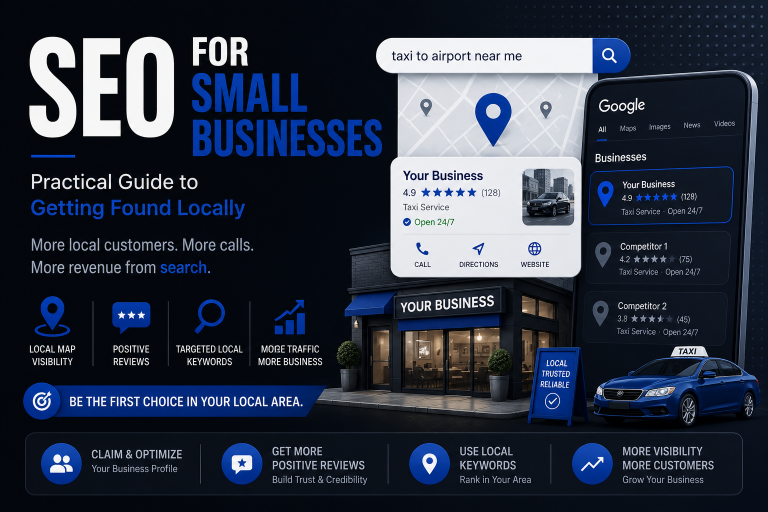
Search engine optimization (SEO) helps small businesses get more free visitors from search engines. Focus on claiming a Google Business Profile for local map results, targeting specific long-tail keywords, making fast mobile-friendly web pages, and answering real customer questions.
Every morning, a potential customer near you searches for exactly what you offer: a taxi to the airport, an immigration solicitor, a local clinic. If your business doesn’t appear in those results, that click (and the revenue that follows) goes to a competitor. Small business SEO isn’t about gaming an algorithm; it’s about being the obvious, trusted answer when someone needs your service. This guide lays out the exact steps to get there, built on years of seeing what actually moves the needle for local service companies. We’ll cover the local signals that put you on the map, the on-page foundations that win clicks, and the technical checks that keep you visible, all backed by the same data-first thinking we use at Inteliware Growth to help taxi firms, law practices, and clinics turn searches into booked appointments.
Essential local SEO steps
Local SEO connects your business with customers in your geographic area. For a small business, appearing in the “local pack” (the top three map results) can drive more calls than a number-one organic ranking. These three steps create the base.
Claim your profile
Fill out every part of your local business listing with your exact name, address, phone number, and photos. A fully optimized Google Business Profile (GBP) is your storefront on Search and Maps. Use your real business name; don’t stuff keywords. Select the most accurate primary category and add relevant secondary categories. Upload high-quality photos of your storefront, team, and work. Set your opening hours including holiday adjustments. Write a description that explains what you do and where you serve. Consistency is critical: the same NAP (Name, Address, Phone) must appear on your website, GBP, and every directory listing. Verification is often the first hurdle; Google typically sends a postcard to your business address, so make sure you can receive mail at that location.
Gather reviews
Ask happy customers to leave positive reviews online. Reviews are a direct ranking factor for local search and heavily influence click-through rate. Create a simple process: after a completed service, send a follow-up email or text with a direct link to your Google review form. Never incentivize reviews, that violates platform policies. Respond to every review, even the negative ones. A professional reply to a complaint shows prospects that you care. Aim for a steady stream of fresh reviews rather than a one-time burst; recent reviews signal ongoing relevance. For businesses just starting out, even five genuine, positive reviews can boost local visibility significantly.
Use local keywords
Add your city or neighborhood name into your web page titles and text. When a cleaning company in Manchester writes a page title like “Eco-Friendly Office Cleaning | Manchester,” they’re matching the exact search terms real people type. Sprinkle location modifiers naturally in headings, body copy, and image alt text. Don’t forget to include the area you serve in your GBP description and posts. For multi-location businesses, build a unique page for each location with distinct, locally relevant content, never just swap the city name. Include embedded Google Maps, local testimonials, and area-specific information to reinforce the location signal.
On-page content basics
On-page SEO tells search engines what each page is about and proves to visitors that you can solve their problem. A well-structured site with clear, question-answering content often outperforms bigger competitors.
One page per service
Build a separate web page for each specific service you offer. A taxi company shouldn’t bury “airport transfers” on the homepage. That service deserves its own page with dedicated title tag, headings, and details about vehicle types, pricing, and pickup process. This structure shows Google that you are a comprehensive resource for that exact need. It also gives you the ability to rank for long-tail searches like “wheelchair-accessible airport taxi Birmingham.” Structure the page clearly: a concise H1, scannable subheadings, benefit-focused bullet points, and a clear call to action. Each service page should link internally to related services and to your contact page to guide visitors smoothly.
Answer real questions
Write content that answers the exact questions your customers ask on the phone. Listen to your sales team, check your email inbox, and look at “People also ask” boxes in Google. An immigration law firms might notice clients frequently ask “What documents do I need for a spouse visa extension?” That’s a blog post. Write in plain English, use a conversational tone, and place the answer early. When you thoroughly address a topic, Google may pull your text into featured snippets or AI overviews, placing you right at the top. Structure your content with clear question-and-answer formats using subheadings; this helps both readers and search engines quickly extract the information.
Optimize tags
Put your main search terms into your page title tags, main headings (H1), and image alt text. The title tag remains one of the strongest on-page ranking signals. Keep it under 60 characters, front-load the primary keyword, and make it compelling. Your H1 should match the promise of the title and clearly describe the page. Use descriptive alt text for images: not just “photo1.jpg” but “immigration solicitor reviewing visa documents in London office.” This helps accessibility and image search. Meta descriptions, while not a direct ranking factor, impact click-through rate, so craft a unique 150–160 character summary for each page that includes a clear benefit.
Technical health & tracking
Even the best content won’t rank if your site is slow or search engines can’t read it. Technical SEO ensures your pages get indexed and provide a good user experience.
Mobile speed
Make sure your site loads quickly and works well on mobile phones. Google uses mobile-first indexing, and over 60% of local searches happen on a smartphone. Test your site with Google PageSpeed Insights. Common culprits for slowness are oversized images, clunky website builders, and cheap hosting. Compress images, use a content delivery network (CDN), and eliminate unnecessary scripts. A site that loads in under 2.5 seconds keeps visitors from bouncing back to the search results. Beyond speed, ensure buttons and links are easily tappable on small screens, text is readable without zooming, and your phone number is click-to-call enabled.
Free tools
Use Google Search Console to track how people find your site. This free dashboard shows which queries bring impressions and clicks, whether your pages are indexed, and any mobile usability errors. Pair it with Google Analytics to understand visitor behaviour, which pages keep people reading and which leak traffic. Set up alerts for indexing issues so you can fix them before rankings slide. Small business owners often overlook these tools, but 15 minutes a week inside Search Console can uncover quick wins like a high-impression keyword that just needs a title tweak to improve its click-through rate. You can also monitor backlinks and internal link performance.
Be patient
Good SEO takes 6 to 12 months to show major results. Unlike paid ads, organic rankings build compound returns over time. The first few months involve laying the groundwork: technical fixes, content publishing, and review generation. By month four to six, you should see steady movement for long-tail and local terms. Track progress with a simple spreadsheet: monitor keyword positions, organic traffic, and phone calls or form fills from organic channels. Consistency is the differentiator: a business that adds one helpful page per month for a year will leave its static competitors behind. Remember that algorithm updates can cause short-term fluctuations; focus on the long-term trend, not daily ripples.
A quick checklist for small business SEO
Use this table to audit your current efforts and prioritise next steps.
| Area | Must-do action | Frequency |
|---|---|---|
| Local | Claim & fully complete your Google Business Profile | Once, then monthly updates |
| Local | Request and respond to reviews | Weekly |
| On-page | Build a dedicated page per service | As you launch services |
| On-page | Write content that answers customer questions | Biweekly |
| Technical | Run a mobile speed test and fix flagged issues | Monthly |
| Tracking | Review Search Console performance | Weekly |
Why SEO matters even more for niche service businesses
Service-based businesses, like taxi companies, immigration law firms, and private clinics, compete in tight, intent-driven markets. A person searching “family visa solicitor near me” is ready to hire. If your site answers that need with authority and location signals, you win the highest-converting traffic available. At Inteliware Growth, we build growth frameworks for exactly these industries. We know that an immigration lawyer’s funnel looks completely different from a cleaning company’s, and that a taxi service relies on local pack visibility more than organic position one. The principles in this guide apply universally, but they deliver outsized returns when matched to the right sector dynamics. For example, a doctor’s clinic must emphasize local trust signals like practitioner bios and patient reviews, while a cleaning company might prioritize service area pages and booking integrations.
When to fuel SEO with paid advertising
SEO is the long game, but sometimes you need customers today. Combining organic strategies with targeted Google Ads gets you visible for competitive terms immediately while your rankings mature. A taxi firm can bid on “airport transfer London” and appear at the top of the page while building its local profile over the months ahead. That data then feeds your SEO: the top-converting keywords from paid campaigns become your on-page priority list.
Inteliware Growth specialises in this hybrid approach for high-intent niches. We audit your existing funnel, map keyword-intent clusters, and launch campaigns that pay back fast, all tracked in real-time dashboards so you see exactly where every pound goes. Whether you need patient acquisition for a clinic or app installs for a startup, our 5-step roadmap turns search demand into measurable growth. You can [View all our services](https://inteliwaregrowth.com/[services](https://inteliwaregrowth.com/services/)) to see the full range of data-driven solutions tailored to your industry.
FAQs: Small business SEO
How long does SEO take for a small business?
Expect initial local ranking improvements within 3–4 months if you stay consistent. Sustainable, major results typically take 6–12 months.
Is SEO better than Google Ads for small businesses?
SEO builds lasting free traffic over time; Google Ads deliver immediate leads. The strongest strategy for service businesses usually combines both.
How much does small business SEO cost?
It can be free with your own effort using free tools. Professional help generally ranges from £300–£1,500 per month depending on competition and location scope.
Do I need a blog for my service business?
Not a traditional blog, but you do need content that answers real customer questions, through FAQ sections, detailed service pages, or guides.
What is the most important local SEO ranking factor?
A fully complete Google Business Profile, proximity, NAP consistency, and fresh reviews are the top actionable levers for local pack visibility.
Take the next step with data-driven growth
Small business SEO isn’t guesswork; it’s a repeatable system. Start by claiming your local profile, building service-specific pages, and listening to the questions your customers already ask. Track everything, stay patient, and layer in paid acceleration when you need immediate volume.
If you want a partner who treats your marketing budget like their own, we’re ready. Inteliware Growth builds custom growth roadmaps for niche service businesses, combining precise paid campaigns with the organic foundations that make them stick. Our clients, from taxi fleets to immigration solicitors, see real-time results on transparent dashboards, with every decision driven by data, not hunches.
Contact Us
📞 +92 344 3503901
📧 sales@inteliwaregrowth.com
📍 London, United Kingdom
Book Your Free Consultation