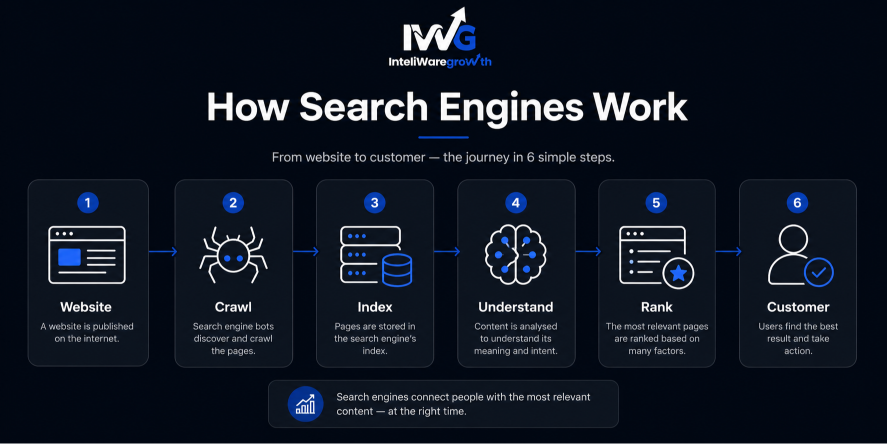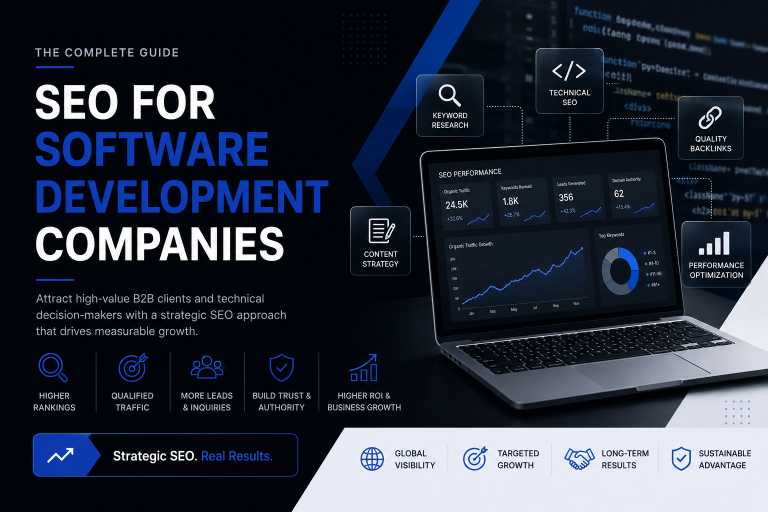
SEO for software development companies focuses on attracting high-value B2B clients and technical decision-makers by targeting commercial search intent. Success requires aligning technical site health, deep industry-specific keyword targeting, and authoritative content that proves real engineering capability.
Many software firms still rely solely on referrals and outbound sales while competitors quietly capture decision-ready buyers from organic search every day. The companies that win don’t just do SEO. They build a discovery engine aligned with how CTOs, VP Engineers, and product managers actually research technology partners. This guide shows you how to turn your website into a lead-generating asset that ranks for commercial queries and demonstrates genuine engineering credibility.
Why software development SEO is different
B2B software services sit inside a highly considered purchase environment. A business doesn’t Google hire a software development company and buy within hours. They compare technical stacks, evaluate case studies, and involve multiple stakeholders long before a sales call. Your SEO must reflect that journey.
- Decision-makers are technical. A CTO or engineering lead will scrutinise your site for competence signals; poor performance, thin content, or generic claims immediately erode trust.
- Buyer intent is multi-layered. They search for custom software development company, but also React Native vs Flutter for enterprise app, or how much does healthcare portal development cost. Your strategy must capture informational, commercial, and navigational queries at different stages.
- Trust assets matter more than ever. Links from GitHub, Stack Overflow, Clutch, and tech publications carry enormous weight because Google interprets them as peer-validated authority.
This isn’t a content-volume game. It’s a precision strategy that maps technical audiences to high-intent search terms, and proves real engineering capability.
Keyword strategy for software development SEO
A keyword framework built without understanding the buyer’s technical vocabulary misses qualified leads. Software development companies need a strategy that mirrors how procurement actually works, from broad solution exploration to vendor-specific evaluations.
Target commercial intent phrases first
Commercial intent keywords signal readiness to engage. Phrases like custom software development services, enterprise app modernization company, or cloud migration partner put your service pages in front of buyers actively comparing firms. Instead of scattering these terms across a single page, create dedicated service-line pages that match each high-value cluster. A page optimised for cloud migration services should detail your methodology, supported clouds (AWS, Azure, GCP), and real outcomes, never generic filler.
Internal tip: Use Google Ads data to validate which commercial terms actually convert. As a performance marketing agency, we cross-reference paid search query reports to inform organic targeting; the overlap reveals the highest-intent language your prospects use.
Focus on tech stack and niche terms
A generic software development company page competes with thousands of global agencies. A tightly focused page on React Native development company or Python backend engineers for fintech immediately filters for qualified traffic with precise needs. These niche terms often have lower search volume but significantly higher conversion potential. A healthcare startup searching for HIPAA-compliant React Native developers isn’t browsing; they’re actively vetting partners.
Audit your project portfolio and build service pages around the specific languages, frameworks, and platforms your team excels in. Include developer-oriented details: testing frameworks, CI/CD pipelines, and architectural patterns you commonly implement. This speaks directly to the technical decision-maker scanning your page.
Build topical clusters around industry solutions
Don’t just publish isolated service pages. Build topical clusters that cover vertical-specific solutions—fintech software, healthcare portals, logistics platforms—and link them to a comprehensive pillar page. A pillar page on Healthcare Software Development can support cluster content like:
- HIPAA compliance checklist for app developers
- FHIR integration guide for healthtech startups
- Case study: reducing patient wait times with custom portal development
This structure tells Google you have topical depth, improving rankings for all pages within the cluster. It also matches how procurement teams research: they start with an industry problem, then drill into technical requirements and potential partners.
Content and authority that proves capability
CTOs and product managers are immune to marketing fluff. They need proof you can deliver complex projects, communicate clearly, and handle edge cases. Content that satisfies these audiences doubles as a ranking engine.
Engineering-style case studies
A generic case study earns zero trust and zero rankings. Structure every case study to answer the questions a technical lead would ask in a vendor call. Check out our case studies for real examples of how we document complex software deliveries with measurable results.
A high-performing case study includes:
- The problem in engineering terms: What legacy system limitations, scaling bottlenecks, or compliance hurdles existed?
- Tech stack choices and rationale: Why React over Angular? Why PostgreSQL over MongoDB? This demonstrates architectural thinking.
- Measurable business outcomes: Not just improved efficiency, but reduced data processing time from 4 hours to 12 minutes, handling 10x concurrent users post-migration.
These details serve dual duty. They satisfy Google's E-E-A-T requirements by proving real-world experience, and they give procurement teams the evidence needed to advocate internally for your firm.
CTO-level technical guides
While competitors produce generic benefits of custom software articles, you can dominate by publishing engineer-worthy guides that target informational queries preceding a purchase decision. Our blog regularly publishes technical deep-dives that attract backlinks from developer forums and tech newsletters.
Examples of high-value technical content:
- Architecting multi-tenant SaaS applications on AWS: a decision framework
- Trade-offs between microservices and modular monoliths for early-stage startups
- A practical guide to SOC 2 compliance for app development teams
Such content attracts backlinks from developer forums, tech newsletters, and Stack Overflow discussions—signals that directly boost authority. It also positions your team as experts before a sales conversation starts.
Backlinks from tech and open-source platforms
Link building for software development companies doesn't mean guest posting on unrelated blogs. The highest-quality backlinks come from where your peers and clients already spend time.
Focus on:
- Software review directories: Platforms like Clutch and GoodFirms—claim and optimise profiles, and earn client reviews that naturally include your URL.
- Tech publications and engineering blogs: Contribute articles to sites like Smashing Magazine or industry verticals.
- Open-source contributions: Maintain or significantly contribute to open-source projects. When other developers reference your library or tool, you gain contextual, editorially-given backlinks that Google loves.
- Speaking and webinars: Conference talk pages and event recaps often link to speaker companies, another authoritative signal.
Each link acts as a peer-driven vote of technical competence, far more valuable than volume-based schemes.
Technical SEO that earns developer trust
A software development company with a slow, poorly architected website sends exactly the wrong message. If you can't optimise your own digital infrastructure, why would a client trust you with theirs?
Fast page speeds and core web vitals
Google's Core Web Vitals directly affect rankings, but for a technical audience, page speed is also a credibility signal. Avoid heavy JavaScript rendering that blocks search crawlers. If your own site relies on a bloated React SPA without server-side rendering, you're actively harming indexation while advertising your React expertise—an ironic and costly disconnect.
Implement server-side rendering or static site generation where appropriate. Optimise image delivery, reduce third-party scripts, and use a CDN. Lighthouse and WebPageTest should be your constant companions.
Structured data to showcase your expertise
Structured data doesn't directly boost rankings, but it creates rich results that increase click-through rates and establish brand presence in SERPs. For detailed implementation, refer to Schema.org for the full vocabulary.
For software development companies, essential schema types include:
- Organization schema: Anchor your brand entity with logo, social profiles, and description.
- Service schema: Mark up each service page to describe what you offer.
- FAQ schema: On service or technical guide pages, answer common procurement questions like What's your typical engagement model? and mark them up for rich snippets.
- Article and How-to schema: For detailed technical guides, helping them surface with step-by-step previews.
Implementing structured data demonstrates a solid grasp of modern SEO, something technical buyers will appreciate when your result outshines competitors' plain text listings.
Clean site architecture and internal linking
A flat, logical site architecture helps both users and crawlers find your deepest content. Software development sites often suffer from service page graveyards; buried pages that get no internal link equity.
Map internal links between:
- Relevant service lines (custom software development → cloud migration services)
- Tech stack pages and corresponding case studies (React Native case study linked from the React Native services page)
- Industry solutions and related technical guides (fintech software service page linked to a PCI compliance for app developers guide)
This internal linking weaves a topical web that signals semantic relevance to search engines, while guiding prospects deeper into your content, increasing time on site and conversion opportunities.
How SEO integrates with your broader growth engine
While SEO builds your long-term organic pipeline, coupling it with performance marketing accelerates results. We frequently layer Google Ads on top of organic keyword data, targeting the exact same commercial-intent phrases that drive SEO leads, while using paid social retargeting to nurture visitors who read technical guides but didn't convert. Combining SEO with conversion rate optimisation (CRO) then ensures every organic visitor lands on a page engineered to capture demos or consultations. A well-optimised service page with a clear value proposition and trust signals can double conversion rates without increasing traffic.
Partner with a growth agency that understands technical audiences
Inteliware Growth is a UK-based performance marketing agency that helps high-intent service businesses turn search intent into revenue. Learn more about our approach and how we apply the same data-driven framework that works for taxi fleets, law firms, and app startups to software development companies, because at the core, it's about connecting technical buyers with the right solutions at the exact moment they're searching.
View [our services](https://inteliwaregrowth.com/[services](https://inteliwaregrowth.com/services/)) to see exactly how we can support your growth goals. Our framework—audit, strategy, execution, tracking, and scale—works whether you're launching a new service line or want to outrank legacy competitors who've rested on referrals for too long.
Ready to build an SEO engine that brings qualified technical leads every month?
📞 Phone: +92 344 3503901
📧 Email: sales@inteliwaregrowth.com
📍 Address: London, United Kingdom
Book Your Free Consultation – reach out directly or visit our website to start the conversation.
Conclusion
SEO for software development companies isn't a side task; it's the primary mechanism to attract B2B clients actively searching for your exact services. By aligning commercial keyword intent, content that proves engineering depth, and a technically flawless website, you position your firm as the obvious partner. At Inteliware Growth, we combine deep performance marketing expertise with a genuine understanding of technical audiences, helping you build a lead pipeline that runs 24/7. Let's turn your search presence into your strongest growth channel.
Frequently Asked Questions
How long does SEO take to generate leads?
Expect initial traction in 4–6 months for commercial terms. SEO compounds over time, so the work you do today keeps delivering for years.
Local SEO or national/international SEO?
Local SEO works if you serve a defined region. For most B2B software firms, national or international targeting around industries and tech stacks brings better leads.
Does GitHub help with SEO?
Yes. An active GitHub profile signals technical legitimacy to search engines, and code references from other developers earn natural backlinks.
Can we rank without a blog?
Yes, service and case study pages can rank for commercial queries. A blog adds top-of-funnel traffic and builds the authority that lifts your money pages.
How to measure SEO success?
Track organic traffic to service pages, conversion rates, and assisted conversions. Focus on keywords that produce qualified leads, not just raw traffic.