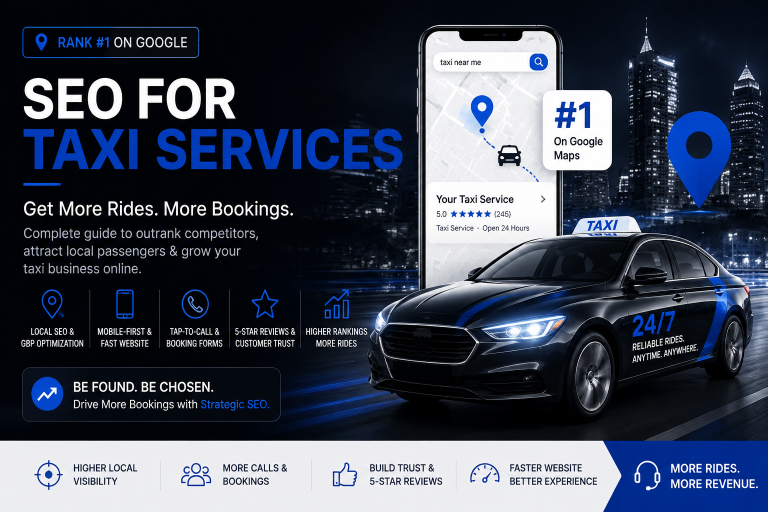
SEO for taxi services is the practice of optimizing your online presence so your cab company ranks high on Google when local customers search for rides, airport transfers, or "taxi near me". Because most bookings happen on mobile phones during urgent travel needs, dominating local search results directly drives phone calls and ride reservations.
But simply having a website isn’t enough. Your future passengers are making split-second decisions while standing on a curb or waiting at baggage claim. If your cab company doesn’t appear in the top 3 results, you’ve already lost that fare to a competitor. The battle for customers is won or lost in the Google Maps 3-pack and the first few organic positions. This guide breaks down exactly how to build a high-ranking online presence that turns searches into bookings, backed by the performance marketing principles we use at Inteliware Growth every day.
Why local SEO matters
Before we dive into the tactics, let’s understand the search intent. When someone types “taxi near me” or “airport cab service,” they have an immediate, transactional need. They aren’t researching for a trip next month; they want a ride now, or within the hour. Google knows this, which is why it prioritizes local map results over traditional blue links for these queries.
This changes everything about your SEO strategy. You aren’t just competing with other taxi firms; you’re competing for a tiny piece of digital real estate in Google’s local pack. Success requires a hyper-local, mobile-first, and trust-driven approach. Get this right, and you’ll have a direct line to the highest-intent passengers in your city. At Inteliware Growth, we specialise in building these exact conversion-focused funnels for private hire and taxi companies, turning local search intent into immediate revenue.
Google Business Profile optimization
Your Google Business Profile (GBP), formerly Google My Business, is the single most important tool for local taxi SEO. It’s what populates the Google Maps 3-pack and the knowledge panel on branded searches. Think of it as your rank on the digital taxi meter.
Claim and verify your profile like a pro
If you haven’t claimed and verified your listing, you’re essentially invisible. Go to the Google Business Profile page, claim your business, and complete the verification process, usually via a postcard to your physical address. Without this step, you can’t manage the information Google displays, and you won’t appear in Maps. It’s the first action we take in our audit phase when a taxi company partners with us.
Fill in every detail with pinpoint accuracy
A half-filled profile signals to Google that you aren’t a serious business. Include your real, consistent business name (don’t keyword-stuff it), the exact local address, a 24/7 phone number, and accurate operating hours. Choose Taxi service as your primary category and add relevant secondary categories like Airport shuttle service or Transportation service. Upload high-quality photos of your vehicles, drivers, and office; profiles with images get significantly more clicks and direction requests.
Actively collect 5-star reviews to build trust
Reviews are the fuel for your local ranking engine. A steady stream of positive 5-star reviews not only builds trust with passengers but also signals to Google that your business is reliable and responsive. After every successful ride, send a polite text follow-up with a direct link to your Google review page. Always respond to reviews: thank happy customers and professionally address any negative ones. This demonstrates active management, a key local SEO signal. To scale this, we often build automated review request systems for our clients as part of their overall strategy.
Website and mobile optimization
Your GBP gets you the visibility, but your website closes the deal. When a user clicks through to your site, the experience must be instantaneous and friction-free. A slow, clunky website is the fastest way to send a passenger straight to your competitor.
Make it lightning-fast and mobile-first
Over 70% of taxi bookings happen on smartphones. Your website must load in under three seconds on a 4G or 5G connection. Use Google PageSpeed Insights to test your current performance. Compress images, eliminate unnecessary code, and use a reliable hosting provider. A mobile-responsive design isn’t optional; it’s mandatory. If passengers have to pinch and zoom to find your number, you’ve failed the core task of your site. Our development and CRO teams obsess over this, ensuring every landing page we build for taxi clients passes Core Web Vitals.
Tap-to-call and booking forms
This is the single highest-impact conversion tactic for a taxi website. Never make a mobile user copy and paste your phone number. Place a prominent, click-to-call button that floats on every page. Right next to it, or as a smooth alternative, embed a stripped-down booking form: name, phone, pickup address, drop-off address. That’s all you need. Every extra field you demand reduces your conversion rate. We regularly A/B test simpler versus complex forms and see booking rates jump by 20-40% just by removing friction.
Target local keywords
Optimise your key pages for the exact phrases your customers use, but do it naturally. Your homepage title tag could be: 24/7 Taxi Service in [Your City] | Reliable Airport Transfers & Cabs. Then, build out keyword-rich but unspammy content around terms like:
- cab company near me
- airport taxi [city name]
- [neighbourhood] to [airport code] taxi
- late-night cab [town]
Always write for a human scanning for a ride, then check your keyword inclusion. Never sacrifice clarity for keyword stuffing.
Content and local citations
To rank for the hundreds of local route variations passengers search for, you need a smart content and citation strategy that proves you are the authority in your specific service area.
Build dedicated service area pages
One generic Services page won’t cut it. Create dedicated, highly useful pages for each neighbourhood, suburb, or major landmark you service. A page optimised for Heathrow Airport Taxi to Reading with the exact pickup procedures, estimated fares, and meeting points provides immense value to both Google and the searcher. Write these pages in a helpful, first-person voice that demonstrates your drivers’ deep local knowledge. This is a key component of the scalable content frameworks we build for taxi brands.
Local directory listings
Consistency is critical. Your business Name, Address, and Phone number (NAP) must be identical everywhere it appears on the web: your website, GBP, Yelp, Thomson Local, and niche transport directories. BrightLocal is an excellent tool for managing these citations and finding industry-relevant listing opportunities. Every accurate citation reinforces Google’s trust that you are a legitimate, well-established local business. We sweep and clean up NAP inconsistencies as a foundational step in our audit process, because even a single wrong digit can dilute your local authority.
Add local business schema markup
This is the technical bit that gives you an edge. Schema markup is code you add to your website that spells out in language search engines can understand exactly what your business is, what services you offer, your hours, and the geographic area you serve. When you implement LocalBusiness and TaxiService schema, you can trigger rich results that display your star rating, phone number, and service area right in the search results. This increases your click-through rate dramatically and is a staple of our advanced tracking and implementation phase.
Turn taxi SEO into a revenue engine
While the local SEO tactics above are essential, treating them in isolation is a slow game. The fastest way to dominate your city’s taxi market is to combine an airtight organic foundation with intelligent, data-driven paid strategies and conversion optimization. That’s exactly how our 5-step framework operates for private hire and taxi firms:
- Audit: We dive deep into your competitor data, search terms converting in your area, and the leaky gaps in your current funnel.
- Strategy: We map a custom roadmap combining SEO, Google Ads for high-intent “taxi near me” searches, and targeted social retargeting.
- Execution: We build your optimized landing pages, launch laser-focused Google Ads campaigns, and perfect your GBP.
- Tracking: We implement advanced attribution and real-time dashboards so you see every call, booking, and cost.
- Scale: We shift budget aggressively onto the channels and keywords proving profitable through automated, transparent data.
This holistic approach means you aren’t just getting SEO tips; you’re getting a performance marketing engine built to maximise taxi bookings in the shortest possible time. See how our taxi company growth services deliver measurable results.
Capture every passing fare starting today
Stop watching potential passengers book with your competitors. Your taxi company deserves a digital marketing strategy that works as hard as your drivers do, capturing high-intent searches, converting them to calls, and scaling your bookings with transparent ROI.
At Inteliware Growth, we’re a UK-based performance marketing agency that builds data-driven funnels specifically for taxi and private hire companies. We don’t just write reports; we guarantee every campaign is measured against real ride bookings and revenue. Review our case studies to see proven results for fleets like yours.
Contact Us
📞 +92 344 3503901
📧 sales@inteliwaregrowth.com
📍 London, United Kingdom
FAQs about taxi SEO
How long does SEO take for a taxi company to see results?
You can expect noticeable local ranking improvements within 3 to 6 months. Pairing SEO with Google Ads delivers immediate bookings while organic rankings grow.
Why are Google reviews so important for my taxi business?
High star ratings and review volume are top local ranking factors that directly influence your position in the map pack. They also build instant trust with potential passengers.
Can I just run Google Ads instead of doing SEO?
Yes, but you pay for every click. A hybrid approach uses paid ads for instant visibility while SEO builds a free, long-term booking channel that lowers your cost per ride. Explore our Google Ads management services for a ready-made solution.
What is the most common SEO mistake taxi websites make?
Slow mobile load times and missing tap-to-call buttons. If your site takes more than 3 seconds, you lose passengers before they ever see your number.
Do I need separate pages for every town I cover?
Absolutely. A dedicated page for each area you service ranks much better for local searches and provides riders with the specific information they need.