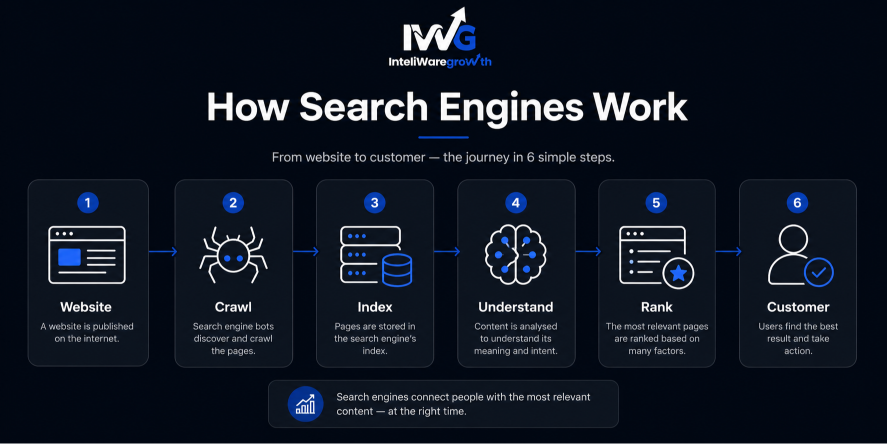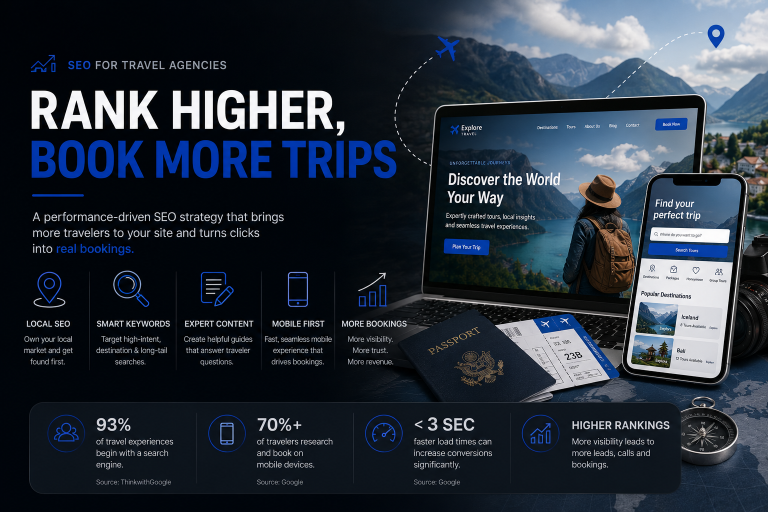
SEO for a travel agency is the practice of optimizing your website and online footprint to rank higher on search engines like Google. Winning at travel SEO means targeting high-intent local and destination keywords, fixing technical mobile speeds, and publishing expert guides that beat big booking aggregators.
The travel industry is brutally competitive online. Expedia, Booking.com, and TripAdvisor dominate the search results with million-dollar budgets. For an independent travel agency, showing up on page one can feel impossible. But it’s not. At Inteliware Growth, we’ve seen that a razor-sharp SEO strategy—rooted in performance data and conversion science—can systematically steal clicks from the giants. It can turn those clicks into real bookings. This guide walks you through exactly how to build that engine.
Why most travel agencies fail at SEO
The biggest mistake travel agencies make is treating SEO like a vanity metric. They chase generic traffic for terms like “travel agency.” They celebrate a spike in visitors who will never book a trip. That is a failure of intent.
A performance-driven approach flips the script. It starts not with keywords but with the revenue goal. That goal is more completed booking forms, more phone calls, and more walk-ins. Every decision is judged by its impact on conversions. You aggressively filter out irrelevant traffic. You build content that answers real traveler anxiety. You track every lead back to its source. When you layer that discipline onto solid SEO foundations, you create a channel that does not just rank. It earns.
Local SEO – own your backyard first
Before you dream of ranking for “Thailand luxury tours,” you must own your backyard. Most agencies generate a significant chunk of revenue from local clients. These clients want to walk in, talk to a human, and book a complex itinerary. Local SEO ensures those people find you first.
Claim and optimize your Google Business Profile
This is your new homepage for local searches. Add accurate working hours, your physical address, a local phone number, and high-quality photos of your office and team. Select the correct category. “Travel agency” is the obvious choice. You can add secondary categories like “Tour operator” if applicable. Without this profile, you are invisible on Google Maps and the local pack.
Collect client reviews consistently
Reviews are the online currency of trust. After every successful trip, send a polite email or WhatsApp message. Ask the client to leave a Google review. Even a handful of fresh, detailed reviews per month signals activity and reliability. This directly boosts your map pack rankings and local trust.
Target hyper-local service terms
Integrate phrases your neighbors actually type. Use “travel agency near me,” “best tour operator in [your city],” or “[city] visa services.” Build a dedicated landing page that weaves these terms naturally. Include them in headlines, service descriptions, and testimonials. A London-based agency should have a robust page titled “Family Travel Agency in London.” That page must outline local expertise, the office location, and a clear contact form.
Keyword & content – beat the aggregators with intent
You cannot outspend the big aggregators, but you can out-think them. The aggregators win on broad, head terms. Your edge lies in specificity, personalization, and the depth of your local knowledge.
Focus on long-tail destination queries
Forget trying to rank for “travel” or even “UK tours.” The money is in the long tail. Think “Lake District family tour packages,” “Cornwall summer holidays 2026,” or “best autumn walking tours in the Cotswolds for seniors.” These queries come from people deep in planning mode. They often have a budget and timeframe already in mind. Build individual, richly detailed pages for each such tour package.
Answer traveler questions through helpful blog posts
Your blog is not a corporate journal. It is a 24/7 travel consultant. Write posts that remove friction and anxiety. Provide step-by-step visa requirement checklists. Offer honest breakdowns of the best months to visit each destination. Create interactive packing lists and cultural etiquette guides. A post titled “Isle of Skye in October: Weather, Road Conditions, and What to Pack” will attract pre-bookers. These readers need confidence before they call you. Use your real, on-the-ground experience. Add original photos and anecdotes the aggregators lack.
Build structured topic clusters
Connect your content so Google sees you as an authority, not just a collection of posts. Create a pillar page for a broad destination, like “Complete Travel Guide to the Scottish Highlands.” Link from it down to all your specific tour booking options, packing lists, and area guides. This internal linking strategy passes authority. It helps users navigate seamlessly from research to booking. It tells search engines that you cover the topic comprehensively.
Technical & mobile – speed wins bookings
Travel research and booking have shifted almost entirely to mobile. Your site must perform flawlessly on a 4G connection. A slow site burns money. Google knows this and punishes clunky mobile experiences.
Ensure your site loads fast on mobile phones
Run your key pages through Google’s PageSpeed Insights. Aim for a “Good” score on both mobile and desktop. Common killers for travel sites are uncompressed hero images and bloated third-party scripts. Work with your developer to eliminate render-blocking resources. The “Book Now” button must be visible and tappable in under three seconds.
Compress high-resolution destination pictures into WebP formats and use lazy loading
Gorgeous visuals sell trips. A 5MB PNG of the Lake District will drive your bounce rate through the roof. Convert all images to modern WebP format. This saves 25-35% on file size without visible quality loss. Implement lazy loading so images only download when a user scrolls to them. This dramatically improves initial load time. It is a direct ranking signal and a key user experience factor.
Add schema markup to stand out with rich snippets
Structured data helps search engines understand your content. It lets them display it prominently. Use TouristTrip schema to mark up your specific tour packages. Include price, duration, and itinerary. Use FAQ schema on pages that answer common questions, like visa info. This can win you prime real estate with expandable rich results. Those results push competitors down the page. For a travel agency, a rich result showing a star rating, price, and trip length massively boosts click-through rates.
Clicks to bookings – turn traffic into revenue
Ranking is only half the battle. If your traffic does not convert into leads and customers, your SEO investment is wasted. Performance marketing demands that we optimize every step of the funnel.
Think like a traveler. A user lands on your “Lake District Family Tour” page from a search. They need instant reassurance. Your headline must match their search intent. Display a clear, mobile-friendly “Book Free Consultation” button above the fold. Use trust signals. Show a “5.0 Google Rating” badge. Mention “Family-Run Since 2003.” Include a real photo of you guiding a family. Embed a short, fast-loading video testimonial. Replace generic contact forms with simple inquiry buttons. Those buttons should trigger WhatsApp or a callback request. At Inteliware Growth, we obsess over these micro-conversions. They directly lift your ROI from organic traffic. You can see how we apply this same conversion-first thinking for other high-intent service niches like Immigration lawyers.
Track what matters – attribution over vanity metrics
Vanity metrics like “page views” mean nothing if you cannot tie them to revenue. A mature SEO strategy requires transparent, real-time tracking. You must know exactly which keyword drove the phone call that booked a £5,000 safari.
Implement call tracking with dynamic number insertion. This attributes phone leads to the correct organic landing page. Set up form submission tracking in Google Analytics 4 and tie it to your CRM. Use UTM parameters on all internal campaign links. Build a real-time dashboard. It should show how many booked consultations and completed booking forms came from organic search this week. This data lets you double down on what is working. You can ruthlessly cut what is not. This is a core principle of our Audit-to-Scale framework at Inteliware Growth. Explore our Case studies to see how data-driven tracking has transformed campaigns in competitive spaces.
Avoid these travel SEO budget drainers
- Chasing head terms. Ranking for “flights” is a resource pit. Prioritize specific tour pages.
- Duplicate content from suppliers. Copy-pasting hotel descriptions from your DMC is a surefire way to get flagged. Write unique, experience-led descriptions.
- Neglecting the post-booking experience. Sending an automated email with packing tips, local contacts, and a review request closes the loop. It feeds your local SEO.
- Ignoring old, outdated blog posts. A 2019 visa guide with wrong fee information hurts your E-E-A-T. Update or prune regularly.
- Not building any backlinks from local media and tourism boards. Genuine links from reputable sources remain a top-3 ranking factor.
SEO + paid search – own the SERP completely
SEO is a long-term asset. Paid search captures demand instantly. Together, they dominate the SERP. Use Google Ads to bid on your highest-intent keywords immediately while you build organic authority. Remarket to users who read your destination guides but left without booking. The insights from your paid campaigns can directly inform your SEO keyword and content strategy. This holistic, performance-first approach works spectacularly for travel agencies ready to scale.
How Inteliware Growth helps travel agencies win
As a UK-based performance marketing agency, Inteliware Growth does not do fluffy “SEO packages.” We build data-driven growth frameworks for service industries. For travel agencies, this means a five-step roadmap.
- Deep Audit: We analyse your current SEO, competitor strategies, audience intent, and your full booking funnel.
- Custom Strategy: We map out a roadmap with clear KPIs. These include organic booking form submissions, qualified phone calls, and map pack visibility.
- Execution: We create custom, conversion-optimised landing pages and expert content that answers traveler intent.
- Advanced Tracking: We implement attribution models so you see exactly which organic touchpoints drive revenue.
- Scale: We expand budgets and content production based purely on what the real-time data proves is working.
We understand high-intent niches. Whether you are a local travel agent in Manchester or a specialist tour operator in Edinburgh, our methodology turns search visibility into predictable revenue. [View all our services](https://inteliwaregrowth.com/[services](https://inteliwaregrowth.com/services/)) to see the full scope of how we help service businesses grow.
Frequently Asked Questions about SEO for travel agency
Q: How long does travel agency SEO take to show results?
A: Local rankings often improve in 3–6 months. Competitive destination terms can take 12+ months. Pair SEO with paid ads to generate leads from day one.
Q: Can a small travel agency really compete with Expedia on Google?
A: Yes. Win on long-tail queries, local expertise, and unique content that big aggregators cannot replicate.
Q: Do I need a blog for my travel agency website?
A: Absolutely. A static site will not rank. A regularly updated blog builds authority and attracts high-intent visitors.
Q: What is the most important ranking factor for a local travel agency?
A: A complete Google Business Profile and consistent reviews drive local visibility. Expert content and fast mobile speed win destination queries.
Ready to turn searchers into travelers?
Stop fighting algorithms and start building a conversion engine. The strategies above are the exact blueprint we use to drive measurable bookings for service businesses. If you want a performance audit of your current travel agency website and a clear, data-backed plan to dominate your market, let’s talk.
Contact Us
📞 +92 344 3503901
📧 sales@inteliwaregrowth.com
📍 London, United Kingdom