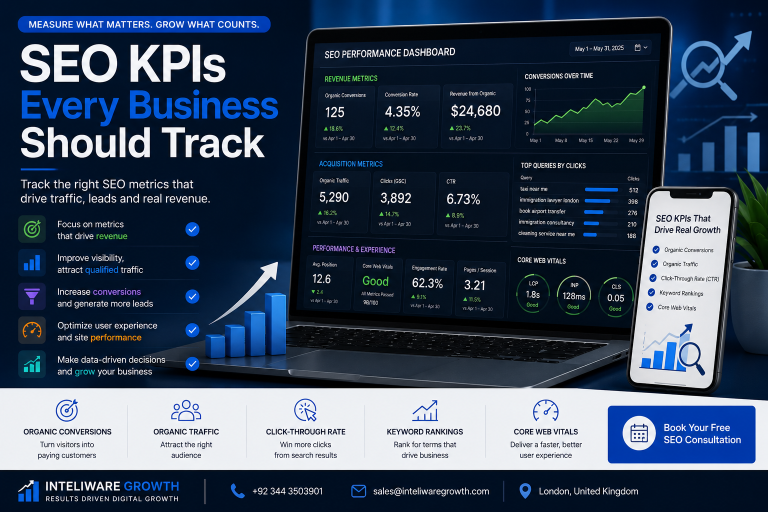
Every business should track SEO metrics that directly impact revenue rather than just “vanity” metrics. The most critical KPIs to measure are Organic Conversions, Organic Traffic, Click-Through Rate (CTR), Keyword Rankings, and Core Web Vitals. Together, these five indicators give you a complete picture of whether your search engine visibility is actually filling your pipeline or just burning your budget.
At Inteliware Growth, we connect these SEO dots directly to your sales data using real-time performance dashboards. This guide shows you exactly what to measure and how to make the numbers work for you.
Why vanity metrics don’t pay the bills
Many agencies send glossy reports full of “impressions” and “total backlinks.” These numbers often have zero correlation with cash in the bank. A taxi company doesn’t need a million impressions abroad; it needs a local customer to book a ride. An immigration firm doesn’t need traffic from casual researchers; it needs a qualified lead ready to pay a retainer. That’s why we focus on conversion-centric KPIs—the clicks that turn into calls, the rankings that attract high-intent clients, and the user experience that keeps them from bouncing.
1. Organic conversions the ultimate business KPI
Organic conversions are the North Star. This metric counts visitors from unpaid search who complete a desired action—booking a consultation, calling your office, downloading an app, or making a purchase. It is the only metric that definitively proves your SEO investment generates tangible revenue.
For service businesses, a conversion might be a form submission for an immigration solicitor or a “Book a Ride” tap for a taxi company. If organic traffic rises but your conversion rate stays flat, you’re merely boosting your server bill.
How to track it:
- Set up Goal Tracking in Google Analytics 4 (GA4) for key actions like form submissions, phone clicks, and checkout completions.
- For phone-heavy industries, integrate call-tracking software that records the organic source.
- Compare conversion rates across service pages to spot underperformers that need CRO tweaks.
2. Organic traffic quality over quantity
Organic traffic is the total number of visitors from unpaid search results. But not all traffic is created equal. A cleaning company’s blog about “the history of soap” might bring traffic, but it won’t generate a single booking. We want high-intent traffic—users searching for “[service] near me” or “best [service] in [city].”
How to track it:
- Google Search Console shows exactly which queries drive clicks. The Performance report makes it easy to filter by page and query, as described in Google’s official documentation.
- In GA4, combine “Session source / medium” with “Landing page” to see which pages attract the most engaged visitors. Always pair traffic with Engagement Rate. High traffic with a 5-second engagement time means you’re attracting the wrong crowd.
3. Click-through rate (CTR) your serp shop window
CTR measures the percentage of people who see your link on the search results page and actually click. A high impression count paired with a low CTR screams that your meta titles and descriptions need rewriting. You have visibility, but your shop window looks uninviting.
How to improve a poor CTR:
- Add the current year to titles (e.g., “2025”) to signal freshness.
- Use power words that spark curiosity.
- Mirror the search intent. For “immigration lawyer fees,” a title like “Complete Fee Breakdown” will out-click “Our Law Firm Services.” This kind of copy tweak matters for a specialist law firm where clients compare costs before contacting anyone.
- Implement structured data for rich snippets. According to Google’s own search guidelines, structured data powers rich results that visually expand your listing and can significantly increase click-through rates.
4. Keyword rankings are you visible for the right terms?
Keyword rankings show where your pages land on the SERP for target queries. This KPI indicates how well your content is optimized against competitors. For local service industries, the Google Map Pack (the top 3 local results) is often more valuable than traditional blue links.
Focus on a portfolio of transactional and local long-tail keywords. A clinic targeting “private GP near me” will get far more appointments from a #3 ranking than a #1 ranking for a generic medical term that no local patient ever searches. Track positions weekly, not daily, to avoid reacting to normal wobbles.
5. Core web vitals the technical foundation
Core Web Vitals measure real-world user experience and are a direct ranking factor. The three pillars, explained in detail on web.dev, are:
- Largest Contentful Paint (LCP): Loading speed (aim under 2.5 seconds).
- Interaction to Next Paint (INP): Responsiveness to clicks and taps.
- Cumulative Layout Shift (CLS): Visual stability—the page shouldn’t jump around.
Poor scores lead to frustration and higher bounce rates. If a user taps “Book Now” on your taxi page and the button shifts as the page loads, you’ve lost a fare. Track this via Google Search Console and PageSpeed Insights, and fix technical debt immediately.
6. Supporting engagement & authority metrics
Beyond the big five, several other KPIs complete the picture.
- Engagement rate & bounce rate : GA4’s Engagement Rate is the inverse of the old bounce rate. A rate below 50% on a landing page flags that visitors aren’t finding what they need.
- Pages per session : High depth indicates trust. A user reading case studies, pricing, and your team bio is warming up to convert. Link internally from blog posts to service pages to fuel this journey.
- Top exit pages : Find where people leave. If a pricing page is a top exit, you have a conversion bottleneck. Apply CRO tweaks like adding testimonials.
- Backlink quality : One link from a local chamber of commerce is worth thousands of spammy directory links. Track referring domain authority and topical relevance, not just raw link count.
- Average SERP position & impressions : Watch your overall average position trend. Impressions define your visibility ceiling—a sudden drop is often the first warning of a technical issue or competitor surge.
7. How to build a simple SEO KPI dashboard
Don’t drown in data. Use Looker Studio to pull in Search Console, GA4, and CRM data into three clear sections:
- Health metrics: Impressions, CTR, Average Position, Core Web Vitals.
- Engagement metrics: Sessions, Engagement Rate, Pages Per Session.
- Revenue metrics: Organic Conversions, Conversion Rate, Revenue.
The ultimate power move is linking your CRM to see which organic keyword drove a phone call that became a closed deal. At Inteliware Growth, this revenue-led transparency is baked into every campaign.
Industry-specific seo KPIs are non-negotiable
Every niche has a different “money” metric. For taxi firms, it’s ride bookings; for Immigration lawyers, it’s consultation requests; for cleaners, it’s quote forms; for App Startups, it’s installs; for clinics, it’s appointments.
Common SEO KPI mistakes to avoid
- The single metric obsession : Chasing traffic while a 2% conversion rate collapses is business suicide.
- Ignoring local grid results : For service businesses, the local 3-pack is the real battleground.
- No benchmarking : Without comparing metrics to your own history and industry averages, you’re navigating blind.
- Daily ranking checks : Rankings wobble daily. Track weekly to see the genuine trend.
From metrics to money
Tracking SEO KPIs isn’t a reporting exercise—it’s a decision engine. If Core Web Vitals are red, fix site speed today. If your CTR is 1.5%, burn your old meta descriptions. If organic conversions climb, you have the confidence to scale your spend. Don’t let your SEO data gather dust. Let’s turn it into a growth engine.
At Inteliware Growth, we connect these SEO dots directly to your sales data using real-time performance dashboards. This guide shows you exactly what to measure and how to make the numbers work for you.
Book Your Free Consultation
📞 +92 344 3503901
📧 sales@inteliwaregrowth.com
📍 London, United Kingdom
Frequently Asked Questions
Which KPI should I track first as a new business? Focus on Keyword Rankings and Organic Traffic from branded and high-intent local terms. Confirm your site is being discovered for the right searches first, then shift focus aggressively to Organic Conversions.
How do I connect SEO KPIs to actual phone calls? Use dynamic number insertion on your website. This swaps the phone number based on the visitor’s source. Integrate that call data into your CRM to see exactly which keyword drove a revenue-generating call.
Are Core Web Vitals really a priority for a small local business? Yes. Google uses mobile-first indexing. A local customer searching for a “taxi near me” on a slow connection will leave if your site takes 4 seconds to load. Poor vitals directly suppress local rankings. Aim for a green pass in Search Console.