SEO advice ages faster than an open browser tab. Tactics that worked three years ago can now silently strangle your organic growth. Worse, well-meaning myths keep circulating, wasting budgets and stealing momentum from businesses that desperately need qualified traffic.
At Inteliware Growth, we’ve audited hundreds of campaigns for Taxi Companies, immigration law firms, cleaning businesses, and medical clinics. One pattern keeps emerging: decisions built on SEO mythology, not measurable reality. This article dismantles the most stubborn SEO myths, explains why they stick, and gives you the actionable truth that puts your pages in front of paying customers – not just casual browsers.
If you’re ready to align your SEO with what Google actually rewards in 2026, let’s start clearing out the noise.
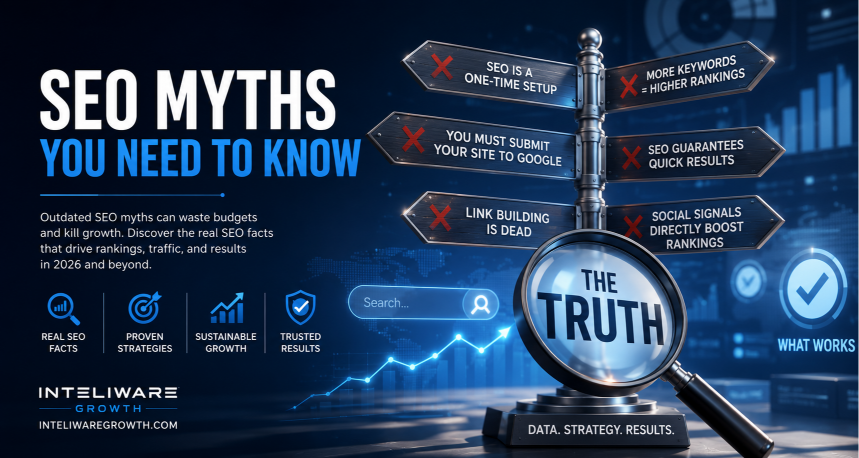
Myth 1: SEO is a one-time setup
Why it persists: The fantasy of “set and forget” is seductive. Many site owners believe that once meta tags are plugged in and a few keywords are sprinkled across the home page, the work is done.
The reality: SEO is a continuous feedback loop. Search algorithms change daily. Competitors publish new content, build fresh links, and refine their technical infrastructure. Your rankings are a moving target.
A site left untouched for six months will almost certainly lose ground, especially in high-intent niches like immigration law or private hire, where rivals aggressively bid for every local query. What’s needed isn’t a project with a finish line. It’s an ongoing improvement engine. Technical health checks, content refreshes, and conversion-path optimization never stop.
Myth 2: More keywords on a page mean higher rankings
Why it persists: Early search engines were primitive enough that keyword density genuinely moved the needle. That legacy trickled into mainstream advice and refuses to die.
The reality: Google’s systems understand topic depth, not keyword counting. Stuffing a cleaning company’s service page with repetitive phrases triggers spam signals and degrades readability, running directly counter to the helpful content system.
Instead of chasing density, build semantically rich pages that answer related questions. Use primary terms naturally in the title and heading, and let variants appear organically. Write for the anxious patient Googling symptoms at 11 p.m., not for a keyword checker.
Myth 3: You Must Submit Your Site to Google
Why it persists: Ancient SEO tutorials often opened with “submit your URL to search engines.” Many business owners still believe Google won’t find them unless manually pinged.
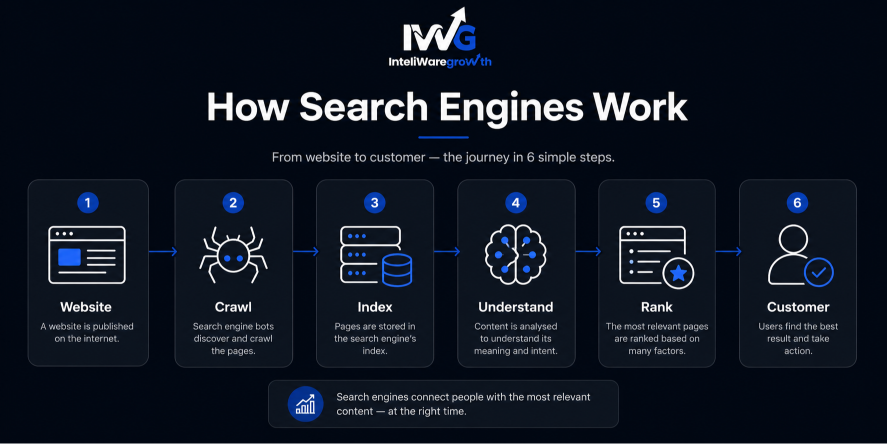
The reality: Google discovers content through links. If another indexed page links to your domain, Googlebot will follow it. The problem is almost never discoverability; it’s crawl budget allocation and indexation quality.
Your focus should shift to creating an accurate XML sitemap and maintaining a clean site structure. If you’re in a local-intense industry like taxi services, claim and optimize your Google Business Profile. That single step surfaces you in local pack results far faster than any manual submission tool ever could.
Myth 4: SEO Guarantees Quick Results
Why it persists: Ad agencies sometimes dangle “page one in 30 days” to close deals. It preys on the desire for immediate returns.
The reality: Organic growth compounds. Low-competition long-tail terms may move in weeks, but competitive commercial keywords can take 6 to 12 months of disciplined work. Google trusts sites that have earned authority over time.
What legitimate SEO does guarantee, when done right, is a sustainable cost-per-acquisition curve. Once organic rankings drive leads, your marginal cost per click is zero. That’s the asset paid search can’t match. Anyone promising a magic ranking sprint is selling hope, not a marketing strategy.
Myth 5: Link Building Is Dead
Why it persists: Google’s Penguin update penalized manipulative link schemes, and overzealous summaries turned “bad links can hurt you” into “all link building is risky.”
The reality: Links remain a core ranking factor. The difference is how you earn them. Buying 500 directory links is dead. Earning a mention from a legal journal because you published original research on visa application trends is alive and authoritative.
For service businesses, link building often hides in plain sight. Sponsoring a local event or creating a genuinely useful checklist generates natural, topically relevant backlinks. Our growth frameworks for immigration law firms regularly include digital PR that gets the firm quoted in trusted news outlets.
Myth 6: Social Signals Directly Boost Rankings
Why it persists: There’s an intuitive appeal to the idea that viral tweets or Facebook shares act as votes of confidence.
The reality: Google has repeatedly stated that social signals are not direct ranking factors, a point John Mueller has reiterated multiple times. However, social media indirectly amplifies everything that does affect SEO.
A well-promoted piece of content reaches industry professionals who may link to it from their own sites. It drives brand searches, which correlate with authority. For App Startups, paid social campaigns paired with organic content marketing can create a surge of branded queries — a strong relevance signal.
Myth 7: SEO Is Only About Ranking #1
Why it persists: The SERP is a leaderboard, and human nature fixates on the top slot.
The reality: Ranking first for a term nobody clicks, or for a query that doesn’t convert, is a vanity metric. Performance marketing cares about one thing: profitable customer actions.
The goal is to appear for high-intent search queries and to make your snippet so compelling that users click and convert. Meta description copy, structured data for star ratings, and clear site navigation influence click-through and lead quality more than a single rank position difference. Chase revenue, not a trophy position.
Myth 8: Local SEO Doesn’t Matter for National or Niche Brands
Why it persists: “Local” seems like a small-town concern, irrelevant to Immigration lawyers serving clients nationwide or App Startups targeting a global audience.
The reality: “Local” in SEO means “location-based intent,” and it covers everything from “immigration solicitor near me” to “airport transfer London.” Google’s local pack now appears for an enormous range of queries.
If you serve a geographic area, your Google Business Profile, local citations, and location pages govern whether you show up in the map results that dominate mobile screens. We’ve seen this repeatedly for taxi fleets, where local pack visibility directly drives ride requests. Explore our dedicated approach for Taxi Companies to see how industry-specific local SEO works in practice.
Myth 9: A Beautiful Website Automatically Ranks Well
Why it persists: Design agencies sell beauty, and it’s tempting to believe that a stunning visual experience equals search success.
The reality: Google’s crawler is blind to aesthetics. It reads code, content hierarchy, speed metrics, and mobile responsiveness. A gorgeous site built entirely on heavy JavaScript might be virtually invisible to search engines if not rendered properly.
User experience matters for conversions, but SEO demands a technical foundation first. Fast servers, clean HTML, proper schema markup, and accessible navigation create a crawlable, indexable architecture. Our conversion rate optimisation work consistently shows that a fast, functional site with clear calls to action outperforms a visually elaborate one.
Myth 10: The Meta Keywords Tag Still Matters
Why it persists: Content management systems still include the meta keywords field, and plugins still prompt for it.
The reality: Google stopped using the meta keywords tag as a ranking signal in 2009. Bing announced it ignores it for ranking purposes as well. Filling it out only gives your competitors a neat list of terms you’re targeting.
Spend that energy on title tags and meta descriptions, which genuinely influence click-through rates. Write them like ad copy: integrate primary keywords naturally, convey a clear benefit, and include a call to action. Every impression is a pitch.
Why These Myths Are Costly in High-Intent Industries
When a private hire company believes SEO is a one-and-done activity, they gradually lose airport transfer bookings to a competitor refreshing content weekly. When an immigration law firm stuffs keywords, it risks looking untrustworthy to vulnerable clients seeking genuine expertise.
Myth-based SEO creates a false sense of progress while real opportunities — featured snippets, local pack visibility, mobile-first indexing advantages — are missed. The antidote is data. Real-time dashboards that connect keyword rankings to call tracking and form submissions prove what actually drives revenue.
Actionable Steps: What to Do Instead
Stop chasing myths and start building an SEO framework that feeds your bottom line. Here’s a practical checklist:
- Perform a technical audit quarterly. Identify crawl errors, slow pages, and mobile usability issues before they hurt rankings.
- Map keywords to intent, not just volume. Separate informational queries (blog content) from transactional queries (service pages) and create assets for both.
- Optimize Google Business Profile with accurate categories, real photos, and a steady stream of genuine reviews.
- Earn links through value. Publish original data, industry guides, or tools. Promote them via targeted outreach and Paid Social retargeting.
- Track conversions, not rankings. Connect Google Search Console with your CRM. Know which terms drive phone calls, booked consultations, or ride requests.
- Align paid and organic strategies. Use Google Ads to gather instant keyword data, then feed winning terms into your SEO roadmap. Our Google Ads management frequently informs content priorities.
- Make speed a religion. Compress images, leverage caching, and monitor Core Web Vitals monthly.
Conclusion
SEO myths survive because they offer simple, static answers in a dynamic field. But simple answers rarely generate revenue. Your competitors who invest in continuous technical refinement, intent-driven content, local dominance, and conversion-led measurement are quietly pulling ahead while myth-believers wait for a ranking fairy.
Performance marketing demands that every tactic ties back to measurable business outcomes. If you’re ready to replace SEO superstition with an accountable growth strategy, the team at Inteliware Growth builds frameworks for exactly that — day in, day out, across taxi fleets, law firms, App Startups, clinics, and cleaning companies.
Book Your Free Consultation
📞 +92 344 3503901
📧 sales@inteliwaregrowth.com
📍 London, United Kingdom
Frequently Asked Questions
1. Are all SEO myths dangerous?
Not always; some are simply outdated. But acting on them diverts resources from activities that genuinely move the needle. In competitive niches, that delay can cost you leads.
2. How often should I update old content?
Review high-performing pages quarterly. Update statistics, refresh examples, and check for broken links. Significant rewrites may be needed when user intent shifts or competitors publish substantially better resources.
3. Does AI-generated content violate Google’s guidelines?
Google evaluates content quality, not its creator. AI-assisted content is acceptable if it demonstrates expertise, accuracy, and user value. Low-quality, mass-generated text designed to manipulate rankings violates spam policies.
4. Can I handle SEO on my own, or do I need an agency?
Small sites can manage basic on-page and local SEO with time and commitment. But as you scale, technical audits, link earning, and conversion analytics benefit from specialist expertise and tooling.
5. Is mobile optimisation still a ranking factor?
Absolutely. Google uses mobile-first indexing, meaning it predominantly crawls and evaluates the mobile version of your site. Poor mobile experience directly hurts rankings and conversions.
6. How do I know if my SEO agency is using ethical practices?
Transparent reporting, clear explanations of strategy, no guarantees of specific rankings, and a focus on conversions and ROI are strong indicators. If they promise “secret tricks,” proceed with caution.