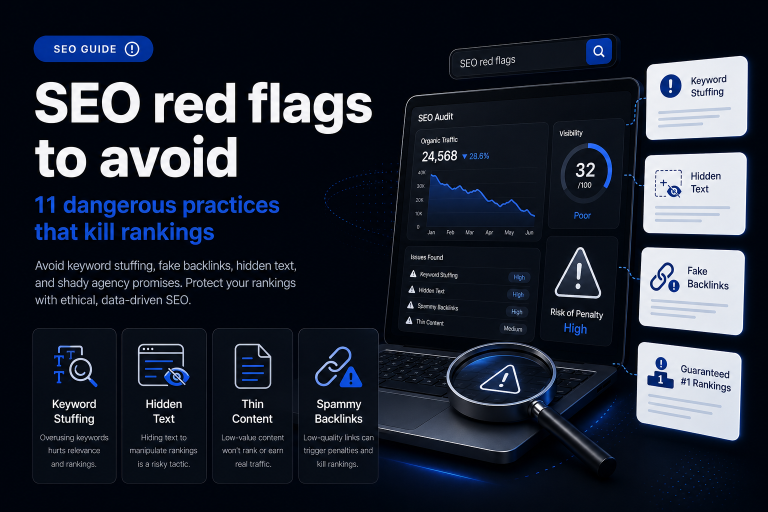
SEO red flags are dangerous website practices or shady agency promises that can get your site penalized, banned, or stripped of traffic by search engines. Major traps include keyword stuffing, buying fake backlinks, hiding text, and hiring experts who guarantee instant #1 rankings.
For high-intent industries like taxi companies, immigration lawyers, or medical clinics, a single Google penalty can mean losing thousands of potential customers. The difference between a thriving digital presence and a ghost town often comes down to avoiding these critical mistakes.
At Inteliware Growth, we specialize in transparent, data-driven marketing. We believe the foundation of good SEO and Paid Media is not tricking the algorithm, but working with it. Whether you are an app startup or a cleaning company, avoiding these red flags is the first step to sustainable growth.
Here are the dangerous practices you must avoid on your website and when hiring an agency.
On-site content red flags
Content is the backbone of your website. However, when optimization turns into manipulation, it becomes a liability. These are the most common on-page mistakes that trigger manual actions from Google.
Keyword stuffing
Keyword stuffing involves repeating a word too many times so sentences sound fake and hard to read.
In the early 2000s, this was a hack. Today, it signals to Google that your content is low-quality and designed for bots rather than humans. Modern search algorithms actively demote pages that prioritize keyword repetition over user value. If your text reads like a robot wrote it, you are not just annoying readers; you are telling Google your site lacks E-E-A-T, which stands for Experience, Expertise, Authoritativeness, and Trustworthiness.
Hidden text or links
This refers to making text the same color as the background or hiding words off-screen just to trick search bots.
Some webmasters try to stuff keywords into a page without ruining the visual design. They might make font white on a white background or position text far off-screen. This is a direct violation of Google’s Spam Policies. Search engines render pages like a user would. If a user cannot see it, but the bot can, that is a red flag that often results in a severe penalty or de-indexing.
Thin or copied content
This involves stealing text from other sites or publishing short, low-value pages that do not help users.
If you run a cleaning company, copying a competitor’s blog post is not a strategy; it is plagiarism. Google’s algorithms easily identify duplicate content and the original source. If your site is mostly scraped content or doorway pages created solely to rank but with no real information, your rankings will crater. Focus on original insights, like how your taxi service handles airport logistics differently, rather than generic filler text.
Cloaking
Cloaking is showing one version of a page to human visitors and a completely different version to search engine bots.
This is one of the most serious red flags in SEO. It is a blatant bait-and-switch. For example, a user clicks a link expecting to find immigration law advice, but lands on a spammy gambling site. While there are legitimate technical reasons to serve different content based on device or location, serving different content based on the user-agent, meaning bot versus human, is strictly prohibited. It nearly always results in a permanent ban.
Technical red flags
Technical SEO is the plumbing of your website. If it is broken, the whole house floods. These technical issues signal to Google that your site is not a trustworthy source for users.
Ignoring image alt text
Forgetting to add descriptive file names and text tags to pictures is a common oversight.
While it seems minor, this is a massive red flag for technical audits. Alt text serves two purposes: accessibility for visually impaired users and context for search engine crawlers. If your Doctors and Clinics page has images named IMG_0023.jpg, you miss a huge opportunity to rank in image search. Failing to describe images tells Google you do not care about user experience, which is a ranking negative.
Poor URL structure
Using messy, confusing link paths instead of clean, organized categories hurts your crawl budget.
A URL like yourbusiness.com/p?=123 means nothing to a user or a search engine. A clean URL like yourbusiness.com/services/immigration-law tells the crawler exactly what the page is about. Poor URL structures often indicate a deeper site architecture problem. If Google cannot easily follow your links, it will not index your pages properly, leaving your app startup or taxi service invisible.
Broken mobile design
Having a site that loads slowly or breaks on phones and tablets is unforgivable in the current landscape.
Google uses mobile-first indexing. This means it primarily looks at the mobile version of your site to determine rankings. If your site has small text, unplayable videos, or horizontal scrolling issues on a phone, you will lose rankings. For local businesses like cleaning companies or taxi firms, most customers are searching on the go. A bad mobile experience is a technical red flag that directly translates to lost revenue.
Agency and service red flags
Sometimes the danger is not on your website; it is in the contract you sign. When hiring an agency, especially for Google Ads or SEO, you must watch for these behavioral red flags.
Guaranteed rankings
Promising a permanent or immediate #1 spot on Google is a lie; no one can guarantee this.
Google itself states that no one can guarantee a #1 ranking. If an agency offers this, they are either planning to use high-risk black-hat tactics that will get you penalized or they are lying to get your signature. At Inteliware Growth, we focus on ROI and data, not false promises. We understand that while we can predict outcomes based on historical data, search algorithms shift constantly. Run away from anyone offering guaranteed SEO results.
Secret tactics
Claiming to use secret methods or a special insider relationship with Google is a scam.
There are no secrets in digital marketing, only expertise and hard work. Google’s algorithm guidelines are public knowledge. An agency that refuses to explain what they are doing is likely hiding something unethical, such as PBNs, which stands for Private Blog Networks, or spammy link wheels. Transparency is key. You should know exactly where your budget is going, even if you do not understand every technical nuance.
Buying cheap backlinks
Purchasing bulk link packages from spammy or unrelated websites will poison your link profile.
A backlink from a random directory in a foreign country is not a vote of confidence; it is a red flag. Google’s Penguin algorithm specifically targets link spam. If your cleaning company suddenly gets 500 links from casino websites, Google will notice, and you will likely be penalized. Effective link building is slow, manual, and requires genuine outreach, not a fifty dollar Fiverr package.
Hiding data access
Refusing to give you direct ownership or access to your own analytics accounts is a major red flag.
This is often called hostage taking in the industry. If an agency sets up your Google Analytics, Google Tag Manager, or Google Ads account under their email and refuses to give you admin access, they are trapping you. If you try to leave, you lose your historical data. A reputable agency will always ensure you own your accounts from day one. At Inteliware Growth, we believe in real-time dashboards and full transparency because it is your data.
What the professionals say
The consensus on r/bigseo shows that professionals agree a major red flag is when an agency refuses to explain their strategy or focuses only on metrics without linking them to real business goals.
This is a crucial distinction. Vanity metrics like impressions or traffic mean nothing if they do not translate into calls, bookings, or sales. For an immigration lawyer, a thousand visitors from a viral post about cooking are worthless. A good agency ties every action back to conversion tracking and business growth.
Inteliware approach
We understand that avoiding these red flags is only half the battle. You also need to actively execute a strategy that works. As a UK-based performance marketing agency, Inteliware Growth focuses on high-intent niche services.
We do not believe in the spray and pray approach of generic marketing. Our five-step framework ensures total compliance with Google's standards while focusing purely on revenue.
- Audit: We look at competitor data, audience intent, and your existing funnel to spot current red flags.
- Strategy: We build a custom roadmap based on KPIs, not vanity metrics.
- Execution: We launch custom ad creatives and clean, optimized landing pages.
- Tracking: We implement advanced attribution and analytics where you have admin access.
- Scale: We expand budgets based purely on winning, automated data.
We specialize in creating profitable acquisition systems for:
- Taxi Companies: Turning local search intent into immediate ride requests.
- Immigration Lawyers: Ensuring compliant, high-converting lead generation.
- App Startups: Reducing CAC while scaling installs.
- Cleaning Companies: Dominating local search for service queries.
- Doctors and Clinics: Streamlining patient acquisition and booking.
Protect your site, grow your revenue
Navigating the world of SEO and Paid Media is tricky. The line between optimization and manipulation is thin, but crossing it can ruin your business. By identifying these SEO red flags in your content, your code, or your agency, you protect your brand from catastrophic penalties.
Do not let a shady agency or a bad SEO habit destroy your organic traffic. The goal of a search engine is to serve the best answer to the user. Be the best answer, and you will win.
Ready to work with a team that values transparency and data? Book a free consultation today. We show you exactly how your marketing budget is performing.
Contact Us
📞 +92 344 3503901
📧 sales@inteliwaregrowth.com
📍 London, United Kingdom
Frequently Asked Questions
What is the biggest agency red flag?
Guaranteed #1 rankings or instant results. No one can promise that because Google changes algorithms daily. Another big one is keeping control of your analytics accounts.
Can I recover from a Google penalty?
Yes. Remove the bad content or links, then file a reconsideration request or wait for Google to recrawl. Prevention is always faster than recovery.
How does keyword stuffing hurt my site?
It makes your content unreadable. Visitors bounce, Google sees the poor engagement, and your ranking drops.
Why does mobile design matter for SEO?
Google uses mobile-first indexing. If your site breaks on phones, you lose rankings everywhere, including desktop.
What counts as thin content?
Pages under 300 words that do not answer a user's specific question. Fix by adding value or using a noindex tag.