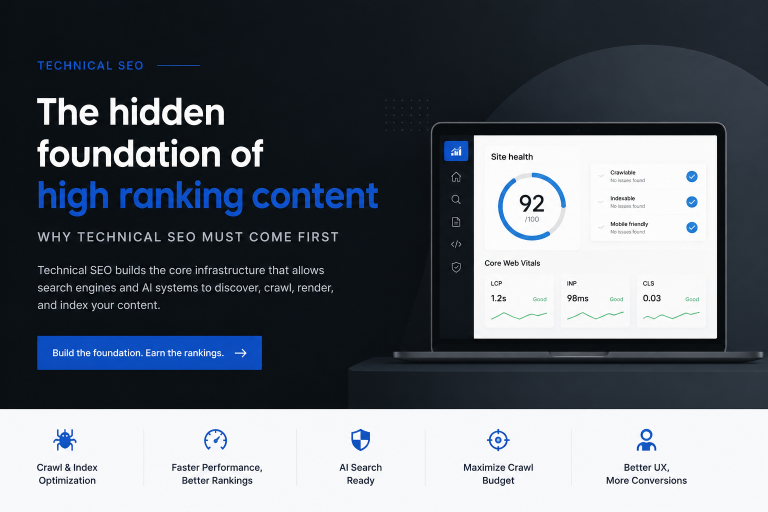
Technical SEO must come first because it builds the core infrastructure that allows search engines and AI systems to discover, crawl, render, and index your content.
In the fast-paced world of performance marketing, there is a constant temptation to skip the boring stuff. Marketers want to write flashy copy or launch aggressive Google Ads campaigns immediately. However, if you are building a long-term organic strategy for industries like taxi companies, immigration lawyers, or app startups, you cannot afford to ignore the bedrock of your website.
Without a technically sound foundation, your expensive content and high-intent landing pages are essentially invisible to Google. At Inteliware Growth, we view technical SEO not as a checklist, but as the critical infrastructure that supports every other growth initiative.
The core reasons
To understand why this discipline takes precedence, we must look at how modern search engines interact with your website. It is a common misconception that Google sees a website the way a human does.
The multiplier effect
Technical SEO acts as a multiplier rather than a standalone ingredient. Great content cannot perform if search bots cannot access or interpret the underlying code.
Why it matters: you could have the most persuasive copy written for a cleaning company, but if your JavaScript is blocking the text from loading for the Googlebot, that content has zero value. Technical SEO ensures your assets, whether they are service pages for immigration lawyers or landing pages for app installs, are accessible. It multiplies the return on your content investment. If your technical foundation is broken, the multiplier is zero.
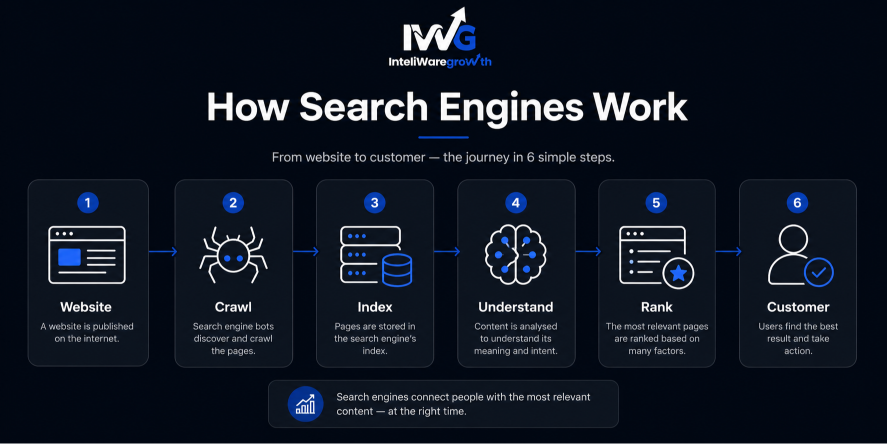
The crawl and index process
Search engines like Google must successfully crawl and render a page before evaluating it for rankings. You can learn more about this process from the Google Search Central documentation.
The reality of bots: think of a search engine as a librarian who must physically walk through the library to catalog books. If the doors are locked (robots.txt blocks), the aisles are dark (unrenderable JavaScript), or the books are scattered (poor site architecture), the librarian cannot do their job. Your pages will remain uncatalogued, meaning they will never appear in the search engine results pages (SERPs). Technical SEO opens the doors and turns on the lights for the crawler.
AI search readiness
Modern discovery tools, such as Google AI overviews and ChatGPT, rely on clean technical layouts, site structures, and metadata to properly cite your pages.
The new frontier: the future of search is generative AI. To be cited by Google's AI overview or scraped by ChatGPT, your content must be semantically clear and technically structured. AI models prefer websites with clear schemas, fast load times, and logical HTML tags. If your technical structure is messy, AI tools will struggle to extract the relevant facts from your pages, leaving you out of the next wave of search traffic.
Resource waste prevention
Fixing structural issues, broken links, and duplicate paths early prevents search engines from wasting limited crawl budgets on low-value pages.
Crawl budget: especially for large sites or directories (like a multi-city taxi service), Google allocates a specific crawl budget. If your site is full of technical errors, like duplicate URLs or infinite loops, Google wastes time crawling junk instead of your money pages. By prioritizing technical fixes, you direct the bot's attention exactly where you want it: on your high-converting service pages. To understand more about crawl budget optimization, check out this guide from Google Developers.
Better user experience
Fast loading speeds, secure HTTPS protocols, and mobile optimization are direct technical factors that benefit both human visitors and ranking algorithms.
Core web vitals: technical SEO and user experience (UX) are now intertwined. If a doctor's website takes 8 seconds to load on a mobile device, patients will bounce back to the search results. Google measures these interactions through core web vitals. A technically optimized site ensures that the user journey from search query to booking a consultation is frictionless.
The business impact: why marketers must care
For a growth agency like Inteliware Growth, the goal is never just traffic; it is conversions. We build growth frameworks for high-intent niches, and technical SEO is the mechanism that supports profitability.
Reducing cost per acquisition (CAC)
When your website is technically sound, your paid and organic efforts work in synergy. For example, if you are running Google Ads for an app startup, sending traffic to a landing page that loads instantly will result in a higher quality score. Google rewards good technical experiences with lower costs per click. Explore our Google Ads management services to see how we combine paid and technical strategies.
Protecting your brand reputation
For regulated industries like immigration law firms or doctors and clinics, trust is paramount. A website that shows not secure warnings or breaks on mobile devices destroys credibility instantly. Technical SEO (specifically SSL certificates and responsive design) ensures your digital storefront exudes professionalism from the first interaction.
The competitive edge in niche markets
In competitive niches like cleaning companies or taxi companies, most local competitors have poor technical foundations. By prioritizing this, you can leapfrog them even if they have more content. It is often easier to fix a technical error than to build a massive content library, yielding faster ranking wins. See how we help taxi companies dominate their local search results.
Common technical SEO pitfalls to avoid
To illustrate the importance of putting this first, let's look at what happens when you ignore it. We often audit sites with the following critical errors.
1. Render-blocking JavaScript
Many app startups use heavy JavaScript frameworks. If the JS is not configured properly, the page appears blank to a bot. Solution: server-side rendering (SSR) or dynamic rendering. For a deeper dive into JavaScript SEO, refer to this resource from Google's JavaScript guide.
2. Poor mobile experience
Google uses mobile-first indexing. If your site is designed for desktop only, you are ranking based on the worst version of your site. This is critical for local services like taxi companies where users are searching on the go.
3. Duplicate content
E-commerce or multi-location sites often accidentally create duplicate title tags or pages. This confuses Google about which page to rank.
How to implement a technical SEO strategy
If you are ready to build your foundation correctly, here is an actionable roadmap.
Step 1: run a full audit
Use tools like Google Search Console, Screaming Frog, or Sitebulb to identify crawl errors, broken links, and orphan pages. For Inteliware Growth clients, this is the audit phase of our 5-step roadmap. We look at the data before making a move. Learn more about our approach to data-driven audits.
Step 2: fix indexation
Ensure your XML sitemap is clean and submitted. Verify that your robots.txt file is not accidentally blocking important scripts or images.
Step 3: optimize site architecture
Your navigation should be logical. For example, a law firm might have services, immigration, spouse visa rather than burying pages 10 clicks deep. Flat architecture spreads link equity and helps bots find content.
Step 4: implement schema markup
This is the secret weapon for AI search readiness. Use local business, FAQ, or service schema. For a doctor's clinic, this allows you to appear in rich results with star ratings and appointment links directly in the SERP. You can find comprehensive schema guidelines at Schema.org.
Step 5: improve core web vitals
Compress images, upgrade hosting, and defer non-critical JavaScript. Speed is a ranking factor. A fast website also improves the ROI of your Google Ads campaigns, as users are less likely to abandon a slow page.
When should you do technical SEO?
The answer is always: yesterday.
If you are launching a new website for an app startup or a law firm, the technical setup is the first step before design and copy. If you are retrofitting an old site, fixing the technical health should precede any new content pushes.
Think of it like building a house. You would not paint the walls or hang the curtains before pouring the concrete foundation. Yet, many businesses write thousands of words of content and spend thousands on ads without ensuring the foundation is solid. For a complete technical SEO checklist, visit Search Engine Journal.
Conclusion
Technical SEO is not just a box to tick; it is the strategic enabler of your entire digital presence. By ensuring your site is crawlable, fast, and structured, you create an environment where high-quality content can thrive and your paid campaigns can convert at a lower cost.
At Inteliware Growth, we do not chase vanity metrics. We build growth frameworks for high-intent industries like taxi companies, immigration lawyers, cleaning companies, and doctors. Our strategy starts deep in the data and technical infrastructure to ensure that when we scale your ads and content, you actually see a return on investment.
Do not let a broken foundation hold back your growth. If you are ready to dominate the search results in your niche, we are ready to help.
Book a free consultation with our team today to audit your technical infrastructure and unlock your site's true potential. Check out our case studies to see real results from our clients.
Frequently asked questions
1. Is technical SEO more important than content?
Technical SEO is the prerequisite. Without it, content cannot be crawled or indexed. They work together, but technical must come first.
2. How does technical SEO affect Google Ads?
A fast, secure landing page improves quality score, lowering your cost per click and improving ad performance.
3. Can AI tools read my website without technical SEO?
AI tools rely on clean structure and schema. Poor technical SEO prevents AI from understanding and citing your content.
4. How long does it take to see results from technical SEO fixes?
Changes can often be recrawled within days, but ranking improvements may take weeks depending on the issue.
5. Do I need technical SEO if I only get leads from referrals?
Yes. Referrals still check your site. A slow or insecure site damages trust and misses branded search opportunities.
Ready to build your foundation?
If you operate a high-intent service business, whether you are a taxi company looking to dominate local search, an immigration lawyer needing qualified leads, or an app startup aiming to scale downloads, Inteliware Growth has the data-driven framework to get you there.
Contact Us
📞 +92 344 3503901
📧 sales@inteliwaregrowth.com
📍 London, United Kingdom