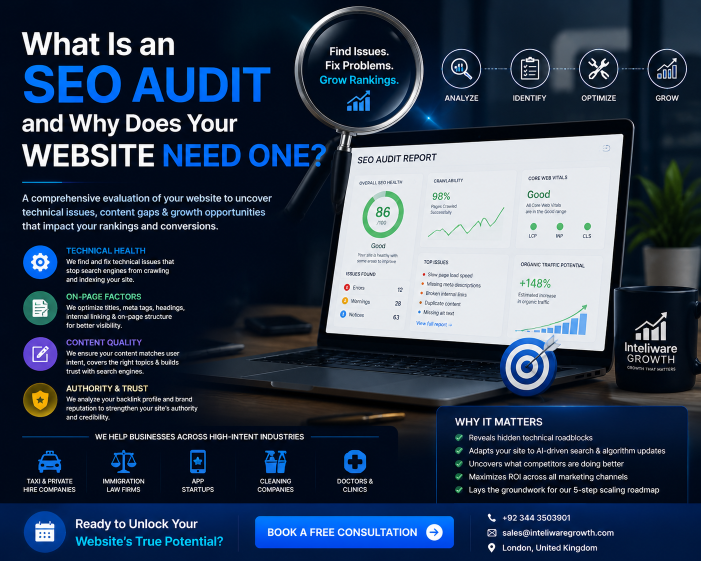
An SEO audit is a comprehensive evaluation of a website to assess its visibility and performance in search engine results. It functions as a health check, pinpointing technical glitches, content gaps, and user-experience issues that prevent a site from ranking higher, while uncovering opportunities to drive more organic traffic.
At Inteliware Growth, we consider this diagnostic work the bedrock of every performance marketing funnel. Before we launch a Google Ads campaign or redesign a landing page for a taxi firm or immigration law practice, we always ask: “Is the website built to convert the traffic it already gets?” The answer comes from hard data, turning a static digital brochure into a lead-generating engine that compounds value over time.
A thorough investigation covers four main areas:
- Technical health: Checks if search engines can effectively crawl and index your site. It reviews speed, mobile responsiveness, Core Web Vitals, HTTPS security, and structured data.
- On-page factors: Evaluates the structure and content of individual pages, including title tags, meta descriptions, header tags, keyword usage, and internal linking.
- Content quality: Assesses whether your material matches user intent, avoids thin or duplicate pages, and covers topics your target audience is searching for.
- Authority and trust: Reviews your backlink profile and overall brand reputation across the web.
Why does your website need one?
Many business owners assume their site is “fine” until they see the report. Here’s exactly what a professional evaluation fixes.
It reveals hidden technical roadblocks
Broken internal links, orphaned pages, or a misconfigured robots.txt file can silently instruct Google to ignore your most important service pages. We’ve seen cleaning companies lose local traffic because their “areas served” pages returned 404 errors, and Immigration law firms whose mobile site speed exceeded 5 seconds—burying their consultation booking page. This kind of analysis surfaces silent killers before they destroy your visibility.
It adapts your site to AI-driven search and algorithm changes
Search engines now surface answers via AI Overviews and generative experiences. Google also releases several core updates each year. A regular check ensures your content is semantically rich enough to be cited as a trusted source. If you ignore the shift toward entity-based search, you hand your traffic to a competitor who’s already optimized for it.
It uncovers exactly what competitors are doing better
A competitor analysis isn’t about copying; it’s about identifying tactical gaps. By studying the keywords rivals rank for and the backlinks they earn, you create a blueprint for market share. A taxi company might be unaware it ranks for “airport transfer guide,” while a rival app startup captures installs through comparison posts that a diagnostic would immediately flag as missing content pillars.
It maximises your ROI across all channels
Paid traffic is powerful but expensive when landing pages leak conversions. Aligning organic health with paid performance is a direct outcome of the process. Sending Google Ads traffic to a slow, confusing page wastes ad spend and erodes Quality Score. Fixing what gets found turns organic rankings into a compounding asset that generates leads even when your PPC budget pauses.
It lays the groundwork for our 5-step scaling roadmap
Our entire approach begins with a deep dive into competitor data, audience intent, and existing funnels. This diagnostic shapes the Strategy, Execution, Tracking, and Scale phases that follow. Without this raw intelligence, your growth plan runs on guesswork. With it, every ad creative and landing page tweak is data-driven.
What exactly does a full evaluation cover?
Let’s dissect each pillar in the context of high-intent service industries.
Technical health
Google cannot rank what it cannot crawl. A thorough check spots broken redirect chains, incorrect canonical tags, and inefficient XML sitemaps. For a doctors’ clinic using a booking plugin, a common finding is that appointment pages are blocked by JavaScript, making them invisible to search engines. Fixing that recaptures local patient searches instantly. We also ensure your most valuable pages—like “Skilled Worker Visa Solicitor”—are no more than three clicks from the homepage.
On-page factors
This goes beyond keyword placement. An assessment analyzes whether your H1 truly matches the search intent behind a query. If someone looks for “cleaning services for Airbnb turnovers” but your page only talks about deep cleaning a family home, you have a costly mismatch. Internal linking also comes under the spotlight: connecting an “app customer acquisition cost” blog post to a conversion case study funnels authority to money pages that drive installs.
Content quality
Thin material destroys trust. A review identifies pages with fewer than 300 words, duplicate meta descriptions, and cannibalizing topics. It also pinpoints content gaps. When we examine a taxi company site, we often find they’ve covered airport transfers but missed “corporate account management” or “accessible ride booking”—queries competitors are owning. Filling those gaps with genuine experience and original data builds the E-E-A-T signals Google demands.
Authority and trust
Not all links are good. Toxic backlinks from spammy directories can trigger manual penalties. An examination of your full link profile flags harmful domains for disavowal and benchmarks your domain authority. It also surfaces unlinked brand mentions—low-hanging fruit for an immediate trust boost.
Common issues uncovered by industry
Each sector has unique failure patterns. Here’s what we routinely spot across Inteliware Growth’s core niches.
- Taxi & private hire companies: Heavy hero videos that wreck Core Web Vitals. Service pages built on images instead of text, preventing Google from understanding location-based availability. For a growth framework built specifically for this vertical, explore our Taxi Companies solution.
- immigration law firms: Bio pages with no schema markup, missing knowledge panel visibility. Legal content that lacks citations to government sources, fatally weakening E-E-A-T for Your Money or Your Life (YMYL) topics. Learn more on our dedicated page for Immigration lawyers.
- App-based startups: Feature-focused blog that ignore “best alternative to [competitor]” queries. Download pages with no deep linking, so organic users drop off before reaching the store. Discover how we scale installs on our App Startups portal.
- Cleaning companies: Near-duplicate location pages that trigger content cannibalization. Missing Google Business Profile integration causing NAP inconsistency. See our tailored approach for cleaning companies.
- Doctors & Clinics: Slow online booking widgets that spike bounce rates. Pages discussing symptoms but failing to link to the clinic’s treatment pages, breaking the conversion path. View our patient acquisition framework for Doctors & Clinics.
How to perform your own check: a 7-step checklist
You can kick-start the process yourself using this streamlined checklist. Each step provides data points a performance marketing agency needs to scale your leads.
- Crawl your entire site: Use a desktop crawler to mimic how Googlebot traverses your domain.
- Semrush exports all broken links, redirect chains, and missing title tags.
- Ahrefs provides a comprehensive site audit with similar detail.The exported file becomes your raw diagnostic.
- Analyse indexing and crawlability: In Google Search Console, compare your XML sitemap pages with what’s actually indexed. A large gap signals low-quality content or technical blocks. Verify robots.txt isn’t disallowing critical folders.
- Audit on-page elements: For your top 10 money pages, check title tags (50–60 characters), unique meta descriptions, and a logical header hierarchy. Ensure your primary keyword appears naturally in the first 100 words and a clear call-to-action is above the fold.
- Evaluate content depth and intent: Classify each page as informational, commercial, or transactional. The format must match the intent—a “consultation booking” page should never read like a generic article. Merge cannibalizing pages and map content gaps against competitors.
- Review backlinks and E-E-A-T signals: Sort referring domains by authority. Flag toxic links and strengthen credibility with clear author bios, accreditations, secure badges, and genuine testimonials.
- Stress-test page experience: Run your most profitable landing pages through PageSpeed Insights. Focus on Largest Contentful Paint (LCP) and Cumulative Layout Shift (CLS). A taxi booking page that jumps during load will always lose stressed travellers.
- Run a competitor content gap analysis: Pick your three closest competitors. Use a gap analysis tool to extract keywords they rank for in the top 10 that you don’t cover. Those keywords become your content roadmap.
Connecting findings to paid performance
Treating organic and paid media as separate silos is a classic mistake. The intelligence gathered should directly influence your Google Ads campaigns. If you discover that “compliant legal case management” is your highest-converting organic page, that page should receive budget priority in paid search. When location-based queries climb in impression share, your PPC geo-bid adjustments must mirror that. At Inteliware Growth, this integration of diagnostic intelligence into paid social and PPC execution creates transparent, scalable ROI.
How we turn the results into a growth engine
We follow a 5-step process built entirely on the intelligence gathered.
- Deep discovery: We go beyond a standard crawl. We map competitor funnels, analyse audience intent with real-time search data, and overlay your conversion metrics to find exact leak points. This isn’t a generic PDF; it’s a strategic attack plan.
- Custom strategy: Using the findings, we build a custom roadmap with specific KPIs—like reducing CPA by 30% for an immigration firm or tripling app installs while lowering CAC.
- Precision execution: Our team launches compliant ad copy, high-converting landing pages, and precise targeting across Google and Meta, every action rooted in the opportunities discovered.
- Transparent tracking: We implement advanced attribution and real-time dashboards so you see exactly which fix drove the most new client enquiries.
- Safe scaling: Once the data confirms a winning formula, we aggressively expand budget and channels. The initial diagnostic becomes the baseline that makes scaling predictable and profitable.
Conclusion
A regular, in-depth website check is far more than a technical checklist. It’s the strategic foundation that aligns your organic presence with user intent, algorithmic reality, and commercial goals. It reveals the invisible errors silently costing you leads, highlights content gaps your competitors don’t want you to find, and provides the actionable data you need to scale paid and organic channels profitably. For service industries operating in high-stakes niches, committing to this review cycle turns your website into a durable asset that compounds trust, visibility, and revenue over time.
Frequently Asked Questions
What’s the difference between an SEO audit and a general website audit? A website audit may cover design, accessibility, and legal compliance, while the search-focused version concentrates strictly on visibility, rankings, and organic traffic performance.
Can I do the work myself without paid tools? You can manually check titles and speed, but a full review requires crawler software to analyse thousands of URLs and backlink databases. Use Google Search Console for indexing insights, but competitive analysis needs professional suites.
How long does a complete check take? A technical crawl finishes in hours, but interpreting data, prioritising fixes, and mapping competitor content gaps typically takes a dedicated analyst several days to a week.
Does a small local business really need a backlink audit? Yes. Local competitors often build low-quality directory links that can harm your rankings by association. A clean link profile helps you dominate the local map pack and AI Overviews.
How does this process improve Google Ads performance? It identifies your fastest, most relevant landing pages. Sending paid traffic there increases Quality Score, lowers cost per click, and improves conversion rates, directly boosting return on ad spend.
Which comes first, the website check or a new design? Always the in-depth review. It provides the structural and content performance data that should inform your redesign’s information architecture, preserving organic equity and preventing traffic loss.
Get your free, no-obligation seo audit today
Stop wondering what’s holding your website back and find out with absolute clarity. Our team will conduct a tailored performance review of your site, identify exactly where you’re losing traffic, and map out the revenue opportunities hiding in plain sight.
Book Your Free Consultation
📞 +92 344 3503901
📧 sales@inteliwaregrowth.com
📍 London, United Kingdom