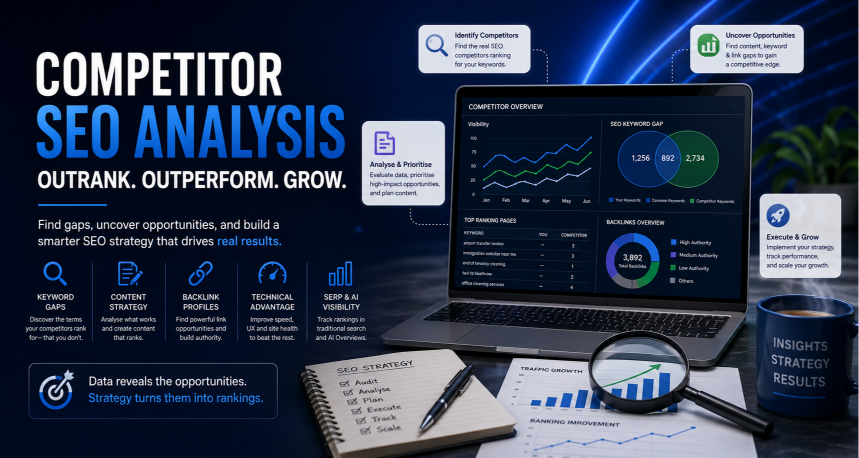
Competitor SEO analysis is the process of researching the websites that rank higher than yours on search engines to uncover their strategies. The goal is to reverse-engineer their success, find content gaps, and identify opportunities to outrank them.
The biggest mistake businesses make is confusing their real-world competitors with their SEO competitors. The sites that outrank you may not sell the same service—they could be directories, publishers, or content aggregators. A proper analysis starts by identifying the right online rivals and understanding exactly why they dominate the search results.
At Inteliware Growth, we’ve refined this process across dozens of high-intent service industries—from taxi fleets to immigration law firms. This guide shows you how to perform the same analysis, step by step, and use the insights to build a ranking strategy that captures measurable growth.
Why competitor SEO analysis matters now more than ever
Search has evolved far beyond ten blue links. AI Overviews, map packs, and video carousels now control page-one real estate. For service businesses that depend on urgent, local intent—like “immigration solicitor near me” or “airport transfer taxi”—visibility across all these surfaces is the key to survival.
When traffic flatlines, the cause is rarely that SEO has stopped working. It’s usually that competitors adapted faster. They built stronger topical authority, filled content gaps, and optimised for AI-driven answers. Competitor analysis reveals exactly where they pulled ahead and what you need to do to catch up.
It also turns SEO into a prioritised investment. Instead of guessing which keywords to chase, you build a ranked list of gaps based on real data. That shift—from hope to data—is exactly how we structure every campaign inside our Google Ads management and organic growth strategies.
Key elements of a competitor SEO analysis
A complete analysis examines several interconnected pillars. Each one reveals a different piece of the ranking puzzle.
Keyword overlap and gaps
Identify the search terms your competitors rank for that your site is missing. This builds a targeted content roadmap. Use a domain comparison tool to pull all queries where a competitor appears in the top 10 and you don’t rank at all.
Focus on low-effort, high-impact terms first. These are keywords where competitors have thin content or weak pages. For a taxi company client, gap analysis uncovered over 80 long-tail airport-transfer phrases no competitor had properly addressed. Dedicated landing pages boosted organic traffic by 214% within five months.
Content quality and strategy
Analyze top-performing competitor pages to understand what search engines reward. Look at format, depth, schema markup, and multimedia use—not just word count. Pages with author bios, FAQ sections, and clear hierarchical structure consistently outperform generic blog posts.
A successful content strategy for Immigration law firms demanded a question-answer-example structure, complete with legal disclaimers and verified solicitor credentials. Replicating that expert-driven format became the backbone of their organic lead generation.
Backlink profiles
Evaluate the quantity and quality of websites linking to your competitors. This shows you where to focus digital PR and link-building campaigns. One government or educational domain link can outweigh dozens of low-quality directory entries.
Map the domains linking to multiple competitors but not to you. These are your most replicable opportunities. For a cleaning company we worked with, earning links from local eco-friendly blog and business directories—places competitors already appeared—created a measurable ranking boost within weeks.
Technical SEO and user experience
Check competitor site speed, mobile-friendliness, and architecture. If their pages load in 1.2 seconds and yours take over 4, even superior content may not close the gap. Google’s Core Web Vitals are direct ranking signals and critical to user experience.
Run both sites through PageSpeed Insights and compare Largest Contentful Paint, Cumulative Layout Shift, and Interaction to Next Paint. Also study their internal linking structure. A logical silo that clusters related pages signals expertise to Google and helps your crawl budget.
AI and SERP visibility
Track how often competitors appear in traditional results and AI-generated answers. AI Overviews can cite a page ranking fourth, effectively stealing position zero. This trend has permanently changed the SERP.
Use rank trackers that differentiate classic web results from AI snapshot citations. Analyse what makes content quotable: concise definitions, bulleted lists, clearly structured data. Optimise your pages to be the most quotable source. Many brands still overlook this, creating a narrow window for first movers.
How to perform a competitor SEO analysis
Drawing from our 5-step growth framework—Audit, Strategy, Execution, Tracking, Scale—here’s a practical workflow.
Step 1: Identify your true SEO competitors
Search the keywords most valuable to your business. Record the domains that consistently appear in the top five organic results. Exclude massive non-service sites that aren’t your direct competition. You should end up with three to five benchmark competitors that are similar in size and scope.
Step 2: Analyse keywords and content gaps
Plug your domain and competitor domains into a keyword gap tool. Filter for terms they rank for (positions 1-10) that you’re missing, queries where they outrank you, and long-tail questions with transactional intent.
Tag each keyword by intent—informational, commercial, transactional, navigational. For service businesses, transactional queries (“book cleaning service London”) deserve immediate attention. Build a prioritised content calendar based on volume, difficulty, and current ranking.
Then dissect the top five pages driving competitor traffic. Note content type, multimedia use, heading structure, trust signals, and schema. Patterns become your on-page upgrade checklist.
Step 3: Dissect backlink profiles
Run a backlink gap analysis against your top two competitors. Target domains linking to them but not to you, prioritised by authority and relevance. Build outreach lists for local newspapers, complementary service providers, and niche directories. Study anchor text distribution—competitors with high exact-match ratios may carry over-optimisation risk.
Step 4: Benchmark technical health and AI visibility
Crawl competitor sites to understand architecture, indexation, and page depth. Compare Core Web Vitals using Chrome UX Report data. Note structured data and technical features they use that you don’t.
For AI visibility, manually search key queries and check which sites get cited in AI Overviews. Track this over time. If a competitor consistently appears, format your top pages with direct, succinct answers and proper semantic markup to increase your chances of being cited.
Step 5: Turn insights into actionable growth
Group findings into Quick Wins, Strategic Investments, and Long-Term Plays. Map every action to a measurable KPI tracked in real-time dashboards.
Tools to streamline your analysis
Using industry-standard platforms makes data extraction and benchmarking efficient. No single tool covers everything, but combining a few trusted solutions gives full coverage.
- Semrush / Ahrefs: For keyword gaps, backlink audits, and rank tracking across traditional and AI features.
- Google Search Console: To see which queries already bring traffic and where reinforcement is needed.
- Screaming Frog: For deep technical crawls and on-page element extraction.
- PageSpeed Insights: To benchmark performance against competitor URLs.
- AI rank trackers: Tools that monitor visibility in AI Overviews and chat-based search.
We combine these with proprietary real-time dashboards so clients see exactly how they stack up against competitors daily.
Turning insights into actionable growth
Data without action is noise. We group findings into three buckets: Quick Wins (implementable in under two weeks), Strategic Investments (content and development resources), and Long-Term Plays (domain authority and structural changes).
Quick Wins—like optimising pages that already rank on page two for gap keywords or fixing broken backlinks—create immediate momentum. Every action maps to a measurable KPI tracked in real-time dashboards.
For doctors and clinics, this often means dominating local search gaps: healthcare directory listings, doctor profile pages with proper schema, and condition-specific content that answers patient questions. For cleaning companies, the focus shifts to service-plus-location pages and building local blogger relationships that competitors already leverage.
Common pitfalls to avoid
- Copying blindly: Reverse-engineer, don’t replicate. Your unique value must still shine through.
- Ignoring intent mismatches: Not every high-volume keyword a competitor ranks for will convert for you. Validate intent before investing.
- Neglecting AI visibility: If you’re not optimising for AI answers, you’re leaving a growing share of clicks on the table.
- One-and-done analysis: The SERP changes daily. A monthly light review and deep quarterly audit keep you ahead.
How Inteliware Growth builds on competitor insights
Competitor SEO analysis isn’t a one-off report at Inteliware Growth—it’s the engine of our five-step client framework. During the Audit phase, we study intent, funnels, and missed conversion opportunities. Strategy builds a KPI-linked roadmap with channel forecasting. Execution launches landing pages and high-converting content across paid and organic. Tracking delivers transparent, real-time dashboards so you see exactly which competitor-held terms are now yours. Finally, we Scale by doubling down on winning data.
This approach has helped taxi fleets, immigration solicitors, App Startups, and medical clinics systematically outperform larger, slower rivals. It’s a repeatable process rooted in transparency and a relentless focus on ROI.
Contact Us
📞 +92 344 3503901
📧 sales@inteliwaregrowth.com
📍 London, United Kingdom
Frequently Asked Questions
What is the difference between competitor SEO analysis and regular competitor research?
Regular competitor research looks at business models and pricing. Competitor SEO analysis specifically examines organic search performance—keywords, backlinks, content, and technical signals—to understand how rivals earn rankings and traffic.
How often should I perform a competitor SEO analysis?
A light monthly review catches new entrants and quick wins. A comprehensive deep dive each quarter aligns with algorithm updates and shifting AI search features.
Why do AI Overviews matter in competitor analysis?
AI Overviews can cite pages that don’t hold the traditional top spot. If a competitor appears as the source in AI-generated answers, they capture clicks even from lower organic positions. Tracking this visibility helps you fight for that new, highly valuable real estate.