Content marketing is a strategic marketing approach focused on creating valuable, relevant, and consistent content. Its goal is to attract and engage a clearly defined audience. At Inteliware Growth, we see it as a direct revenue engine, not just a buzzword.
The formal definition comes from the Content Marketing Institute, but performance demands more. When executed with a performance mindset, content marketing becomes a predictable growth lever. It generates qualified leads and feeds directly into paid advertising and CRO.
This guide covers what content marketing really means for service businesses. You’ll learn the core types of content that drive measurable results. We’ll also show you how to build a strategy that delivers real ROI, not just vanity metrics.
Why Most Definitions Fall Short
Many businesses fail because they stop at “attract and engage” and never connect content to a sale. They publish blog nobody reads and post on social media without a plan. Engagement alone doesn’t pay the bills for a taxi firm, immigration lawyer, or clinic.
You need a framework where every piece of content ties to a measurable business outcome. That shift turns content from a cost centre into a predictable growth channel. At Inteliware Growth, we apply the same data and intent-mapping rigour we use for Google Ads.
Content Marketing vs Traditional Advertising
Traditional advertising interrupts and asks for the sale immediately. Content marketing attracts, educates, and builds a relationship over time. One is pushed; the other pulls consumers in when they need help. Advertising spend stops when your budget stops. Content assets keep working for months or years, compounding in value. When you combine both, you get lower ad costs and higher conversion rates.
Why It Matters for High-Intent Service Businesses
Even a person urgently needing a taxi or a lawyer consumes content before deciding. They read a guide, check reviews, or compare pricing. If you’re not providing those answers, your competitor is.
Great content builds the trust and authority that makes your paid ads cheaper. It improves your Google Quality Score and boosts organic rankings. For YMYL niches like law and healthcare, demonstrating E-E-A-T is essential, as Google’s Search Quality Rater Guidelines explain.
Content assets are also endlessly reusable. Turn a case study into social proof for a landing page or ad copy.This leverage lowers your overall customer acquisition cost dramatically.
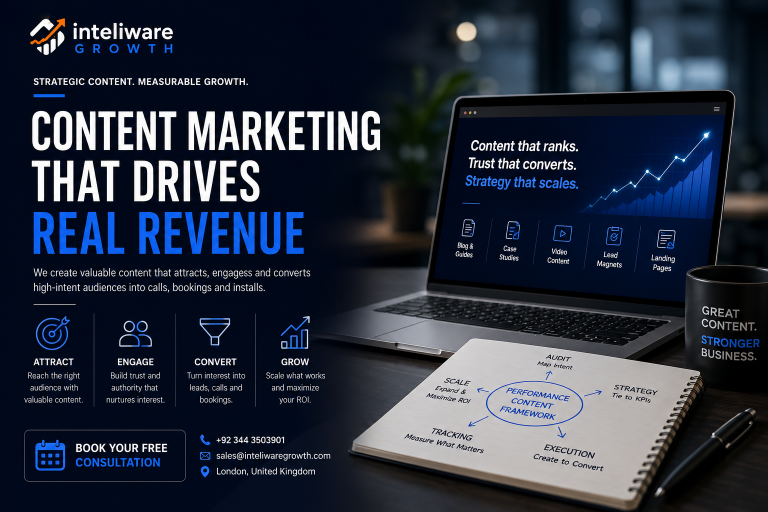
Our Performance Content Framework
- Audit — Map audience intent and competitor gaps
- Strategy — Build a content roadmap tied to KPIs
- Execution — Create high-converting pillar pages, case studies, and lead magnets
- Tracking — Measure leads and revenue, not just traffic
- Scale — Expand winning content across channels
The Performance Content Framework: Audit → Scale We apply our proven 5-step growth roadmap directly to content marketing. It ensures every piece works as hard as your paid ads. Here’s how it breaks down.
1. Audit: Map Intent, Not Just Keywords We dive deep into competitor data, audience intent, and your existing funnel.This identifies the exact questions your customers ask at every buying stage.It also reveals content gaps you can own to capture high-intent traffic.
2. Strategy: Build a Roadmap Tied to KPIs We tie every planned guide, video, or article to a specific business goal.That could be a phone call, a form fill, an app install, or a booked appointment.The roadmap clusters topics to dominate your niche, not just random posts.
3. Execution: Create Content That Converts We blend creative copywriting with direct-response principles that drive action.Headlines answer the query immediately, and clear CTAs point to your services.Schema markup and scannable formatting help both users and search engines.
4. Tracking: Measure What Actually Matters We track phone calls, form fills, and assisted conversions – not just pageviews.Custom dashboards show clients exactly how content is generating revenue.This transparent measurement turns content into an optimisable acquisition channel.
5. Scale: Expand What Works, Kill What Doesn’t Once a piece of content proves it can generate leads, we rapidly scale it.We turn it into a video ad, a lead magnet, or a retargeting audience.This data-driven expansion maximises ROI from your best-performing assets.
Content Types That Drive Real Results
Pillar Pages & Ultimate Guides These comprehensive resources build topical authority and attract backlinks. An immigration firm might publish “The Complete Guide to UK Work Visas 2025.” It becomes a hub that links out to all your detailed service pages.
Case Studies & Success Stories Nothing converts like proof. We create case studies showing specific results. Example: “How We Increased Taxi Ride Bookings by 340% in 90 Days.” These are sales gold for bottom-of-funnel ads and direct email outreach.
Service-Specific Landing Pages Every service line needs a content-rich page that answers common questions. We structure them to showcase credentials, reviews, and clear next steps. This satisfies Google’s E-E-A-T signals while driving visitors to enquire.
Video Content Short explainer and testimonial videos dramatically increase on-page engagement. They can also be repurposed for YouTube and social media ad campaigns. Video builds a personal connection faster than text alone.
Downloadable Lead Magnets Checklists, pricing guides, and reports capture emails from high-intent prospects. A cleaning company might offer a “Commercial Cleaning Cost Guide.” These leads enter a CRM sequence, turning content into a direct pipeline.
How to Create Content That Ranks and Converts
Answer the user’s question immediately in the first 100 words. Use simple, jargon-free language that a busy business owner understands instantly. Add original value with real examples, unique frameworks, or proprietary data. Make every piece incredibly easy to scan. Use descriptive subheadings, short paragraphs, bold text, and bullet points. Link out to credible sources like HubSpot’s annual research to back up claims.
Integrating Content with Paid Ads and CRO
A user reads your guide on taxi licensing but isn’t ready to book yet. We retarget them with a Facebook ad offering a free fleet growth consultation. The trust is already built, so conversion rates are dramatically higher.
Content also directly informs our ad copy and landing page optimisation. If a blog about “hidden visa fees” gets high engagement, we’ll test that language in ads. This synergy makes both your organic and paid channels more efficient.
For App Startups, content attracts users researching the problem your app solves. Those readers become custom audiences for cost-effective app install campaigns. This integrated model significantly cuts your Customer Acquisition Cost (CAC).
Content Marketing for Your Industry
Taxi & Private Hire Companies Focus: Convert local search intent into ride requests and app downloads. Content: “Airport Transfer Guide,” local SEO pages, and video testimonials. Conversion Mechanism: Embedded booking widgets and click-to-call buttons.
Immigration Law Firms Focus: Compliant, low-cost lead generation for high-value legal services. Content: Pillar guides on visa types, FAQ-rich answers, and success stories. Conversion Mechanism: Free eligibility assessment forms and live chat prompts.
App-Based Startups Focus: Profitable user acquisition and scaling app installs intelligently. Content: Use-case guides, competitor comparisons, and product roadmap updates. Conversion Mechanism: In-content app store links and retargeting for installs.
Cleaning Companies Focus: Lead generation for both one-off domestic and recurring commercial jobs. Content: “End of Tenancy Checklist,” office cleaning cost guides, and local pages. Conversion Mechanism: Instant quote calculators and prominent “Book Now” buttons.
Doctors & Clinics Focus: Patient acquisition and local appointment booking with trust. Content: Procedure explainers, symptom-based guides, and practitioner profiles. Conversion Mechanism: Online appointment schedulers and “Ask a Doctor” chatbots.
Common Content Marketing Mistakes to Avoid
Don’t publish without a distribution plan; your content won’t get seen. Always match the format to the search intent – a blog isn’t always the answer. Every piece needs a clear next step, even if it’s just reading another article. Avoid the “set and forget” trap; refresh old posts with new data and insights. Never obsess over vanity metrics like traffic; always tie content back to revenue. These simple discipline fixes often yield the fastest performance improvements.
How to Get Started Today
- Identify the one asset your sales team needs most right now.
- Interview five recent customers and answer their exact pre-purchase questions.
- Set up proper tracking with UTMs and conversion events in GA4.
- Write for humans first, then layer on SEO best practices naturally.
- Repurpose and distribute that asset across email, social, and paid ads.
- Review after 90 days, identify what drove leads, and adjust your plan.
If you want expert guidance, Inteliware Growth builds these frameworks daily. We audit your current content, identify quick wins, and execute a full roadmap. It’s all aligned with transparent, real-time reporting and your revenue targets.
Frequently Asked Questions (FAQs) ** What is content marketing in simple words? It means creating helpful articles, videos, and guides that attract your ideal customers. Instead of selling directly, you build trust so they choose you when ready. It’s a pull strategy rather than a pushy ad.
How is content marketing different from advertising? Advertising pushes a message to an audience who might not be looking for you. Content marketing pulls in an audience by answering their questions or solving problems. The most effective strategies use both together for maximum impact.
Why is it important for small businesses? It levels the playing field against larger competitors with bigger ad budgets. A well-written local service page can bring in leads for years without ongoing spend. It also builds credibility that a standalone ad cannot match.
What content types generate the most leads? Case studies, comparison guides, and cost calculators convert exceptionally well. In local services, a content-rich landing page with strong CTAs is essential. These address bottom-of-funnel questions that signal buying intent.
How do you measure content marketing ROI? Track the number of calls, form fills, or bookings each piece generates. Compare the revenue from those leads to the cost of creating the content. Use call tracking, GA4 events, and CRM attribution to connect the dots.
How often should we publish? A single in-depth, high-quality article each month outperforms four rushed weekly posts. Consistency matters, but depth and user value are what win rankings and trust. Never sacrifice quality just to hit an arbitrary publishing cadence.
Can content marketing work with a limited budget? Absolutely. Start by updating existing content and turning FAQs into blog posts. Repurpose sales call insights directly into articles that answer real customer doubts. Even one excellent asset can generate leads for many months.
Conclusion
A Growth Investment, Not an Expense* Content marketing is the most scalable, compound-return activity a service business can invest in. It builds the authority that makes your ads more effective and captures demand when it matters. At Inteliware Growth, we insist on content that directly drives calls, bookings, and installs.
We don’t create content for content’s sake. We create it to fuel a transparent, measurable growth machine for your business. Whether you run a taxi firm, a law practice, or a startup, our framework delivers.
Ready to turn your content into a predictable revenue driver? Let’s start with a free, no-obligation consultation. We’ll audit your current approach and show you exactly where the growth opportunities are hiding.
Ready to Turn Content into Revenue?
We help service businesses create content that ranks and converts.
Contact Us
📞 Phone: +92 344 3503901
📧 Email: sales@inteliwaregrowth.com
📍 Location: London, United Kingdom