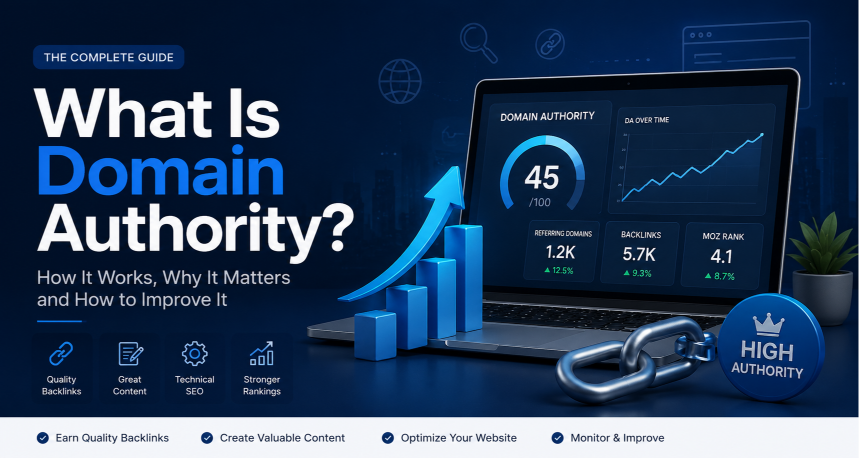
Domain Authority (DA) is a search engine ranking score that predicts how likely a website is to rank on search engine results pages (SERPs). Developed by SEO software company Moz, it is measured on a scale from 1 to 100, with higher scores indicating a greater, more competitive ability to rank.
In this guide, we’ll break down exactly how DA works, how to check and improve it, and why it matters for niche service businesses. Whether you run a local taxi firm, a medical clinic, or an immigration law practice, understanding Domain Authority will help you build a stronger digital presence that attracts more clients and revenue.
How it works and what it measures
The score
DA is calculated by evaluating multiple factors, primarily the number and quality of inbound links (backlinks) pointing to a website. Moz’s algorithm looks at linking root domains and how authoritative those domains are. It then uses a machine learning model to compare your site’s backlink profile against thousands of actual search results.
Comparative metric
Domain Authority is a relative metric rather than an absolute one. A score of 50 is not “average”—it indicates how authoritative your site is compared to the specific competitors in your niche. A local cleaning company with a DA of 35 might be outperforming every rival in its city, while the same score would be low for a national news outlet. Context is everything.
Not an official Google factor
Google does not use Domain Authority as a direct ranking factor. No third-party metric directly influences Google’s algorithm. However, a higher DA strongly correlates with better search engine visibility because the factors that boost DA (quality backlinks, strong content, good site structure) also happen to be what Google rewards.
Typical score ranges
While a “good” score ultimately depends on your direct competitors, Domain Authority scores generally fall into these categories:
- 1–20: Low authority (usually new or very small sites)
- 21–40: Moderate authority (growing small-to-mid-sized businesses)
- 41–60: Strong authority (well-established sites with solid backlink profiles)
- 61–80: Very high authority (large brands, major media outlets)
- 81–100: Exceptional authority (industry titans like Wikipedia or YouTube)
For most niche service businesses—think an immigration law firm or a doctor’s clinic—a DA in the 25–35 range is often healthy and competitive, especially when paired with strong local SEO and a well-optimized website.
How to check it
You can check the authority of your website—or your competitors’ sites—by using the free Moz Domain SEO Analysis tool. Simply enter your URL and you’ll get your DA score alongside other valuable metrics.
Another widely used alternative is Ahrefs’ Domain Rating (DR). It focuses heavily on the quantity and quality of referring domains, and you can explore its methodology on the official Ahrefs Domain Rating glossary page. Tracking your DR over time gives you a slightly different perspective on your link profile strength.
Semrush Authority Score (AS) is a third metric worth monitoring. It factors in backlinks, organic traffic estimates, and even potential spam indicators. Because each tool uses a unique formula, pick one as your primary benchmark and stick with it for consistent trend analysis.
Alternative tools:
How to improve your Domain Authority
Improving your DA is a long-term project that requires consistent effort across several areas of SEO. Here are the most impactful strategies.
1. Earn high-quality backlinks
The single most important factor in DA is the quality and quantity of linking root domains. Research consistently shows the strong correlation between referring domains and higher rankings; for example, an extensive study by Backlinko confirmed that the number of domains linking to a page remains one of the strongest ranking signals. Focus on earning links from reputable, industry-relevant websites. Tactics include guest posting on respected blog, getting featured in local news outlets, and creating resources that others want to cite.
2. Create link-worthy content
Publish original research, in-depth guides, or tools that solve real problems for your audience. A well-researched article or a handy calculator naturally attracts links over time. For service industries, detailed “howto” guides, pricing comparisons, and local market reports work exceptionally well. If you need inspiration for content that earns links, browse the ideas we share regularly on our SEO and marketing blog.
3. Optimize on-page SEO
Moz also considers your overall SEO health. Ensure your title tags, meta descriptions, header tags, and content are fully optimized. Use descriptive alt text for images, and make sure your site is mobile-friendly and fast-loading. These signals indirectly strengthen your link profile by improving user experience.
4. Fix technical SEO issues
Crawl errors, broken links, duplicate content, and poor site architecture can drag your DA down. Conduct regular technical audits using tools like Google Search Console or Moz Pro, and fix issues promptly. A clean, well-organized site gives search engines a clear path to index your pages.
5. Monitor and disavow toxic links
Not all backlinks are helpful. Spammy or low-quality links from irrelevant sites can harm your site’s perceived authority. Use Moz’s Link Explorer or Google Search Console to identify suspicious links, and if necessary, submit a disavow file. However, use disavowals sparingly—Google is generally good at ignoring low-quality links on its own.
Improving DA takes time and patience. Avoid shortcuts like buying links or participating in link schemes; these can result in penalties that are far harder to recover from.
Domain Authority vs. Other SEO metrics
Domain Authority often gets confused with other scores. Here’s how it differs.
- Domain authority (DA) vs. Page authority (PA): DA measures the entire domain’s strength, while PA predicts how well a single page will rank. A new blog post on a high-DA site can inherit some authority, but its own PA starts lower.
- Da vs. Domain rating (DR) (Ahrefs): DR also looks at backlinks but focuses more on the total number of unique referring domains and their DR scores. The numbers can differ significantly because of the calculation methodology.
- Da vs. Authority score (AS) (Semrush): AS considers backlinks, website traffic estimates, and other on-page factors. It can fluctuate more rapidly than DA.
Each metric serves a slightly different purpose, but all point to the same truth: the quality and quantity of links you earn matter enormously for organic visibility.
Why Domain Authority matters for niche service industries
If you run a service business—like a taxi company, a cleaning service, or a healthcare clinic—you compete primarily on a local level. Here, a respectable Domain Authority gives you an edge in every direction.
Taxi & private hire companies: Local search is the lifeblood of your bookings. A strong DA helps your site outrank competitors for terms like “taxi near me” or “airport transfer London.” Combined with a well-managed Google Business Profile, your authority signals trust to both search engines and potential riders. Learn about our tailored strategies for Taxi Companies.
Immigration law firms: Trust is everything in legal services. A higher DA often reflects years of publishing credible, accurate content that other legal sites, news outlets, and government pages link to. This not only improves your visibility for high-intent queries but also reassures anxious clients that you are a legitimate, established practice. See our work with Immigration law firms.
Doctors & clinics: Patients search for symptoms, treatments, and nearby providers. A solid DA means your health content ranks well, driving appointment bookings. Moreover, many health directories link to credible clinic websites, naturally boosting your authority. Explore how we help Doctors & Clinics grow.
Cleaning companies: Higher authority combined with a tight local SEO strategy can drive a steady flow of leads. When your site is seen as trustworthy, potential clients are far more likely to book. Discover our solutions for cleaning companies.
App startups: Building authority helps app-based businesses scale installs more profitably by improving organic discovery and reducing reliance on paid channels. Read about our growth playbooks for App Startups.
Ultimately, DA is not just a vanity metric. It reflects the cumulative effect of good SEO habits that drive real business results—more calls, more bookings, and more revenue.
Common misconceptions about Domain Authority
Even experienced marketers sometimes misunderstand DA. Let’s clear up a few persistent myths.
- Myth 1: da is a Google ranking factor. Google does not use DA or any third-party metric in its algorithm. John Mueller, Google’s Search Advocate, has explicitly stated that Domain Authority is not used by Google for ranking. DA is a predictive score created by Moz. While it correlates with rankings, it’s an indicator, not a direct cause.
- Myth 2: A high DA guarantees top rankings. A high DA helps, but it’s not a magic ticket. On-page relevance, content quality, user experience, and competition still dictate where you rank for specific queries. A site with DA 70 can still lose to a DA 40 site if the latter’s page perfectly matches the search intent.
- Myth 3: DA can be improved overnight. Building genuine authority takes months or years. Any service promising a quick DA boost is likely using black-hat tactics that could harm your site in the long run. Sustainable growth comes from consistently earning quality links and improving your site’s SEO fundamentals.
- Myth 4: Your DA dropping is always a penalty. DA naturally fluctuates as Moz updates its index and as the link profiles of other sites change. A small drop doesn’t mean you were penalized. It often just means another site in your space grew faster or a few old links were lost. Monitor trends over several months before panicking.
Frequently Asked Questions
Is Domain Authority the same as Google PageRank? No. PageRank was Google’s original algorithm for ranking pages, which is no longer publicly available. Domain Authority is a third-party metric from Moz that predicts how likely a domain is to rank, based largely on backlinks.
How often does Domain Authority update? Moz updates Domain Authority scores roughly every 3–4 weeks. The frequency can vary based on the size of their link index refresh. You can use Moz Pro to monitor changes over time and spot meaningful trends.
Can a new website have a high Domain Authority? A brand-new site typically starts with a DA of 1. It can climb relatively quickly if it earns links from powerful, authoritative domains early on, but reaching scores above 40 usually requires months of consistent effort and link acquisition.
Should I focus on DA or just create good content? Both go hand in hand. Great content naturally attracts links, which boosts DA. Think of DA as a lagging indicator of your content marketing and outreach efforts. Prioritize solving your audience’s problems with high-quality resources, and your DA will follow.
Does a higher DA improve paid advertising performance? Indirectly, yes. A site with strong authority often provides a better user experience and is seen as more trustworthy.
Contact Us
📞 +92 344 3503901
📧 sales@inteliwaregrowth.com
📍 London, United Kingdom