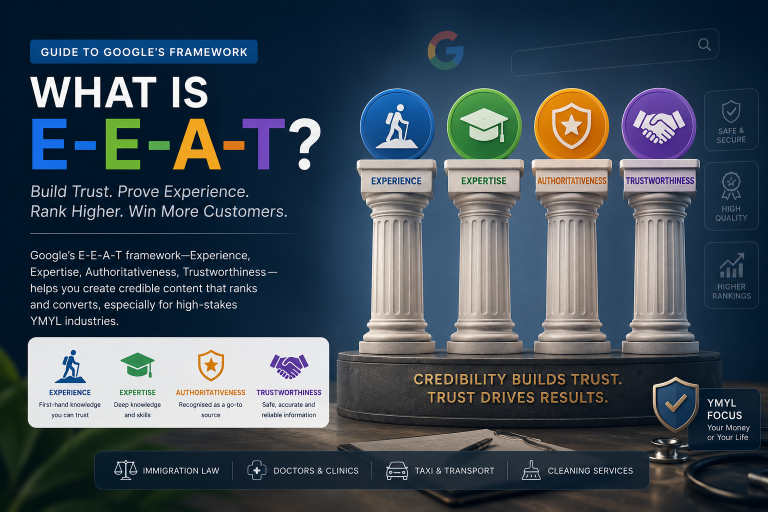
E-E-A-T is a crucial quality framework Google's search algorithms use to evaluate the credibility and usefulness of online content. It stands for:
- Experience: Demonstrating first-hand or personal involvement with the subject matter (e.g., actually using a product, visiting a place, or living through an experience).
- Expertise: Possessing the necessary skill, knowledge, or credentials in a specific topic.
- Authoritativeness: Being recognised as a go-to source or an industry leader by other experts and users.
- Trustworthiness: The most critical component; ensuring the information is honest, safe, secure, and accurate.
Google originally used E-A-T but officially added Experience in late 2022 to penalise generic, rehashed content and reward creators with real, practical knowledge.
You can explore a detailed breakdown in Semrush’s guide.
This framework is especially important for Your Money or Your Life (YMYL) topics like finance, health, and law, where poor advice can directly impact a user’s well-being or wealth.
At Inteliware Growth, we see E-E-A-T not as abstract SEO theory but as the conversion engine behind every successful campaign for high-intent service industries. When you’re driving leads for an immigration law firm, a doctor’s clinic, or a taxi fleet, credibility is everything. This guide breaks down exactly what E-E-A-T means and how to make it work for your business.
Breaking down the four pillars of E-E-A-T
Experience: Prove you’ve walked the walk.
This means the content creator has actually done, used, or lived through the subject. A review from someone who genuinely stayed at the hotel, a guide written by an immigration solicitor who has handled real cases – these demonstrate experience. Without it, content feels hollow.
Expertise: Show you have the knowledge.
For YMYL topics, this often requires formal qualifications or a proven professional track record. For non-YMYL topics, everyday expertise counts. The key is depth of knowledge that goes far beyond surface-level summaries.
Authoritativeness: Be the source others cite.
This is about your broader reputation. Do respected industry bodies link to you? Do other experts reference your work? Authority is essentially your digital standing in the community.
Trustworthiness: The non-negotiable foundation.
Trust includes website security (HTTPS), clear contact details, transparent privacy policies, accurate content, and honest claims. If users can’t trust you, nothing else matters. Think of these four components as legs on a stool – one weak leg, and the whole structure wobbles.
Why E-E-A-T matters for rankings and revenue
E-E-A-T is not a direct ranking factor you can measure in a dashboard. Instead, it’s a concept that shapes how Google’s algorithms are trained and how human quality raters evaluate search results. Those evaluations, in turn, refine the ranking systems. Aligning with E-E-A-T strongly correlates with higher visibility, especially for competitive, high-stakes queries.
For YMYL niches, E-E-A-T is make-or-break. A generic blog about visa appeals with no legal credentials could cause real harm. Google rewards sites that prove they are safe, expert, and authoritative. At Inteliware Growth, we specialise in YMYL-adjacent industries where accuracy and trust are absolute necessities. Weak E-E-A-T in these spaces means zero conversions, because users instantly sense a lack of trust.
Crucially, E-E-A-T also drives conversions, not just traffic. A clinic website with detailed practitioner bios, real patient testimonials, and clear safety information turns visitors into booked appointments. It’s a ranking consideration and a conversion rate optimisation (CRO) powerhouse in one.
The shift from E-A-T to E-E-A-T why google added experience
In December 2022, Google updated its Search Quality Rater Guidelines to put Experience front and centre.
Google’s official post on the E-E-A-T update confirms this was a direct response to the surge of AI-generated, second-hand content that could mimic expertise but lacked real-world grounding.
An article on ride-hailing apps for wheelchair users now needs to show the author has firsthand experience, not just aggregated facts.
The practical takeaway: you can’t simply summarise top-ranking pages. You must inject real case studies, original data, unique photos, and personal insights. At Inteliware Growth, we embed this by showcasing real driver feedback, anonymised case results, and genuine process walkthroughs – the exact kind of experience signal Google rewards.
E-E-A-T and YMYL why credibility is non-negotiable
If your website advises on visa applications, medical symptoms, or financial investments, low-quality content can cause tangible harm. Google’s raters assign Page Quality ratings that consider the potential for harm. A low rating on a YMYL page can suppress an entire domain’s visibility.
For Immigration Lawyers, we build strategies around accredited solicitors, transparent case timelines, and authoritative links from legal directories.
For Doctors & Clinics, every landing page highlights practitioner registrations (GMC/NMC), genuine patient outcomes, and secure appointment forms.
Even for a Cleaning Company, real before-and-after photos, verified reviews, and insurance details transform a generic site into a lead magnet.
E-E-A-T applies to any business where a customer’s property, safety, or peace of mind is at stake.
How google’s quality raters evaluate E-E-A-T
Thousands of human raters use a publicly available handbook to assess sample search results. They don’t directly change live rankings, but their feedback trains Google’s core algorithms. They research the reputation of the website and content creator, check author bios, verify factual accuracy, and hunt for signs of real experience.
Signals they actively look for include:
- Clear author identity and credentials
- Easy-to-find contact information and customer service details
- Secure connection (HTTPS) and a clear privacy policy
- Positive reputation on platforms like Trustpilot, Google Business Profile, or industry bodies
- Citations and references from trusted sources
At Inteliware Growth, we build these signals directly into every landing page and ad campaign, knowing that algorithmic interpretation of E-E-A-T begins with human-visible trust elements.
7 Actionable ways to strengthen your E-E-A-T
1. Showcase first-hand experience generously.
Use original photos of your team, real screenshots of results, and case studies that walk through specific challenges. Avoid stock imagery that screams template.
2. Build detailed author and entity bios.
Every piece of content needs a visible author byline linked to a comprehensive bio. Include qualifications, years of experience, and links to professional profiles.
3. Earn authoritative backlinks and brand mentions.
Create original research, useful tools, or definitive guides that attract links from gov, edu, and leading industry publications.
For an App Startup, a mention on a respected SaaS review site signals real authority.
4. Prioritise transparency and trust signals.
Display your physical address, phone number (+92 344 3503901), and email (sales@inteliwaregrowth.com) prominently. Include a clear privacy policy, terms of service, and professional accreditations. HTTPS is the baseline.
5. Leverage customer reviews and detailed case studies.
Independent reviews provide third-party validation. Publish in-depth case studies that reveal your methodology. We equip clients with real-time dashboards – a living trust signal.
6. Create comprehensive, factually accurate content. Cover topics in full and cite credible external sources like the Search Quality Rater Guidelines. Thin content erodes trust.
7. Keep content fresh and updated.
Outdated advice can be harmful. Regularly review key pages and display the last updated date. This signals accuracy and ongoing maintenance.
Quick myths vs reality
- Myth: E-E-A-T is a direct ranking factor.
Reality: There’s no score. It’s a framework that trains the algorithm. Strong E-E-A-T correlates with success. - Myth: Only YMYL sites need it.
Reality: Every site benefits. A recipe blog with real cooking process photos will outperform a text-only version. - Myth: Adding an author box is enough.
Reality: An author box without verifiable credentials and a real reputation is empty. Google wants genuine depth.
How inteliware growth builds E-E-A-T into performance marketing
We treat E-E-A-T as the architecture of a conversion machine. Our 5-step roadmap amplifies authority at every stage:
- Audit: We map E-E-A-T gaps – missing bios, weak review profiles, thin content.
- Strategy: We craft a plan that showcases real-world experience and third-party validation.
- Execution: We launch campaigns and landing pages rich in trust signals and original proof.
- Tracking: We monitor engagement metrics that signal user confidence, not just clicks.
- Scale: We expand only when the trust framework is solid, so growth never dilutes credibility.
Real outcomes from an E-E-A-T-first approach: A private medical clinic we partnered with struggled to convert traffic because their site lacked practitioner credentials and patient success stories. We revamped their landing pages with GMC-registered bios, video testimonials, and a clear privacy policy. Organic appointment bookings rose by 47% within 90 days.
For a taxi company, we ensure real driver photos, licensing badges, and live booking credibility are front and centre. That kind of trust signal directly lifts both rankings and ride requests.
An immigration law firm we worked with moved from anonymous content to bylined articles by named solicitors, supported by transparent fee structures. Paid search conversion rates more than doubled. These results happen when E-E-A-T becomes strategy, not an afterthought.
Frequently Asked Questions
What does E-E-A-T stand for?
Experience, Expertise, Authoritativeness, and Trustworthiness – Google’s framework for assessing content credibility.
Is E-E-A-T a direct ranking factor?
No, but it heavily influences the algorithms that determine rankings, especially for YMYL queries.
How do I show experience?
Share original photos, case studies, process walkthroughs, and personal anecdotes. Prove you’ve done it, not just researched it.
Why is trust the most critical part?
Without trust, even great expertise is useless. Trust encompasses accuracy, safety, and transparency.
Ready to turn your credibility into predictable revenue?
Book Your Free Consultation
Contact Us
📞 +92 344 3503901
📧 sales@inteliwaregrowth.com
📍 London, United Kingdom