The way people search on Google is undergoing its most radical shift in two decades.
If you’ve recently typed a question into Google and received a neat, AI-generated summary box right at the top of the results, you’ve encountered a Google AI Overview.
This isn’t just a minor tweak to the search engine results page (SERP). It’s a fundamental change in how information is delivered—and how potential customers find your taxi company, immigration law firm, clinic, or app.
For businesses that rely on search visibility to generate high-intent leads, understanding this feature isn't optional. It's the new battleground for organic traffic and the context in which your paid ads now exist.
At Inteliware Growth, we’ve been rigorously analyzing the impact of AI Overviews on our clients’ performance across niche service industries. This guide breaks down exactly what Google AI Overviews are, how they work, and, most importantly, how your business can adapt its marketing strategy to thrive.
What Are Google AI Overviews?
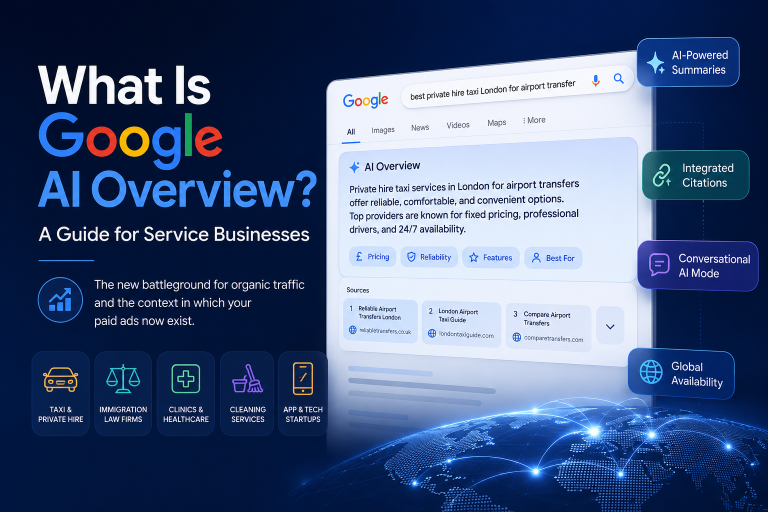
Google AI Overviews are generative summaries powered by the Gemini model that appear at the top of search results. They synthesize information from multiple web sources to answer your queries directly, allowing you to quickly understand complex topics without clicking through numerous links.
Think of them as a supercharged version of the old “featured snippet.” Instead of pulling a single block of text from one page, the AI reviews the web to generate a multi-dimensional, original summary.
It’s a conversational, digestible answer to your question, built in real-time. For a user planning a trip, a query like “best time to visit London and weather tips” might generate an overview comparing seasons, packing advice, and a quick temperature chart.
But what if the query is “best private hire taxi London for airport transfer” or “requirements for UK spouse visa 2025”? That’s where the stakes for your business skyrocket.
How Do AI Overviews Work?
Understanding the mechanics behind the feature is the key to making it work for you. The process relies on a few interconnected components:
- Synthesized, Multi-Source Answers: Instead of just extracting a single snippet, Google’s Gemini model scans and interprets content from a variety of high-authority websites. It then generates a summary that blends these perspectives into a coherent, holistic answer.
It’s not copying; it’s synthesizing. According to Google’s official guidance on AI Overviews and your site, this design helps users “unlock the power of the web” by distilling insights from multiple pages rather than a single source.
- Integrated Citations and Links: Crucially, the overview isn't a black hole for traffic. The generated text includes embedded links or a dropdown arrow that reveals the specific websites used to formulate the answer.
As Google notes on its own AI Overviews information page, these links help you “quickly go to the websites that were used to generate the overview.”
For businesses, this is a lifeline. Earning a citation in an AI Overview can drive highly qualified traffic, positioning your brand as the definitive source Google trusts.
- Conversational AI Mode: At the bottom of an AI Overview, you’ll often see a “Show more” prompt or an option to ask a follow-up question. This activates AI Mode, a conversational interface where you can refine your search while the tool retains the full context of your original query.
It transforms a single search into a dynamic, exploratory dialogue. For a potential client, this might mean starting with “family law immigration solicitor London” and narrowing it down to “how to prove financial requirement for spouse visa” without ever leaving the search page.
Where and When Do They Appear?
Google’s rollout has been expansive. The feature is available in over 120 countries and territories, supporting English searches in the United States and a growing list of other languages.
While you might see them most frequently on informational queries, their footprint on local and commercial searches is steadily expanding. For the clients we work with at Inteliware Growth, we’re already observing AI Overviews on high-intent searches like “cleaning services for offices near me,” “NHS dentist vs private clinic cost,” and “how to market a new taxi booking app.”
The trigger isn't just “what is...” questions; it's any query where a synthesized answer adds value.
How to Turn Off AI Overviews: While they are integrated by default, users can bypass them by clicking the “More” option below the search bar and selecting “Web only.” However, the data shows most users are engaging with the AI snapshot, making its presence a primary marketing consideration.
The Real-World Impact on Your Service Business
If you operate a taxi firm, an immigration law practice, a cleaning company, a clinic, or an app startup, the AI Overview fundamentally alters your click-through dynamics. We’ve broken down the specific implications for your industry:
- Taxi & Private Hire Companies: A search like “best airport transfer London” might now show an AI Overview comparing options based on pricing, reliability, and app features before a user even sees a single organic ad or map listing. If your local SEO and content don't fuel that summary, you’re invisible at the most critical decision-making moment.
- Immigration Law Firms: Complex legal queries (“how to apply for an innovator founder visa”) are prime real estate for AI Overviews. A firm that publishes clear, authoritative, step-by-step guidance is now a direct source for Google’s answer, capturing trust and clicks from those ready to hire.
- App Startups: Searches for “top budgeting apps for freelancers” generate overviews listing apps with key feature comparisons. Without optimizing your app’s web presence and review ecosystem to be source-worthy, your download funnel is blocked at the very top of the search results.
- Cleaning Companies & Clinics: A commercial client searching “weekly vs bi-weekly office cleaning cost London” expects an immediate answer. An AI Overview that cites a cleaning company’s transparent pricing blog post turns that company into an instant authority, driving qualified leads.
- Doctors & Clinics: Health queries (“how long does a private MRI scan take”) are answered by AI Overviews with extra caution, pulling from reputable medical sources. Clinics that produce accurate, E-E-A-T-compliant content are the ones being cited and chosen by patients.
Adapting Your Strategy: The New SEO and Paid Media Playbook
A new search landscape demands a new growth framework. The old playbook of generic blog stuffed with keywords no longer suffices. You need a deliberate strategy to become the source Google’s AI trusts.
1. Optimize Content for Synthesis, Not Just Ranking AI Overviews prioritize content that answers questions clearly, comprehensively, and with logical structure. Use concise headings that mirror the questions your audience asks, and include bullet-pointed lists, tables, and clear definitions. Your content must be the easiest source for the AI to parse and synthesize.
2. Double Down on E-E-A-T Signals Experience, Expertise, Authoritativeness, and Trustworthiness are the currency of generative AI. Cite your own professional credentials, link to official government or industry sources, and include original case studies or data. An immigration solicitor’s detailed guide that cites the official UKVI rules is exponentially more citeable than a generic agency blog.
3. Build a “Citation-Worthy” Web Presence High-quality backlinks from respected industry bodies, robust Google Business Profile reviews, and consistent NAP citations all reinforce your site’s authority. Google’s AI weights a source that is trusted across the web. For our taxi company clients, this means ensuring local directories and ride-hailing aggregators are accurate and glowing.
4. Integrate Paid Search with the AI SERP Your Google Ads don’t exist in a vacuum; they sit below the AI Overview. Ad copy must now acknowledge that a user has just read a synthesized answer. Use ad extensions to highlight unique selling points that the AI couldn’t capture—like a “24/7 instant booking” button for taxis or a “free initial consultation” offer for lawyers. Paid search remains a non-negotiable lever to capture traffic that the overview has pre-qualified.
5. Monitor Your Brand’s Citations in Overviews Use manual searches and rank-tracking tools to see which queries trigger overviews and who is being cited. If a competitor’s content is featured, run a gap analysis through our audit process to understand why their content was deemed more answer-worthy. Did they structure the guide more clearly? Did they have a more recent publication date? The data will tell you.
How Inteliware Growth Builds a Framework for the AI Era
We don’t just react to algorithm changes; we build performance systems engineered for them. Our 5-step roadmap has evolved specifically to capture demand in a post-AI Overview search environment, generating measurable returns for niche service businesses.
Audit: We start with a deep dive into your competitor data, audience intent, and existing funnels. Crucially, we now audit which AI Overviews are dominating your key commercial queries and identify the exact gaps that prevent your brand from being cited.
Strategy: Based on the audit, we build a custom roadmap with KPIs and channel forecasting. For an immigration law firm, this might mean a detailed content calendar aligned with policy updates, while for an app startup, the strategy focuses on landing pages structured for AI comparison queries.
Execution: Our team launches custom ad creatives and builds landing pages designed for both human persuasion and AI readability. We write for the questions your clients actually ask, structuring code and content that Google’s crawlers can digest effortlessly.
Tracking: We implement advanced attribution models and real-time dashboards. You’ll see how often your brand appears in AI Overview citations and the lead conversion rate from those specific sessions. Every penny is accountable.
Scale: Once we identify the winning signals—be it a specific content format, a paid keyword group thriving beneath the overviews, or a conversion funnel tweak—we aggressively expand the budget and content output based purely on automated, profitable data.
Our approach is tailored for each sector we specialize in. We build growth engines for Taxi Companies that turn local search intent into instant ride requests. We design compliant, low-cost lead generation funnels for immigration law firms. We master profitable user acquisition for app-based startups. We fill booking calendars for cleaning companies and doctors and clinics with high-intent patients. And every single one of these frameworks now accounts for the AI Overview landscape.
The Bottom Line: Evolution, Not Extinction
Google AI Overviews do not spell the end of search marketing. They mark its evolution. The days of hollow, keyword-stuffed pages are over. The future belongs to businesses that treat their online presence as a legitimate, authoritative publication worthy of citation.
For the taxi operator, the immigration solicitor, the app founder, the cleaning magnate, and the clinic director, this is an unprecedented opportunity. By committing to genuine expertise, clear communication, and a data-driven marketing partnership, you can own the new frontier of organic search. The AI Overview box at the top of the results can be your welcome mat, not a locked door.
Contact Details###
📞 +92 344 3503901
📧 sales@inteliwaregrowth.com
📍 London, United Kingdom
Frequently Asked Questions About Google AI Overviews
Q1: Can I optimize my existing website to appear in Google AI Overviews?
Absolutely. The core principle is to structure your content to answer specific questions with clarity and authority. Use question-based headings, concise paragraphs, and integrated citations from trusted sources. A technical SEO audit to ensure Google can fully crawl and index your key pages is also essential.
Q2: Will AI Overviews kill my organic traffic?
They will change it, not necessarily kill it. While you might see reduced clicks for pure informational queries, being cited in an overview can deliver highly pre-qualified traffic with stronger engagement. The focus shifts from volume to relevance. Pairing this with a robust paid search strategy ensures you capture demand regardless of the SERP layout.
Q3: How does an AI Overview affect my Google Ads?
Your ads still appear below or beside the overview. The key is that the user’s mindset has shifted; they are now more educated. Your ad copy should pivot from explaining the basics to highlighting your unique differentiator. For instance, a cleaning company’s ad could say “Locally Owned & Vetted Cleaners” rather than simply “Office Cleaning London.”
Q4: Are AI Overviews available for local service searches?
Yes, and their presence is growing. Local AI Overviews often integrate maps pack data and reviews. A fully optimized Google Business Profile, complete with services, high-quality photos, and prompt review responses, becomes a critical source for the AI. We manage this as an integral part of our lead generation programs for local service businesses.
Q5: Does paid search still work effectively?
More than ever. Paid search provides a guaranteed, prominent placement that can counterbalance any organic traffic shifts. When combined with conversion rate optimization (CRO), it remains the most direct on/off switch for high-intent leads. Our clients succeed by using AI Overview insights to sharpen their organic authority, while using paid media to capture immediate, transactional demand.
Turn Search Evolution Into Your Growth Advantage###
Google’s AI shift isn’t a threat to be feared; it’s a conversion engine to be mastered. Let our team build you the exact framework needed to become the cited authority in your niche, and combine it with bulletproof paid campaigns that secure leads at every step.