Your website is live. The copy is sharp. The design is polished. But when search engines crawl your pages, they're still left playing a guessing game: "Is this a blog post, a product, a law firm, or a taxi service?" That's where schema markup—also called structured data—steps in to provide the answer directly to Google, Bing, and AI-powered search systems.
For service businesses such as Taxi Companies, immigration law firms, medical clinics, cleaning companies, and SaaS startups, structured data isn't just a technical enhancement. It's a powerful SEO asset that improves visibility, increases click-through rates, and prepares your website for AI-driven search experiences.
What is Schema Markup?
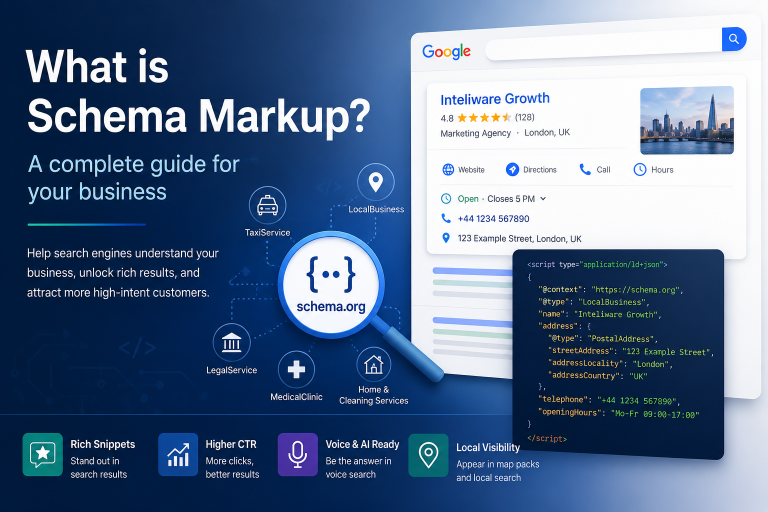
Schema markup is a standardized vocabulary of structured data that you add to your website's HTML. It helps search engines understand exactly what your content represents instead of forcing them to interpret it through natural language processing.
Rather than guessing that a number is a phone number or that a paragraph contains business hours, schema explicitly labels that information.
The vocabulary is maintained by Schema.org and is supported by Google, Microsoft, Yahoo, and Yandex. Today, JSON-LD is Google's recommended implementation format because it is clean, lightweight, and easy to maintain.
Why Schema Markup Matters
Proper schema implementation offers several major SEO benefits:
- Rich snippets with ratings, FAQs, pricing, and business information.
- Better visibility in Google's Knowledge Graph.
- Improved local SEO performance.
- AI and voice-search readiness.
- Higher click-through rates from search results.
- Better understanding of your website by search engines.
Businesses implementing structured data correctly often see significant improvements in organic CTR and search appearance.
How Search Engines Interpret Structured Data
Instead of reading your content like a human, search engines parse HTML and structured data.
For example, LocalBusiness schema clearly identifies:
- Business name
- Address
- Telephone
- Opening hours
- Geographic location
This information powers Google Maps, Local Pack listings, and many rich search features.
Important Types of Schema Markup
1. LocalBusiness Schema
The foundation of local SEO for businesses like:
- Taxi Companies
- Medical clinics
- Immigration law firms
- cleaning companies
- Restaurants
- Agencies
Include:
- Business name
- Address
- Phone number
- Opening hours
- Geo coordinates
- Service area
2. Product Schema
Perfect for:
- Fixed-price services
- SaaS subscriptions
- Consultation packages
- Cleaning packages
It displays:
- Price
- Availability
- Reviews
- Ratings
directly in Google Search.
3. FAQ Schema
One of the most valuable schema types.
Benefits include:
- Rich FAQ snippets
- AI Overview citations
- Voice assistant compatibility
- Improved search visibility
4. Article Schema
Recommended for:
- blog posts
- News
- Case studies
- Educational content
It helps Google better understand your content's author, publication date, and featured image.
5. Review & AggregateRating Schema
Allows eligible pages to display:
- Star ratings
- Review counts
- Aggregate scores
while following Google's structured data guidelines.
6. HowTo Schema
Useful for tutorials such as:
- How to book a taxi
- How to prepare visa documents
- How to schedule appointments
Google can display step-by-step results directly in search.
7. Breadcrumb Schema
Displays navigational paths like:
Home → Services → Taxi Services
improving user experience and search result appearance.
How to Add Schema Markup
Follow these simple steps:
- Identify the correct schema type.
- Generate JSON-LD markup.
- Add the script to your page.
- Test using Google's Rich Results Test.
- Monitor enhancements inside Google Search Console.
Best Practices
- Mark up only visible content.
- Keep information accurate and updated.
- Avoid using irrelevant schema types.
- Combine multiple schemas carefully.
- Follow Google's structured data guidelines.
- Update schema whenever business information changes.
Why Schema Is Only Part of SEO
Structured data amplifies strong content—it cannot replace it.
The best SEO strategy combines:
- Technical SEO
- Content marketing
- Local SEO
- Conversion optimization
- Google Ads
- Performance tracking
When these work together, schema becomes part of a complete growth system rather than an isolated SEO tactic.
Conclusion
Schema markup is one of the highest-impact technical SEO improvements available today. It helps search engines understand your website, improves search appearance, supports AI-powered search, and increases qualified traffic.
Whether you operate a taxi company, immigration practice, medical clinic, cleaning business, or SaaS startup, implementing structured data correctly can significantly improve your online visibility.
At Inteliware Growth, we integrate schema markup into a complete performance marketing strategy that combines SEO, Google Ads, CRO, analytics, and technical optimization to drive measurable business growth.
📞 +92 344 3503901
📍 London, United Kingdom
Frequently Asked Questions
Is schema markup a Google ranking factor?
No. While it is not a direct ranking factor, schema improves rich results and click-through rates, which can positively impact SEO performance.
Can I use multiple schema types on one page?
Yes. Pages often combine LocalBusiness, FAQPage, BreadcrumbList, Product, and Article schema together.
Does schema markup help local SEO?
Absolutely. LocalBusiness schema improves Google's understanding of your business information and supports Maps and Local Pack visibility.
Do I need a developer to implement schema?
Basic implementations can be handled through SEO plugins, while larger websites and custom JSON-LD implementations are best managed by experienced developers.
Which schema format should I use?
Google recommends JSON-LD because it is easier to implement, maintain, and validate than Microdata or RDFa.