Introduction
Search intent is the reason behind a person’s search query. It explains what the user actually wants when they type something into Google.
For example, someone searching “what is Google Ads” wants information. But someone searching “Google Ads agency for Taxi Companies UK” is much closer to hiring a service provider.
That difference matters.
At Inteliware Growth, we do not look at SEO as only keywords and rankings. We look at what the user wants, where they are in the buying journey, and how to turn that intent into leads, enquiries, booked appointments, app installs, or revenue.
Google also explains that its systems are designed to show helpful, reliable, people-first content, not content created only to manipulate rankings. That is why search intent is one of the most important parts of modern SEO.
Why search intent matters in SEO
Search intent matters because Google wants to show the most useful result for each search.
You can write a long blog, add keywords, and publish it perfectly. But if the content does not match what the searcher wants, it will struggle to rank.
For example: For example, someone searching "best immigration lawyer marketing agency" is evaluating agencies and looking for the right service provider, so a detailed service or comparison page is far more useful than a basic article about marketing.
Likewise, a user searching "book taxi near me" wants to make an immediate booking. In this case, a fast-loading local landing page with clear booking options and a prominent call-to-action will better meet their needs than a lengthy informational blog.
This is why intent-led SEO helps businesses attract better traffic, not just more traffic.
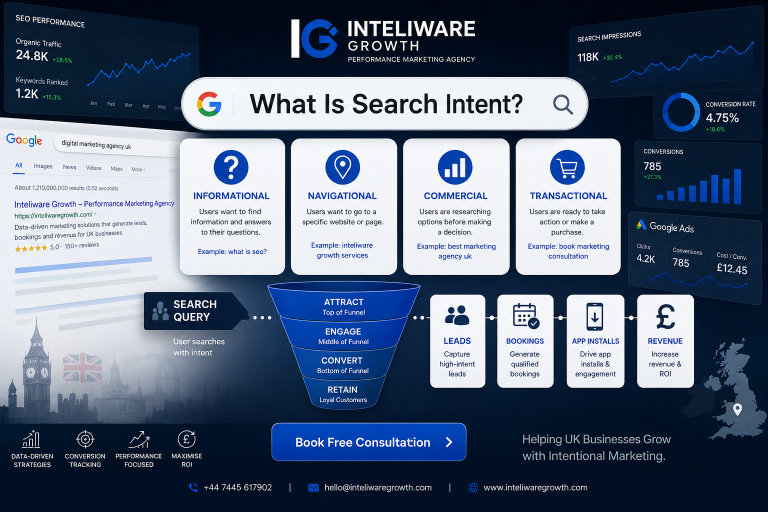
The 4 Main Types of Search Intent
Most SEO professionals divide search intent into four main types:
1. Informational intent Informational intent means the user wants to learn something. Examples:
- What is search intent?
- How does Google Ads work?
- What is local SEO?
- How to get more cleaning leads?
Best content format:
- blog posts
- Guides
- FAQs
- Explainer articles
- Tutorials
For Inteliware Growth, informational content is useful for building trust with businesses that are still learning about digital marketing.
2. Navigational intent Navigational intent means the user is looking for a specific website, brand, or page. Examples:
- Inteliware Growth
- Inteliware Growth Contact
- Google Ads login
- Semrush blog
Best content format:
- Home page
- About page
- Contact page
- Service pages
- Branded pages
For your website, make sure pages like About Us, Case Studies, Blog, and Contact are easy to find and properly linked.
3. Commercial intent Commercial intent means the user is researching before making a decision. Examples:
- Best Google Ads agency for clinics
- SEO vs PPC for cleaning companies
- Best marketing agency for Taxi Companies
- App install advertising agency UK
Best content format:
- Comparison blog
- Case studies
- Service guides
- Industry-specific landing pages
- “Best” and “top” articles
This is a very valuable intent type for Inteliware Growth because users are already considering solutions.
4. Transactional intent Transactional intent means the user is ready to take action. Examples:
- Book Free Consultation
- Hire Google Ads agency
- Contact PPC agency UK
- Get cleaning company leads
Best content format:
- Landing pages
- Contact pages
- Service pages
- Booking forms
- Lead capture pages
For this intent, your page must have a strong CTA, clear service benefits, trust signals, and simple contact options.
Search Intent Examples for Different Industries
| Industry | Search Query | Intent | Best Page Type |
|---|---|---|---|
| Taxi Companies | taxi company marketing agency | Commercial | Taxi Companies landing page |
| Immigration Lawyers | immigration lawyer lead generation | Commercial | Immigration Lawyers service page |
| App Startups | app install advertising agency | Transactional | App Startups landing page |
| Cleaning Companies | how to get more cleaning leads | Informational | blog + Cleaning Companies page |
| Doctors & Clinics | patient acquisition marketing | Commercial | Doctors & Clinics service page |
How to Identify Search Intent
1. Look at the words in the keyword Certain words show intent clearly.
Informational words:
- What
- Why
- How
- Guide
- Meaning
- Tips
Commercial words:
- Best
- Top
- Review
- Compare
- Alternatives
- Agency
Transactional words:
- Buy
- Book
- Hire
- Contact
- Consultation
- Pricing
2. Check Google’s first page Google's search results also reveal the likely intent behind a query:
- Blog typically indicate informational intent.
- Service pages usually reflect commercial or transactional intent.
- Product pages often signal purchase-ready intent.
Before writing any blog, check:
- Top 10 ranking pages
- Headings they use
- Questions they answer
- Content format
- FAQs
- Internal links
- CTA placement
3. Study serp features SERP features also show intent.
Look for:
- Featured snippets
- People Also Ask
- Videos
- Maps
- Shopping results
- Local packs
- Reviews
For example, if Google shows a map pack, the query may have local or visit-in-person intent.
4. Understand the full buyer journey A user may not convert from the first search.
Example journey:
- What is Google Ads?
- Google Ads vs SEO
- Best Google Ads agency for clinics
- Book Google Ads consultation
Each search has a different intent. Your website should have content for every stage.
How to Optimize Content for Search Intent
1. Match the page type to the intent Do not force every keyword into a blog. Use:
- blog for informational intent
- Service page for transactional intent
- Case study for commercial trust-building
- Landing page for lead generation
- FAQ for quick answers
2. Answer the main question quickly Readers should not wait until the middle of the blog to understand the answer.
For example, this bbloglog defines search intent in the first section because that is what the user came for.
3. Use clear headings Good headings help readers scan the page and help search engines understand the structure. Use headings like:
- What is search intent?
- Why does search intent matter?
- Types of search intent
- How to identify search intent
- How to optimize for search intent
4. Add original business value Most blog explain search intent in a general way. But for Inteliware Growth, the real value is connecting search intent with business growth. For example:
- Taxi Companies need local search intent.
- Immigration lawyers need compliant lead generation intent.
- App Startups need user acquisition intent.
- cleaning companies need service booking intent.
- Doctors and clinics need appointment booking intent.
That makes the content more specific, useful, and conversion-focused.
5. Add strong internal links Use internal links naturally throughout the blog. Recommended internal links:
- Google Ads Management
- PPC Services
- SEO Services
- Social Media Advertising
- Conversion Rate Optimisation
- Taxi Companies
- Immigration Lawyers
- App Startups
- cleaning companies
- Doctors & Clinics
- Case Studies
- About Us
- Contact
- blog
6. Add a helpful CTA Search intent is not only about ranking. It is also about guiding users to the next step.
Suggested CTA: Want to attract users who are already searching for your service?Inteliware Growth builds ROI-focused SEO, Google Ads, PPC, and conversion strategies for high-intent industries.
Search intent and paid ads
Search intent is not only important for SEO. It is also critical for Google Ads.
- Emergency taxi near me — Immediate booking intent.
- Best taxi company software — Comparing available solutions. Taxi marketing agency UK — Looking to hire a marketing agency.
At Inteliware Growth, paid campaigns are built around intent, tracking, and conversion data. That means budgets are not spent on random clicks. They are focused on users more likely to become leads, bookings, or customers.
How Inteliware Growth Uses Search Intent
We build SEO and Google Ads strategies around real user intent through our 5-step framework:
- Audit — We analyse competitors, search behaviour, audience intent, landing pages, and existing funnels.
- Strategy — We build a roadmap based on KPIs, channels, keyword intent, and forecasting.
- Execution — We create campaigns, landing pages, ad creatives, and content that match user intent.
- Tracking — We set up conversion tracking, attribution, dashboards, and reporting.
- Scale — We increase budget only when the data shows what is working.
This helps businesses avoid vanity metrics and focus on real outcomes such as leads, enquiries, booked appointments, app installs, and revenue.
Common Search Intent Mistakes
Mistake 1: Targeting keywords without understanding the user A keyword may have search volume, but that does not mean it will bring customers.
Mistake 2: Writing blogs for transactional keywords If the user wants to book, buy, or contact, send them to a landing page, not a long blog.
Mistake 3: Ignoring commercial intent Commercial keywords are powerful because the user is comparing options. Case Studies, service pages, and comparison content work well here.
Mistake 4: Weak CTA placement Every page should guide the reader to the next step. Place CTAs in:
Mistake 5: not updating content Search behaviour changes. Update content every 3–6 months with new examples, internal links, FAQs, and service updates.
Helpful image suggestions for this blog
Add these images to improve readability:
- Search intent funnel graphic
- Table showing intent types
- Buyer journey flowchart
- Inteliware Growth 5-step framework graphic
- Industry-specific intent examples
Recommended image alt text:
- “Search intent types explained”
- “SEO search intent funnel”
- “Search intent examples for service businesses”
- “Inteliware Growth performance marketing framework”
Conclusion
Search intent is the foundation of modern SEO.
It helps you understand what people really want when they search online. Once you understand that, you can create the right page, answer the right questions, add the right CTA, and convert visitors into real business results.
For service businesses, this is especially important. A taxi company, law firm, clinic, cleaning company, or app startup does not only need traffic. It needs leads, bookings, installs, and revenue.
That is where Inteliware Growth helps.
We build data-driven SEO, Google Ads, PPC, paid social, CRO, and lead generation strategies around real search intent.
Frequently Asked Questions
What is search intent in SEO? Search intent is the purpose behind a user’s search query. It tells you whether the user wants to learn something, find a website, compare options, or take action.
Why is search intent important? Search intent is important because Google wants to show results that match what users need. If your page does not match the intent, it may not rank well or convert visitors.
What are the four types of search intent? The four main types are informational, navigational, commercial, and transactional intent.
How do I find search intent? You can find search intent by analysing the keyword language, checking Google’s first page, reviewing SERP features, and studying what top-ranking pages are answering.
Can one keyword have mixed intent? Yes. Some keywords have mixed intent. For example, “best SEO agency” may include commercial research and transactional intent.
How does search intent help Google Ads? Search intent helps Google Ads by targeting users based on their readiness to act. High-intent keywords usually bring better quality leads and conversions.
How often should I update search-intent content? Review important SEO pages every 3–6 months. Update examples, FAQs, internal links, CTA sections, and service details when needed.
Ready to Turn High-Intent Traffic into Customers?
At Inteliware Growth, we help service businesses attract the right visitors and convert them into real results using intent-focused SEO, Google Ads, and conversion strategies.
Contact Us
📞 Phone: +92 344 3503901
📧 Email: sales@inteliwaregrowth.com
📍 Location: London, United Kingdom