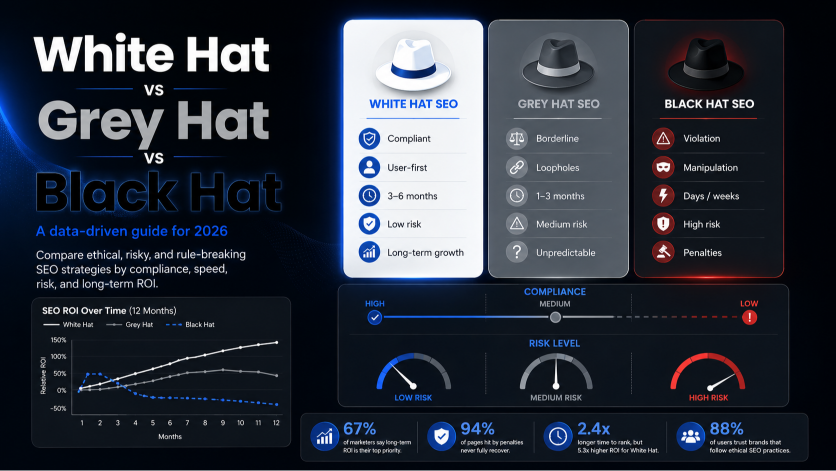
SEO methods are split into three types based on how they follow search engine rules: White Hat (safe and ethical), Black Hat (risky and rule-breaking), and Grey Hat (in-the-middle and risky). White Hat builds long-term trust, Black Hat seeks fast manipulation, and Grey Hat flirts with danger.
In the world of digital marketing, the debate between White Hat vs Grey Hat vs Black Hat SEO is not just about ethics; it is about sustainability and ROI. If you run a niche service business, whether it is a taxi company in London, an immigration law firm, or a cleaning service, your choice of SEO strategy will dictate the lifespan of your online presence.
While Black Hat tactics might offer the allure of quick wins, the algorithms of 2026 are designed specifically to hunt down manipulation. At Inteliware Growth, we believe in leveraging data to build assets that weather algorithm updates, not assets that crumble when Google sneezes.
Here is the comprehensive breakdown of these three distinct SEO methodologies.
The three pillars of SEO
Before you invest a single dollar into search marketing, you must understand the risk profile of your strategy. The digital landscape is littered with businesses that chose the path of least resistance and paid the price with penalties. Conversely, businesses that play the long game often become untouchable in their niche.
What is white hat SEO?
Definition: Strategies that strictly follow search engine guidelines and focus on human users.
White Hat SEO is often described as doing it right. It is the practice of optimizing your website according to Google’s Webmaster Guidelines without attempting to trick the algorithm.
Goal: Build long-term growth, authority, and trust.
The ultimate aim here is not just to rank for a keyword, but to build a brand that users and search engines trust implicitly.
Techniques:
- High-Quality Content Writing: Producing content that actually solves the user's query, just like the article you are reading now.
- Technical Optimization: Fast loading speeds, Core Web Vitals optimization, and mobile-friendly design are non-negotiable.
- Organic Link Building: Earning backlinks through genuine digital PR and outreach, rather than paying for them.
Risks: None. Your site stays safe from penalties. You sleep well at night knowing an algorithm update will likely boost your rankings rather than destroy them.
Results: Slow to show up, but very stable once achieved. In performance marketing terms, White Hat SEO is a high-retention, compounding asset. It is the equivalent of building a brick house instead of a house of cards.
What is grey hat SEO?
Definition: Tactics that sit in a blurred zone between ethical and rule-breaking; they do not explicitly violate rules yet, but they try to trick the system.
Grey Hat SEO is the wild west of digital marketing. It exploits loopholes in the search engine guidelines. These tactics are not explicitly banned in the fine print, but they violate the spirit of the rules. It is the art of technically legal, but ethically dubious.
Goal: Faster rank jumps than White Hat without fully jumping into penalties.
Marketers use Grey Hat because they are impatient. They want to see a return faster than a content-led strategy allows.
Techniques:
- Buying Expired Domains: Acquiring old domains with authority and 301 redirecting them to your main site to pass link equity.
- Moderate Link Exchanges: “I’ll link to you if you link to me” schemes that scale beyond natural behavior.
- Clickbait Headlines: Writing meta titles that promise one thing but deliver another to manipulate Click-Through Rates (CTR).
- Article Spinning: Taking old content and using software to rearrange words to create new content that is essentially plagiarized from yourself or others.
Risks: Medium. Search engine updates can turn these tactics into penalties overnight. If Google updates its Spam Policies to specifically address a grey area you are exploiting, you wake up to a manual action.
Results: Faster than White Hat, but unpredictable long-term. At Inteliware Growth, we avoid this because unpredictable data is bad for business scaling.
What is black hat SEO?
Definition: Aggressive tactics that directly break search engine terms of service to manipulate rankings.
Black Hat SEO is the digital equivalent of a smash-and-grab robbery. It works fast, it looks impressive for a moment, and then it lands you in jail (or in this case, the Google penalty box). It is a direct violation of the terms of service.
Goal: Instant, massive traffic spikes through manipulation.
This is often favored by spammers or churn and burn affiliate sites that do not care if the domain dies in six months, as long as they made a quick buck in the process.
Techniques:
- Keyword Stuffing: Cramming a page with repetitive keywords (e.g., Taxi London cheap taxi London best taxi London) until it reads like nonsense.
- Cloaking: Showing one version of a page to Googlebot and a completely different version to human users.
- Hidden Text: Placing white text on a white background to stuff keywords invisible to users.
- Private Blog Networks (PBNs): Building a network of fake blogs solely to link back to your main site to inflate authority.
- Automated Scraped Content: Using bots to steal content from other sites and republish it without permission.
Risks: Extremely high. Sites face heavy penalties, drops in rank, or complete removal from search results (de-indexing).
Results: Fast initially, but short-lived before getting caught. Google’s AI, including systems like SpamBrain, has made it virtually impossible to sustain these tactics in 2026.
Black hat risks in high-intent niches
At Inteliware Growth, we specialize in high-intent niches like Taxi Companies, Immigration Lawyers, and Doctors & Clinics. For these industries, trust is the currency of conversion.
You cannot afford to risk your domain.
Imagine an immigration law firm that relies on Black Hat SEO. They rank for UK Spouse Visa for three weeks using a PBN. Google detects the network, the site is de-indexed, and the firm loses not only its traffic but its credibility.
In contrast, a White Hat strategy built on solid content about UK Spouse Visa Requirements and authoritative backlinks from legal directories builds a digital asset that cannot be taken away by a competitor. Google’s Search Quality Rater Guidelines (E-E-A-T: Experience, Expertise, Authoritativeness, Trustworthiness) heavily favor legitimate businesses, especially in Your Money or Your Life (YMYL) sectors like law and health.
Our white hat framework
While our core expertise lies in Google Ads Management and Paid Social Advertising, we recognize that Organic SEO and Paid Media are two sides of the same coin. A bad domain reputation ruins your Quality Score in Google Ads, increasing your Cost Per Click (CPC).
Here is how our 5-step roadmap aligns perfectly with White Hat SEO principles:
- Audit: We deep dive into your funnel to ensure you are not accidentally using Grey Hat tactics from a previous agency (e.g., unnatural link profiles).
- Strategy: We focus on high-intent keywords that match your business model, whether that is Taxi near me or Immigration lawyer consultation.
- Execution: We create landing pages that load fast and answer the user's question immediately. This aligns with Google's Core Web Vitals.
- Tracking: We use transparent dashboards. We tell you exactly where your organic clicks and leads are coming from.
- Scale: Once we know a page is converting, we double down on it with both organic content optimization and paid ads to dominate the SERP.
SEO strategy comparison
To summarize the differences clearly, here is a quick data-driven comparison:
| Feature | White Hat SEO | Grey Hat SEO | Black Hat SEO |
|---|---|---|---|
| Alignment with Google Rules | 100% Compliant | Borderline / Exploits Loopholes | Direct Violation |
| Focus | User Experience & Value | Algorithm Tricking | Search Engine Manipulation |
| Time to Results | 3-6 Months | 1-3 Months | Days / Weeks |
| Risk Level | None | Medium | Very High |
| Longevity | Permanent Growth | Unpredictable | Short-Lived / Penalized |
| Cost Efficiency | High (Compounds over time) | Moderate | Low (But very high risk cost) |
Choosing your SEO strategy
The answer depends on your business goals, but for any legitimate brand, the answer is obvious.
Choose White Hat if: You are a startup or an established company building a brand. You want to survive future Google updates and build an asset you can sell or scale. This is the only strategy we recommend for our clients in the App Startups and Cleaning Company sectors.
Choose Grey Hat if: You are experimenting with a disposable domain and you fully understand the risk that your site may be wiped out. We do not recommend this for client-facing businesses.
Choose Black Hat if: You want to make a quick dollar and you are not interested in building a business. At this point, you might as well buy paid ads instead. It is actually safer and often cheaper in the long run because you are not paying to rebuild a domain from scratch.
Conclusion
The battle between White Hat vs Grey Hat vs Black Hat SEO is ultimately a battle between short-term greed and long-term strategy.
In the reference article from Search Engine Journal, the consensus is clear: White Hat is the only sustainable path. Black Hat is playing with fire, and Grey Hat keeps you constantly looking over your shoulder.
At Inteliware Growth, we combine the patience of White Hat with the urgency of performance marketing. We use data to drive decisions, not guesswork. Whether you are a Taxi Company looking to dominate local search or a Doctor’s Clinic looking to book appointments, building authority the right way ensures that when your customers search, they find you, not a warning page.
Stop risking your business with outdated tricks. Build a growth engine that lasts.
Ready to build a penalty-proof SEO strategy?
Contact Us
📞 +92 344 3503901
📧 sales@inteliwaregrowth.com
📍 London, United Kingdom
FAQs
1. Is grey hat SEO illegal?
No, but it violates the spirit of search engine guidelines and risks manual penalties.
2. Can Google detect black hat SEO?
Yes. Google uses AI like SpamBrain to detect Black Hat techniques. It is a matter of when, not if.
3. How long does white hat SEO take?
It typically takes 3 to 6 months to see significant traction, depending on your niche.
4. Does white hat work in competitive niches?
Yes. Local SEO, strong content, and genuine reviews help you outlast spam-based competitors.
5. Can I combine white hat SEO with paid ads?
Yes. Paid Ads capture immediate traffic while Organic SEO builds long-term equity.