Introduction
Why Website Speed Matters
Website speed is critical because it dictates user experience and directly impacts your bottom line. Studies show that nearly 40% of users will abandon a site if it takes more than 3 seconds to load. A fast site improves search rankings, reduces bounce rates, and increases conversion rates.
But for service businesses — where every visitor is a potential ride, client, or patient — speed isn’t just a technical checkbox. It’s the engine behind your lead generation, ad performance, and brand credibility.
At Inteliware Growth, we’ve seen how shaving seconds off load times turns underperforming campaigns into revenue machines. This article breaks down exactly why site speed matters, how it shapes your results, and what you can do today.
What Do We Mean by Website Speed?
Website speed measures how quickly your page loads and becomes interactive. It’s usually captured in these key moments:
- Time to First Byte (TTFB): Server response time.
- First Contentful Paint (FCP): First text or image appears.
- Largest Contentful Paint (LCP): Main content becomes visible.
- Time to Interactive (TTI): Page is fully usable.
For your visitors, speed is the feeling of a page “snapping” open — or that frustrating white screen. That perception decides whether they stay or leave, often within three seconds.
The Direct Impact on Conversions and Revenue
Time is literally money. A single-second delay in page load time can slash customer satisfaction by 16% and cut conversions by roughly 7%, according to research by Akamai (cited via Cloudflare).
Let’s run the numbers for a typical service business. Imagine a taxi company booking site gets 10,000 visits per month, converts at 5%, and has an average ride value of £20. That’s £10,000 in monthly revenue. A 1-second slowdown stealing 7% of conversions costs £700 every month — £8,400 a year — from that single channel.
For chains of clinics or a multi-city cleaning brand, the losses multiply fast. Fixing speed leaks delivers an immediate uplift without extra ad spend.
At Inteliware Growth, conversion rate optimisation often starts with speed. We’ve seen landing pages loading in 4 seconds costing clients 30% of potential leads simply because the “Book Now” button didn’t appear quickly enough.
Why Speed Is a Hard Ranking Factor (SEO & AEO)
Search engines reward great user experience. Google’s Core Web Vitals — loading performance, interactivity, and visual stability — are official ranking signals. A slow site slides down the results, handing organic traffic to faster competitors.
With the rise of Answer Engine Optimisation (AEO) and AI-driven summaries, speed also affects how AI crawlers surface your content. A sluggish site might not get indexed in time to appear in those instant answers.
Your paid media hurts too. Google Ads uses Quality Score, and landing page experience is a major factor. Slow pages degrade that score, driving up cost per click and limiting reach.
For niche services operating on tight cost-per-lead targets, this double penalty is unacceptable. Our Google Ads management service builds high-speed landing pages that keep Quality Scores high and costs low.
User Experience: Fast Sites Build Trust
A quick website shapes how people perceive your brand. Instant loads make visitors feel in control. They browse deeper, explore more services, and trust your business is professional and reliable.
A slow site, however, sends the opposite message. High bounce rates aren’t just a metric — they represent real people who assume your service is equally unreliable.
An Immigration law firms sluggish site risks losing a distressed client who needs urgent help. A cleaning company’s quote form that hangs sends homeowners straight to a competitor. Speed builds the seamless, stress-free experience that keeps visitors engaged.
The Mobile Mandate You Can’t Ignore
Over half of all web traffic now comes from mobile devices. Someone searching “taxi near me” or “GP appointment London” is almost certainly on a phone, often on a spotty connection.
Google’s mobile-first indexing judges your mobile version first. Mobile Core Web Vitals carry immense weight.
For the taxi and app sectors, a mobile load time under 2.5 seconds isn’t a nice-to-have — it’s where lead generation becomes profitable. Our work with Taxi Companies consistently proves this link between mobile speed and ride requests.
How Slow Speed Hurts Your Specific Niche
Speed issues hit different industries in distinct ways. Here’s how the niches we serve feel the pain:
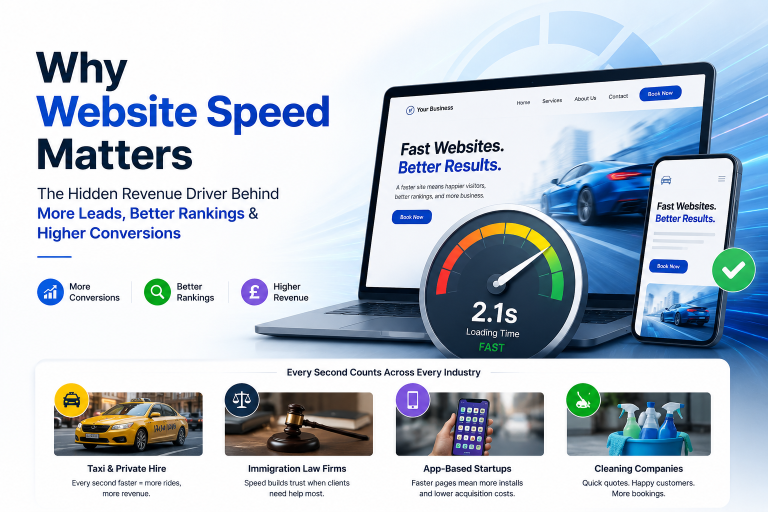
Taxi & Private Hire Companies Ride requests come from immediacy. Someone on a street corner will not wait for a booking widget to load. A delay equals a ride lost to a competitor whose site fired up in under two seconds.
Immigration Law Firms Legal services are high-anxiety purchases. A potential client needs confidence now. A slow website erodes that confidence and pushes them toward a faster, reassuring competitor.
App-Based Startups When spending on app install ads, every second between click and the download page matters. Delay causes massive drop-off, inflating customer acquisition cost. Our app install campaigns tie landing page speed directly to ROI.
Cleaning Companies A cleaning quote is a split-second decision. A fast-loading quote form on mobile can capture the booking before the user decides to “look around later.” Speed directly impacts daily lead volume.
Doctors & Clinics Online appointment booking is the front door to private healthcare. A slow load time loses a booking and possibly pushes a patient toward another provider. Fast, frictionless scheduling is a competitive necessity.
How to Measure Your Website’s Speed Right Now
Before you fix speed, measure it properly. Use these free, industry-standard tools:
- Google PageSpeed Insights: Scores mobile and desktop performance against Core Web Vitals, with actionable tips.
- GTmetrix: Delivers waterfall charts and detailed reports on what’s slowing your pages.
- WebPageTest: Allows testing from different locations and devices for a real-world view.
Run your homepage and top three landing pages through these. Watch LCP (under 2.5 seconds) and Cumulative Layout Shift (keep it under 0.1). Red scores mean you’re haemorrhaging leads.
Quick Wins to Improve Your Load Times
While a full audit is best, some fixes can be applied immediately:
- Compress and properly size images — often the biggest bandwidth hog.
- Leverage browser caching so repeat visitors load your site almost instantly.
- Minify CSS, JavaScript, and HTML to trim unnecessary code.
- Use a Content Delivery Network (CDN) to serve files from locations closer to users.
- Reduce redirects and eliminate render-blocking resources.
- Upgrade your hosting if server response times are consistently slow.
Even these basics can yield noticeable improvements. For businesses that depend on paid traffic, a holistic speed-and-conversion strategy is where the real growth happens.
How Inteliware Growth Turns Speed into Revenue
We don’t treat speed as a standalone IT project. We treat it as the foundation of a high-performing marketing engine. Our framework ensures every millisecond gained translates into measurable leads and sales.
- Audit: We deep-dive into your site performance, competitor benchmarks, and audience behaviour to pinpoint speed bottlenecks costing conversions.
- Strategy: We build a custom roadmap tying speed improvements to KPIs like cost per lead and ROAS. Technical SEO, CRO, and ad channel alignment are baked in.
- Execution: Our team implements optimisations or works with your developers to create high-velocity landing pages that load fast and convert aggressively.
- Tracking: Real-time dashboards link every speed metric back to revenue. You’ll see exactly how a 0.5-second improvement lifts your Google Ads Quality Score.
- Scale: With a lean, lightning-fast site, you can confidently scale ad spend across Google and Meta, knowing your landing pages will capture the demand you’re paying for.
For niche service businesses, we go deeper. Our work with Immigration law firms shows how speed builds the trust needed for high-value case enquiries. For cleaning companies, speed directly feeds the top of the lead funnel.
Whether you run a private hire fleet, a clinic, or an app startup, our industry-specific growth frameworks mean speed optimisation is never an afterthought — it’s embedded in our conversion rate optimisation and ad management services.
The Bottom Line
Website speed isn’t just a developer’s concern. It’s the invisible hand that pushes potential customers into your sales funnel or toward your competitors.
In the UK’s competitive service landscape, a slow site is a liability you can’t afford. The good news: speed is fixable, and the gains are immediate.
Every millisecond you shave off your load time brings you closer to higher rankings, lower ad costs, and more loyal customers. Ready to see what a faster website can do for your business? Let’s talk.
Frequently Asked Questions
What is a good page load time to aim for? Google recommends LCP under 2.5 seconds. For the best user experience and SEO benefit, aim for under 2 seconds on mobile. Tools like Google PageSpeed Insights tell you if you’re meeting this target.
How does website speed affect my Google Ads? A slow landing page lowers your Quality Score, raising your cost per click and limiting ad reach. Improving load time can reduce your cost per lead significantly without extra budget.
Can I improve site speed without a developer? Yes. Image compression, caching, and a CDN are often achievable with plugins or platform settings. For deeper refinements tied to conversion design, a performance marketing team ensures speed gains also lift revenue.
Does mobile speed really matter more than desktop? For most service businesses, yes. The majority of local, high-intent searches happen on mobile. Google indexes the mobile version first, so ignoring mobile speed ignores where your customers actually are.
How often should I test my website’s speed? Test after any significant site update, ad campaign launch, or at least monthly. Continuous monitoring is ideal — it’s part of the real-time tracking we build for clients.
Can slow speed hurt my app installs from ads? Absolutely. If the landing page between the ad click and the store listing lags, drop-off spikes. We design high-speed funnels to protect app install ROI at scale.
How Inteliware Growth Helps
We treat website speed as a core part of our performance marketing strategy — combining technical optimization with conversion rate improvements to deliver faster, higher-converting websites.
Contact Us
📞 Phone: +92 344 3503901
📧 Email: sales@inteliwaregrowth.com
📍 Location: London, United Kingdom